

Dreamlike AI videos: one impossible thing in a quiet, tender moment
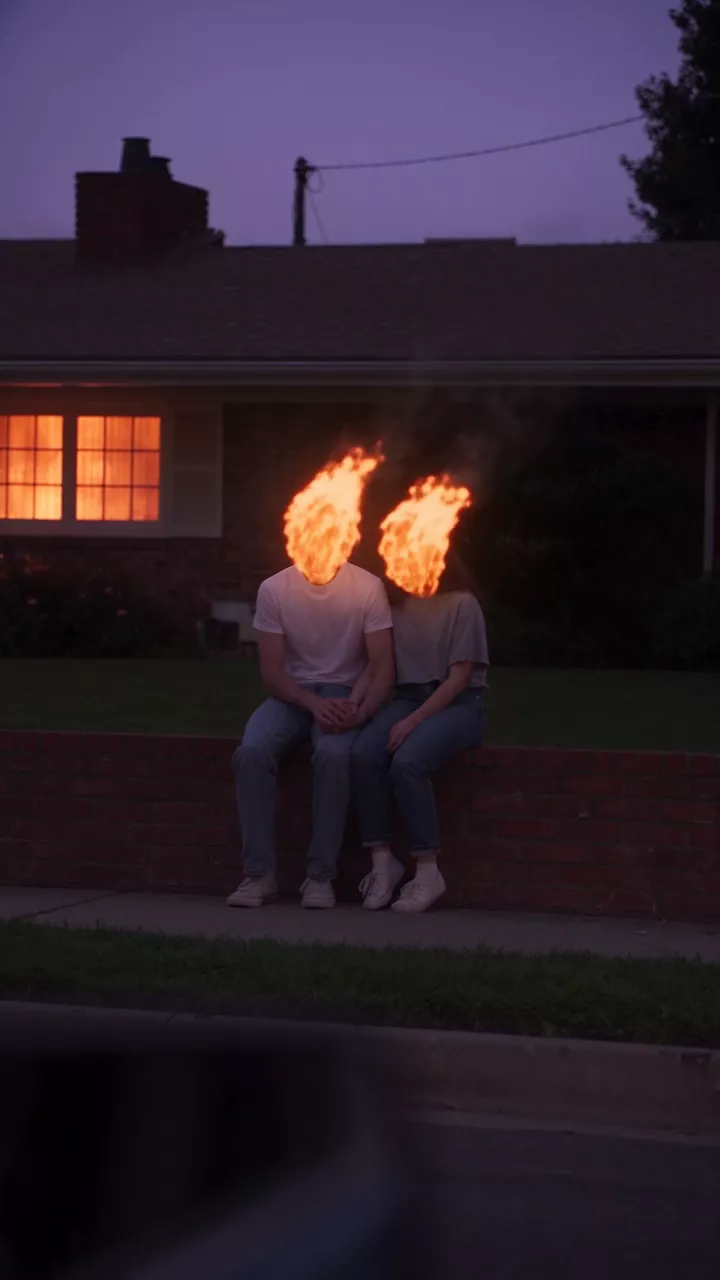
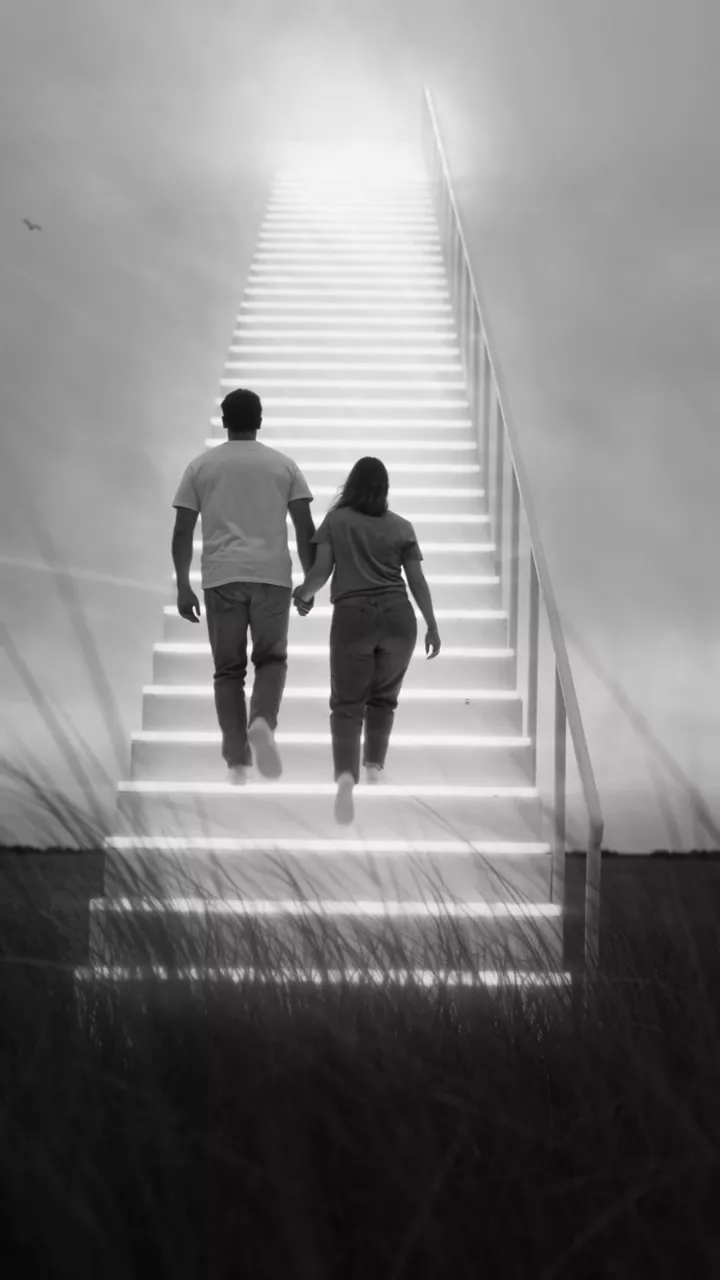
A young couple sits on a porch wall with flames for heads. Two people climb a white staircase into the clouds. Nobody reacts. Here is the method behind a NOLGIA series of dreamlike couples: the rules, three looks to paste, the prompt structure, and 17 Seedance 2.5 clips with the prompts that made them.
- 16 min read
This guide follows one real project made for NOLGIA, called NOLGIA couples: 17 five-second Seedance 2.5 clips of young couples in quiet moments that should not be possible, and the video maker's breakdown of the method, Quiet Impossible. Every prompt below is quoted as it was sent; the only change is that long dashes are typed as hyphens. Everyone in the clips was generated with NOLGIA.
The clips read as recovered home footage of a moment that should not be possible but that nobody on screen finds strange. The tone is tender and nostalgic, never horror or spectacle, and the camera belongs to a bystander who happened to be there.
What these videos are
The effect comes from tension: a completely ordinary, photographic, imperfect world carrying exactly one impossible thing, played completely straight. If the world looks like a movie, the impossible thing looks like a visual effect. If the world looks like a snapshot, it looks like a memory. Four ingredients make it:
| Ingredient | What it means in practice |
|---|---|
| Archive skin | Heavy visible grain, soft focus, halation around lights, faded or crushed blacks, highlights that never reach pure white: pushed 35mm, 1970s or 1980s color negative, or Super 8 |
| One impossible element | A flaming head, a floating couple, a staircase into the clouds: exactly one per shot, there from the first frame, never appearing or transforming |
| Deadpan tenderness | Nobody reacts to it. The couple is busy with each other: a kiss, a hand squeeze, a head on a shoulder. Intimacy is the subject; the impossible thing is the setting |
| Bystander camera | Handheld, slightly tilted and off-center, with a sudden zoom, a small stumble and something blocking the edge of the frame |
The seven rules
Break any of these and the result drifts toward a polished AI clip. Keep them and the footage feels found.
- One impossible element, there from frame one. Do not write that the lights begin to rise or the moon appears: things transforming on screen look like effects. Put it in the starting state and add "This has always been the case and is completely normal." Everything that moves should be ordinary: hair, traffic, mist, a kiss.
- Nobody reacts. The couple never looks at the fire, the sky or the camera, and bystanders ignore it. Reaction shots turn a dream into a disaster film.
- Make the impossible thing big, the people small and plain. Tall roaring flames, a staircase that never ends, a huge sea of clouds; a young woman and a young man in white or gray T-shirts, jeans and worn sneakers.
- Intimacy is the engine. Give the couple small physical actions on a timeline: fingers lacing, a head tilting onto a shoulder, a hand brushing hair back. Specific touch beats words like romantic.
- Candid, never cinematic. Leave out rim lighting, glowing signs, symmetrical hero framing, epic, cinematic, stunning. Those words are the fastest route to a CGI look.
- One palette, one accent. Pick a base (blue-hour ultramarine, violet fog or monochrome) and let exactly one warm accent carry the image: flame orange, a lit window, a low sun.
- Keep faces unseen. Backs to camera, distant silhouettes, profiles, or faces hidden by flame. It avoids uncanny faces and keeps the shots anonymous.
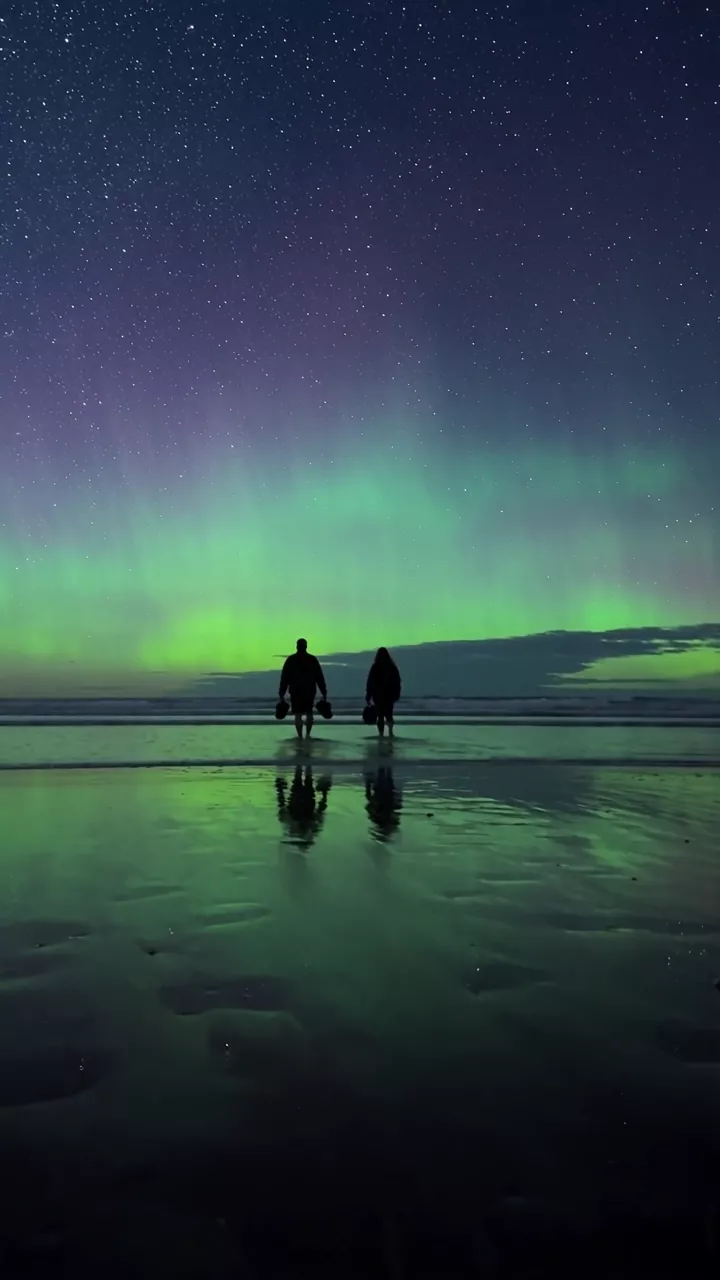
Write every prompt in the same blocks
Every prompt in the series follows the same production-brief skeleton. A fixed structure keeps the model consistent and makes revisions easy: you change one block and leave the rest alone. There is no negative prompt field, so prohibitions go in CONSTRAINTS as plain statements.
| Block | What goes in it | Common mistake |
|---|---|---|
| FORMAT | 9:16 vertical, 5 seconds, one continuous take, 24fps, plus black and white when needed | Leaving out one continuous take, which invites cuts |
| REFERENCE ROLES | What @Video1 controls: the grade, grain, halation and handheld rhythm only, and that its subjects, setting and composition must not be copied | Not limiting the reference, so the model copies its people and set |
| STARTING STATE | The whole frame at second zero: place, light, sky, the couple, their clothes and how they touch, and the impossible element already there, ending with This has always been the case and is completely normal | Describing the impossible thing as something that starts to happen |
| TIMELINE | Range syntax like 0-5s, cause before effect, only ordinary motion: wind, flicker, a kiss at 2s, a hand squeeze at 3.5s | Packing in events: five seconds hold three beats at most |
| CAMERA | Who is filming and from where, plus one sudden zoom, one small stumble and one thing blocking the frame edge | Constant shake, or locked-off tripod language |
| CONTINUITY | What must not change: clothes, positions, flame size, staircase length, light direction, water level | Skipping it, so details drift mid-shot |
| AUDIO | None, with music added in the edit | Letting the model invent sound |
| ENDING STATE | The last frame as a still: where everyone is and what is still true | Ending on a new event |
| CONSTRAINTS | Exactly one impossible element, nobody reacts, no visible faces, no text or logos, no lens flare, no slow motion | Writing wishes instead of firm prohibitions |
| STYLE | The family STYLE line, pasted unchanged | Rewriting it each time, which breaks the series |
FORMAT: 9:16 vertical, 5 seconds, one continuous take, 24fps.[, black and white]

REFERENCE ROLES: @Video1 controls color grade, film grain, halation and handheld camera rhythm only. Do not copy its subjects, setting or composition.

STARTING STATE: [Place, time and light, seen from where]. A young couple in their early twenties [pose and physical contact]. He wears [white t-shirt and jeans], she wears [gray t-shirt and jeans]. [THE ONE IMPOSSIBLE ELEMENT, described as a fact]. This has always been the case and is completely normal.

TIMELINE:
0-5s: [Ordinary motion: wind, flicker, traffic]. At [2s] [one tender action]. At [3.5s] [one more]. Nobody reacts to the impossible element.

CAMERA: Handheld from [where], like a bystander who [why they are there]. Slightly tilted and off-center. A quick sudden zoom in at [1.5s]. A small stumble at [3s] that recovers. [Foreground occlusion] at the frame edge.

CONTINUITY: Same couple, clothes and positions throughout. [Gag-specific details] stay constant.

AUDIO: None.

ENDING STATE: [Final still frame].

CONSTRAINTS: Exactly one impossible element, present from frame one. Calm, tender and deadpan, never looking at the camera. No visible faces. No text, signs or logos. No lens flare. No slow motion. [Extra prohibitions].

STYLE: [Paste family STYLE block]
Tip:Change one block at a time. Between runs, change a single block and note which change fixed which problem. With the same skeleton in every prompt, you always know where to look.
Look 1: blue-hour romance
Couples seen from behind or far away at dusk and night: a city overlook, a lit window, a giant moon, a vintage car. Ultramarine and cyan shadows with one hot orange-pink accent. Paste this STYLE line at the end of every prompt in the family:
STYLE: Photoreal footage on pushed 35mm film stock, heavy visible grain, soft halation around lights, blue-hour ultramarine and cyan shadows with one saturated orange-pink accent, crushed navy blacks, highlights never pure white, slightly soft focus, 1980s snapshot look, imperfect framing.
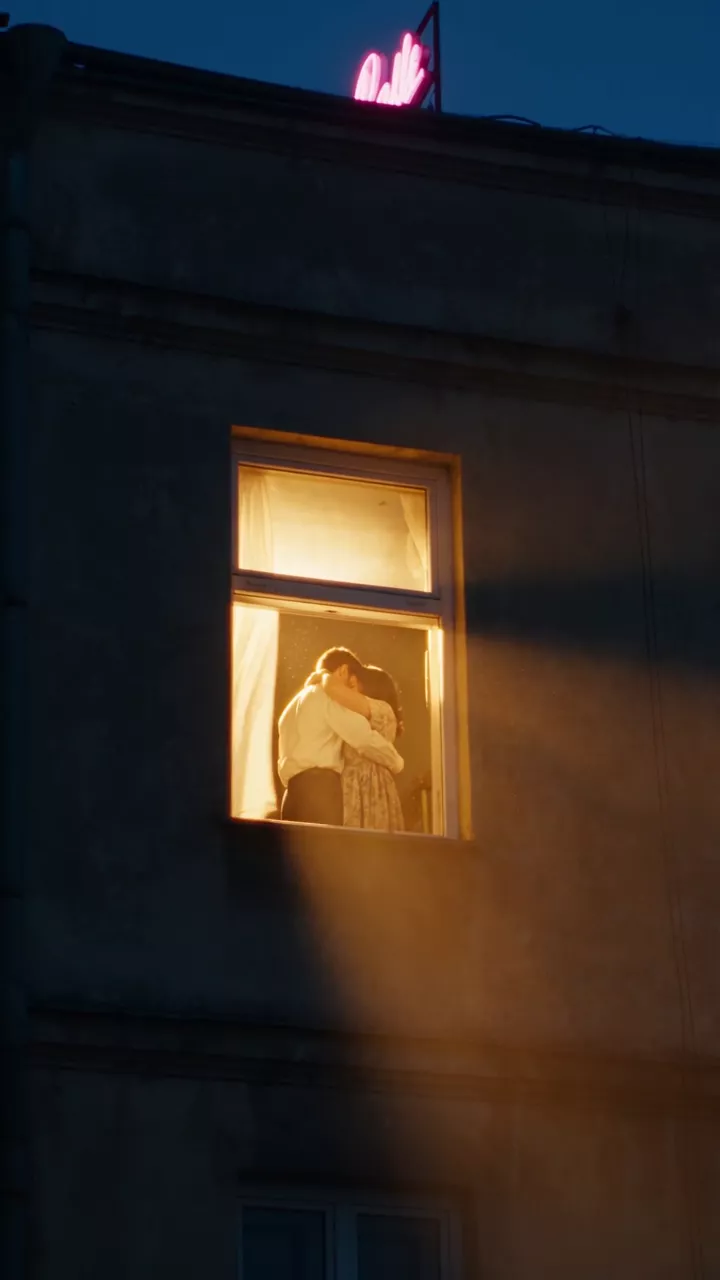
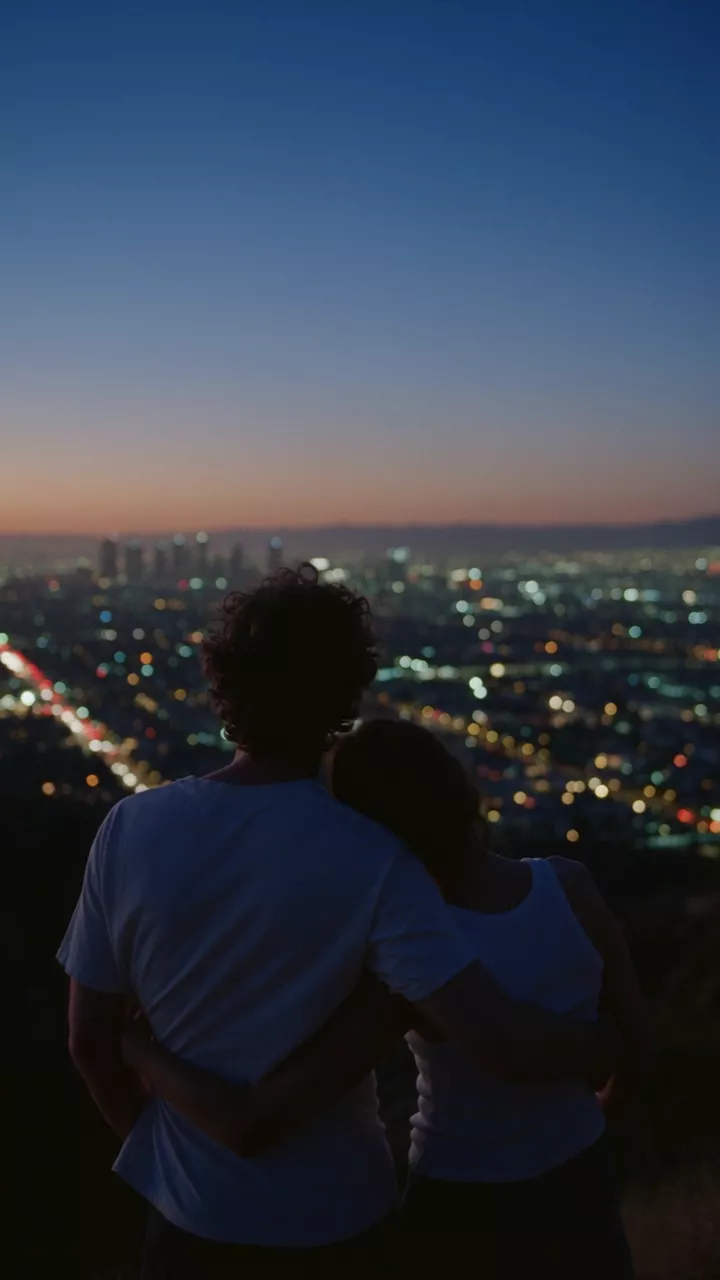
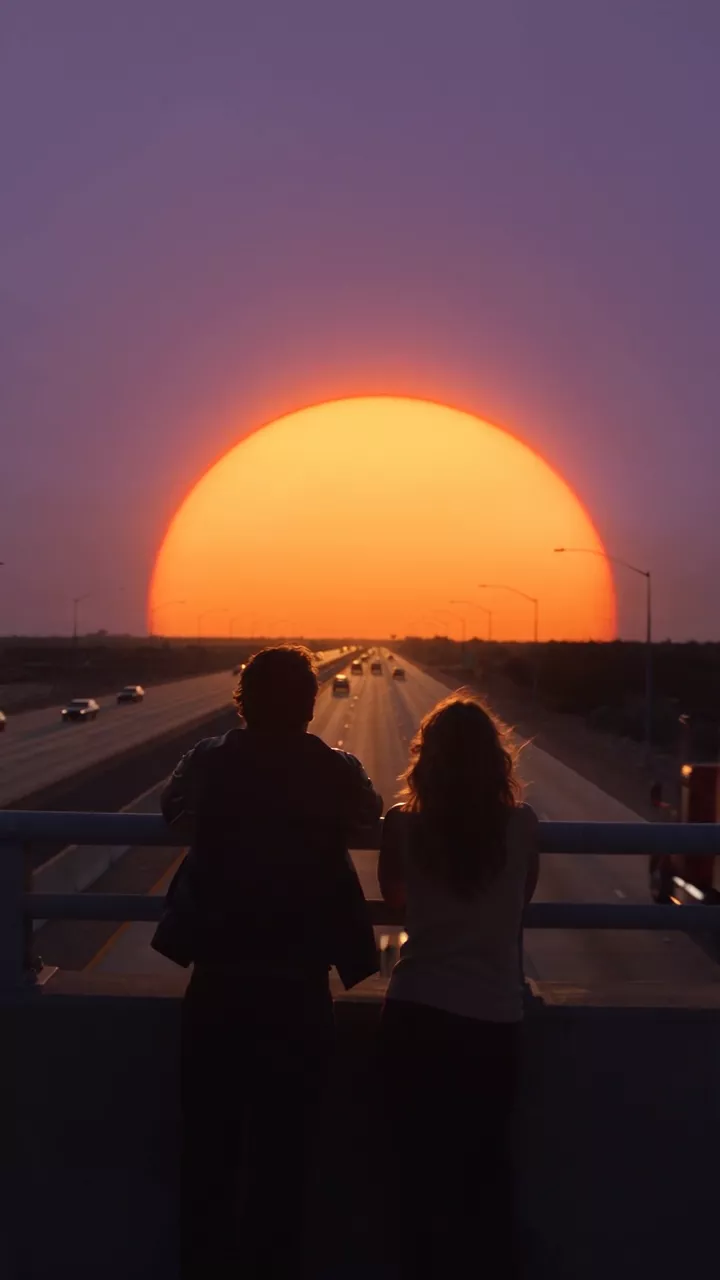
The moon prompt shows the skeleton filled in. The impossible element is a size: a moon "wider than the entire freeway" that is "already sitting low over the far end of the road", so it is a fact of the world from the first frame.
FORMAT: 9:16 vertical, 5 seconds, one continuous take, 24fps.

REFERENCE ROLES: @Video1 controls color grade, film grain, halation and handheld camera rhythm only. Do not copy its subjects, setting or composition.

STARTING STATE: A couple stands seen from behind, leaning on a concrete overpass railing at dusk, he in a dark jacket and she in a light sleeveless top. Ahead of them a multi-lane freeway runs straight toward the horizon under a purple and orange sky. A huge amber moon, wider than the entire freeway, is already sitting low over the far end of the road, filling a third of the frame, as if it has always been there. Its lower edge sits just above the asphalt, and the road's far lanes disappear behind it. Headlights and taillights stream along the lanes toward and around it.

TIMELINE:
0-5s: The moon stays fixed in the same spot and the same size for the whole shot, with no rising, growing or appearing. Traffic flows steadily toward it, and cars in the far lanes pass in front of its glowing surface as dark silhouettes. Wind moves her hair and the hem of his jacket. Both of them lean on the railing and look ahead.
3s: A truck rumbles past on the overpass behind them and the railing shakes slightly.
4-5s: She leans her head toward his shoulder.

CAMERA: Handheld from a few steps behind the couple, like a bystander who just walked up and started filming. Slightly off-center, a little tilted. Off-frame shake at 3s as the truck passes. A sudden quick zoom in on the couple at 3.5s, then a slow settle.

CONTINUITY: Same couple, same railing, same traffic direction. The moon's size, color and position never change from the first frame to the last. Light from the moon falls consistently on the road, the railing and the couple's shoulders.

AUDIO: None.

ENDING STATE: The couple at the railing, the giant amber moon still low over the freeway, traffic streaming past it.

CONSTRAINTS: Exactly one impossible element, the oversized moon, present from frame one and never appearing or changing. Nobody points at it, looks up at it, or reacts to it. No faces visible. No text, signs or logos. No lens flare. No slow motion.

STYLE: Photoreal footage on pushed 35mm film stock, heavy visible grain, soft halation around the moon and car lights, purple-blue dusk shadows with one saturated amber-orange accent, crushed navy blacks, highlights never pure white, slightly soft focus, 1980s snapshot look, imperfect framing. Camera: aggressive handheld, the frame shaking and lurching with the action, quick reframes and an urgent run-and-gun feel.
Look 2: flame-head dusk and night
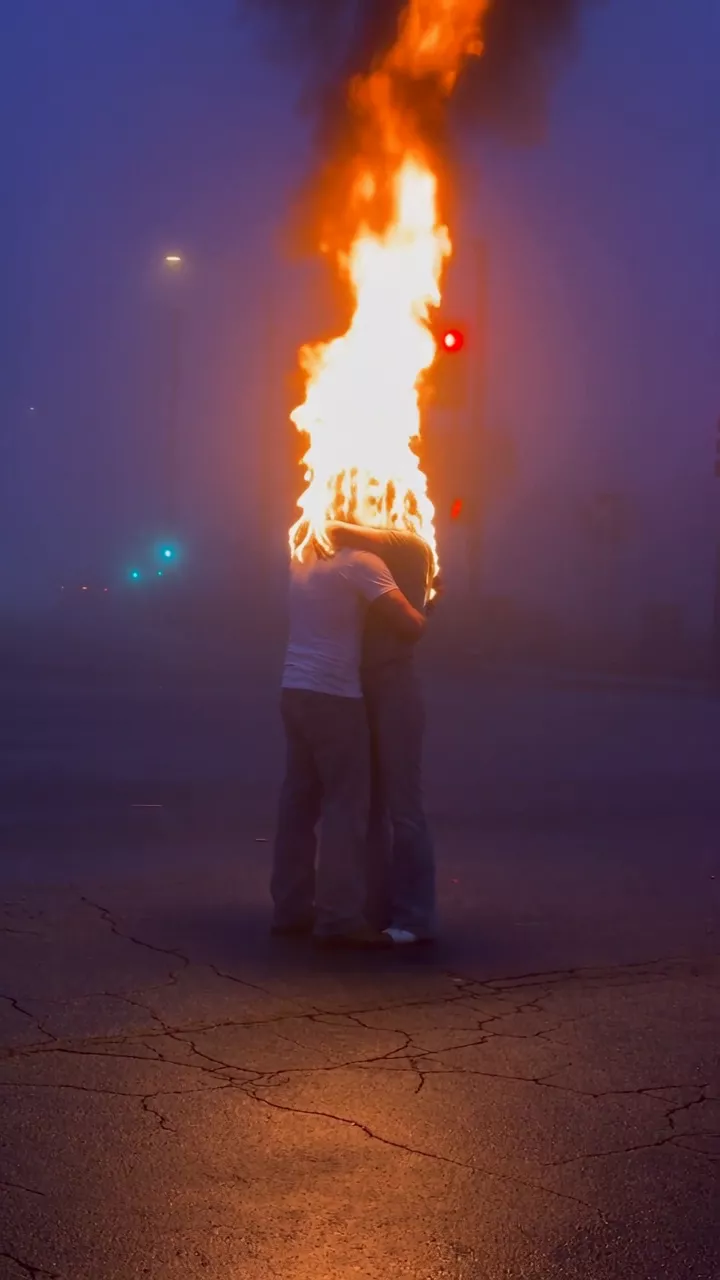
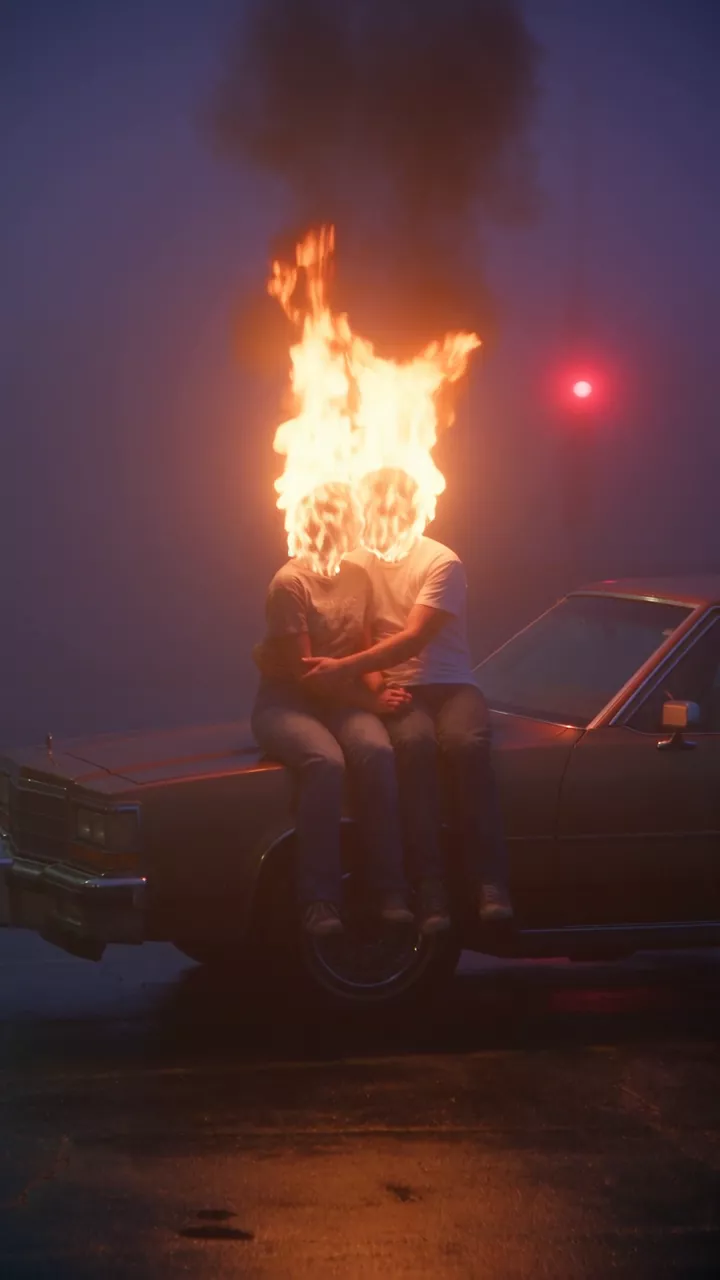
Mundane American places, a porch wall, a billboard, a car hood, an empty intersection, with a young couple whose heads are engulfed in big flames and a dark smoke cloud above. The flames are white-hot at the core and orange at the edges, with warm halation and red and green traffic-light bokeh in the fog.
STYLE: Photoreal footage on grainy 1970s color negative film, heavy visible grain, soft focus, strong warm halation around the flames, deep blue-violet fog with orange as the single accent color and small red and green bokeh, crushed navy blacks, highlights never pure white outside the flame cores, candid snapshot framing, intimate, nostalgic and eerily calm.
For a golden-hour version, swap the grade for warm amber light with cool teal-blue shadows, gently lifted blacks and sun-bleached, old-photo-album color.
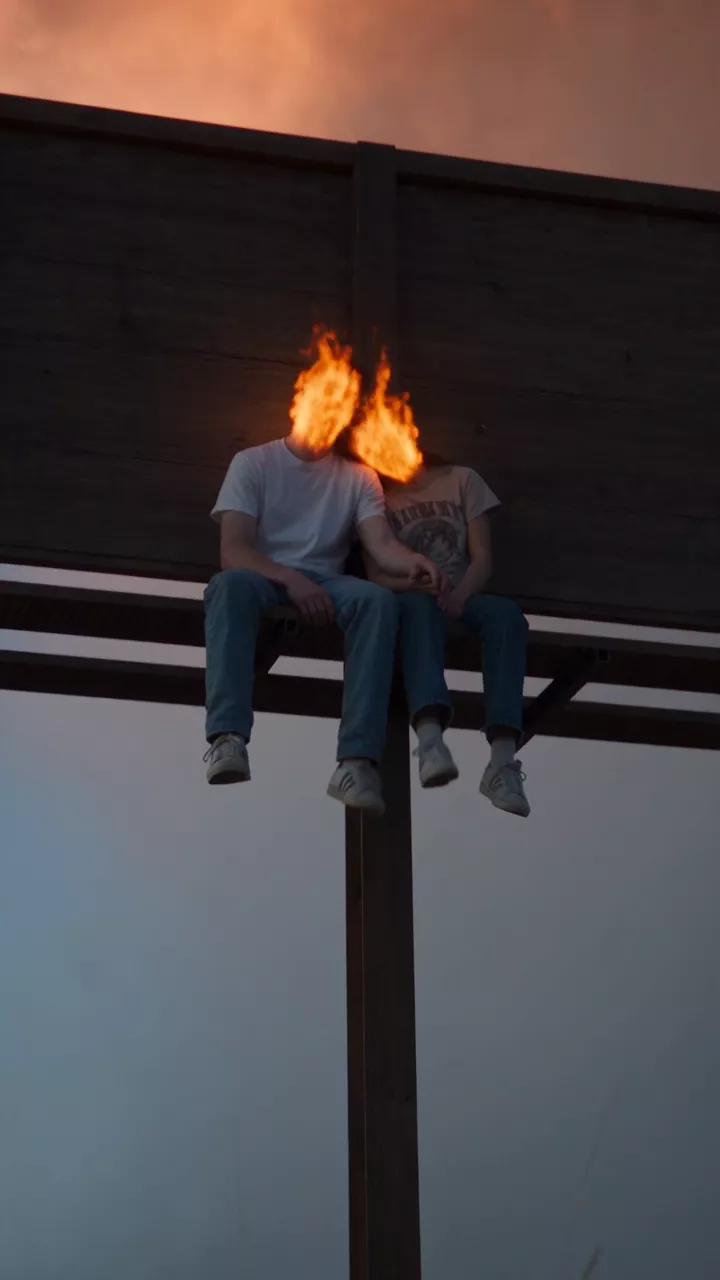
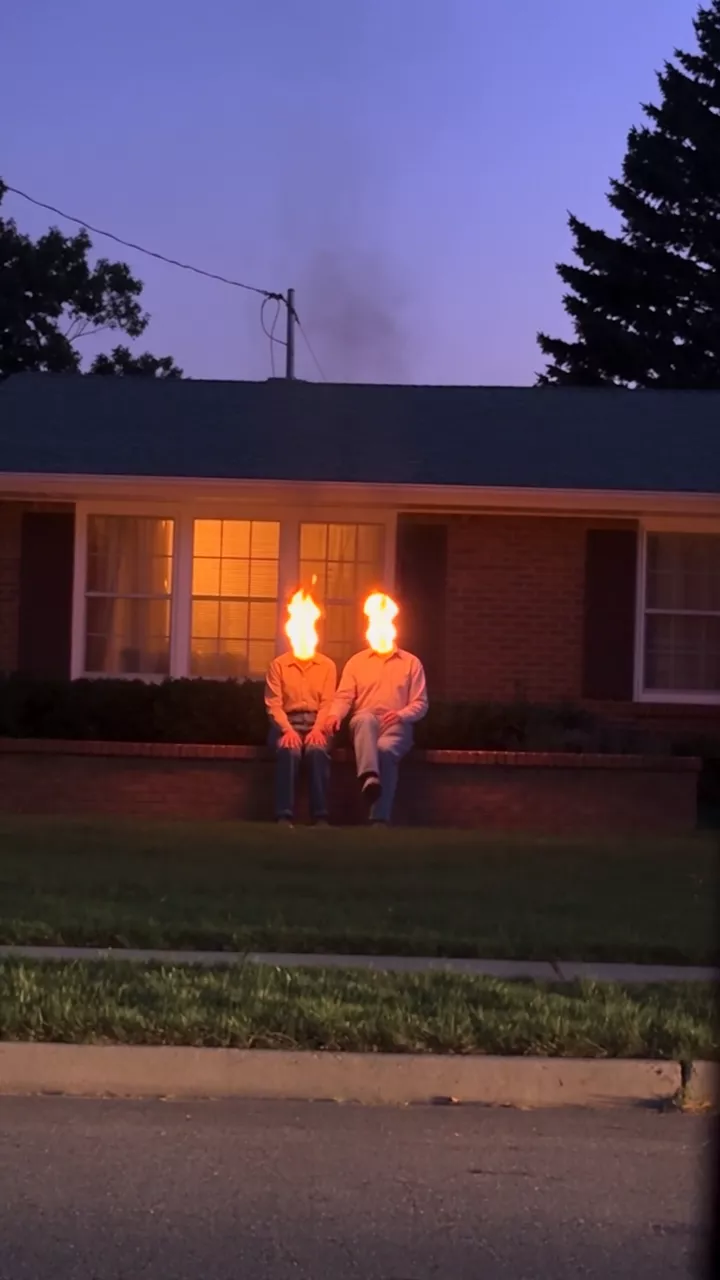
Between that draft and the porch clip at the top of this guide, the prompt moved onto the rules: the elderly couple became a young couple in their early twenties sitting close together, "pats the man's knee" became a timed touch, "At 1s her fingers slip into his", "deadpan and ordinary" became "deadpan and tender", and the Handheld pick was dropped. Several things changed at once, so no single one gets the credit.
FORMAT: 9:16 vertical, 5 seconds, one continuous take, 24fps.

REFERENCE ROLES: @Video1 controls color grade, film grain, halation and handheld camera rhythm only. Do not copy its subjects, setting or composition.

STARTING STATE: A quiet suburban street at dusk, seen from across the road. A 1970s brick ranch house with its front window glowing warm orange. Dark pine trees on both sides, a violet-blue sky. A young couple in their early twenties sits close together on the low front porch wall, his arm around her waist, her head resting against his shoulder. He wears a plain white t-shirt and faded blue jeans, she wears a loose gray t-shirt and jeans, both barefoot or in worn sneakers. Both of their heads are burning, calm steady orange flames where their heads should be, with a thin rope of dark smoke rising behind the roofline. This has been the case since before the shot began and is completely normal.

TIMELINE:
0-5s: The couple sits quietly together watching the empty street. The flames flicker and lean in the evening wind. At 1s her fingers slip into his and their hands rest tangled on his knee. At 3s he pulls her a little closer and she tucks her feet up onto the wall. A neighbor's car drifts past in the foreground and its headlights sweep across the lawn. Neither of them looks at it or reacts to anything.

CAMERA: Handheld from the sidewalk across the street, like a bystander who stopped on the way home. Slightly tilted, off-center. A quick sudden zoom in on the porch at 1.5s. A small stumble at 3s that drops the frame low and then recovers. Foreground occlusion from a parked car's side mirror at the frame edge.

CONTINUITY: Same couple, clothes and positions. The flames keep the same size and brightness for the whole shot. The window glow stays constant.

AUDIO: None.

ENDING STATE: The couple still close on the porch wall under a violet sky, flames burning steadily, the house glowing behind them.

CONSTRAINTS: Exactly one impossible element, the flaming heads, present from the first frame. The pair stay deadpan and tender, never reacting to the fire. Nobody looks at the camera. No faces visible. No text, signs or logos. No lens flare. No slow motion. No other fire anywhere in the frame.

STYLE: Photoreal footage on grainy 1980s color negative film, visible grain, soft halation around the flames and window light, purple-blue dusk shadows with orange as the single accent color, crushed navy blacks, highlights never pure white, slightly soft focus, candid snapshot framing, warm, intimate and deeply nostalgic mood.
Look 3: monochrome silver gelatin
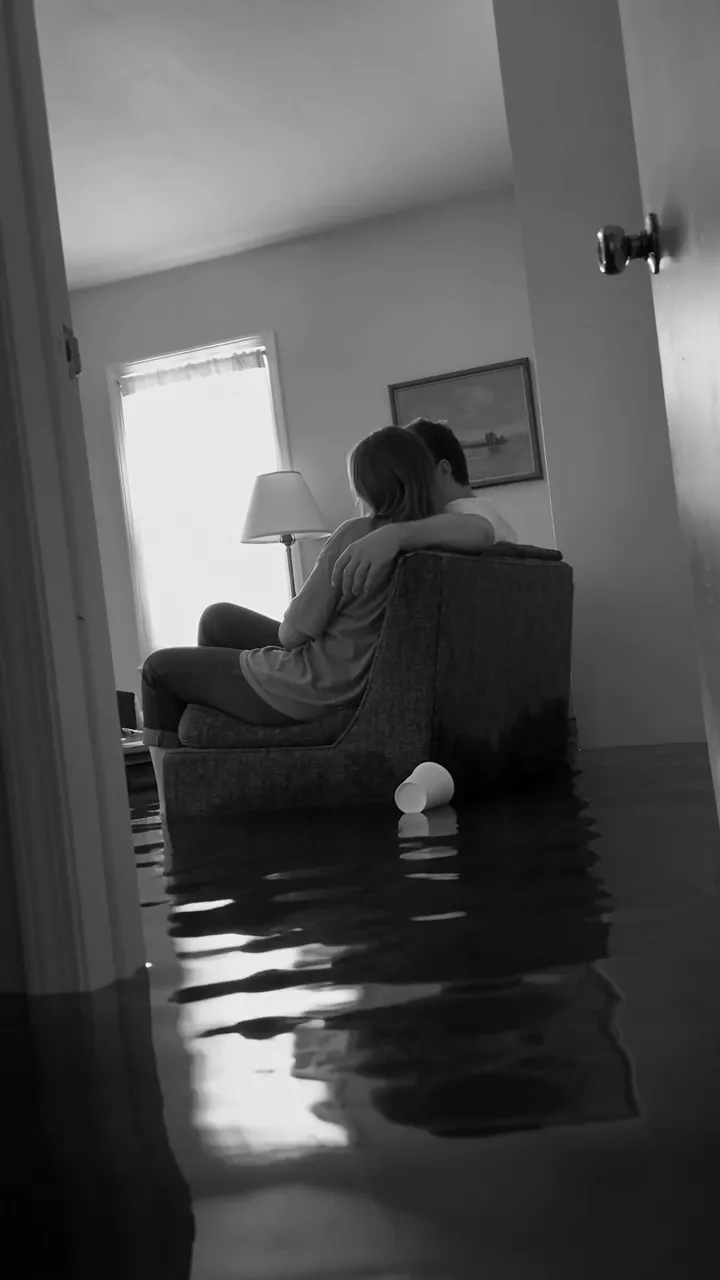
Black and white only: clouds, flooded rooms, endless white stairs, floating couples. The mood is hushed, dreamy and melancholic, and the grain should be coarse enough to see in the sky.
STYLE: Photoreal black-and-white silver gelatin film photograph, very coarse pushed grain like 3200 ISO film, grain visible in the sky and shadows, high contrast, deep blacks, soft luminous highlights never pure white, slightly soft focus, candid snapshot framing, quiet, tender and nostalgic mood.
For a heavenly look, like the white stairs or the floating couple, switch to high key: a bright soft sky, glowing bloom around the white elements, deep gray shadows in the field or the clouds.
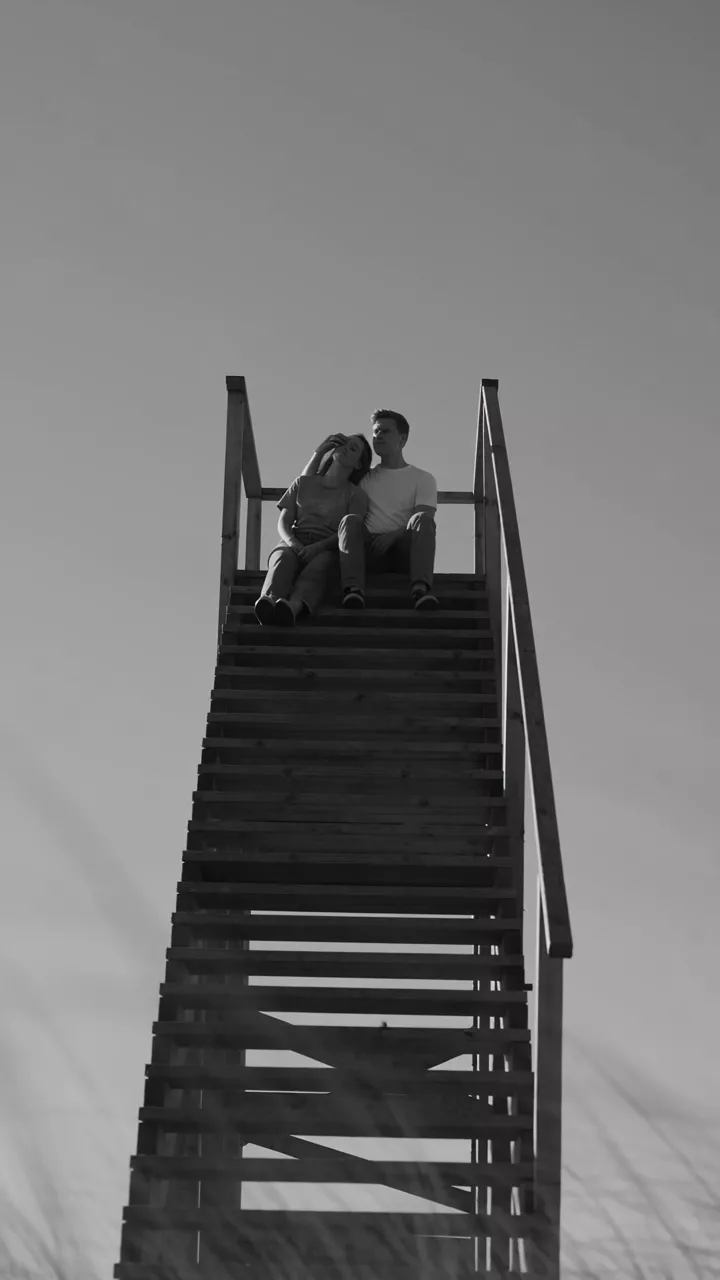
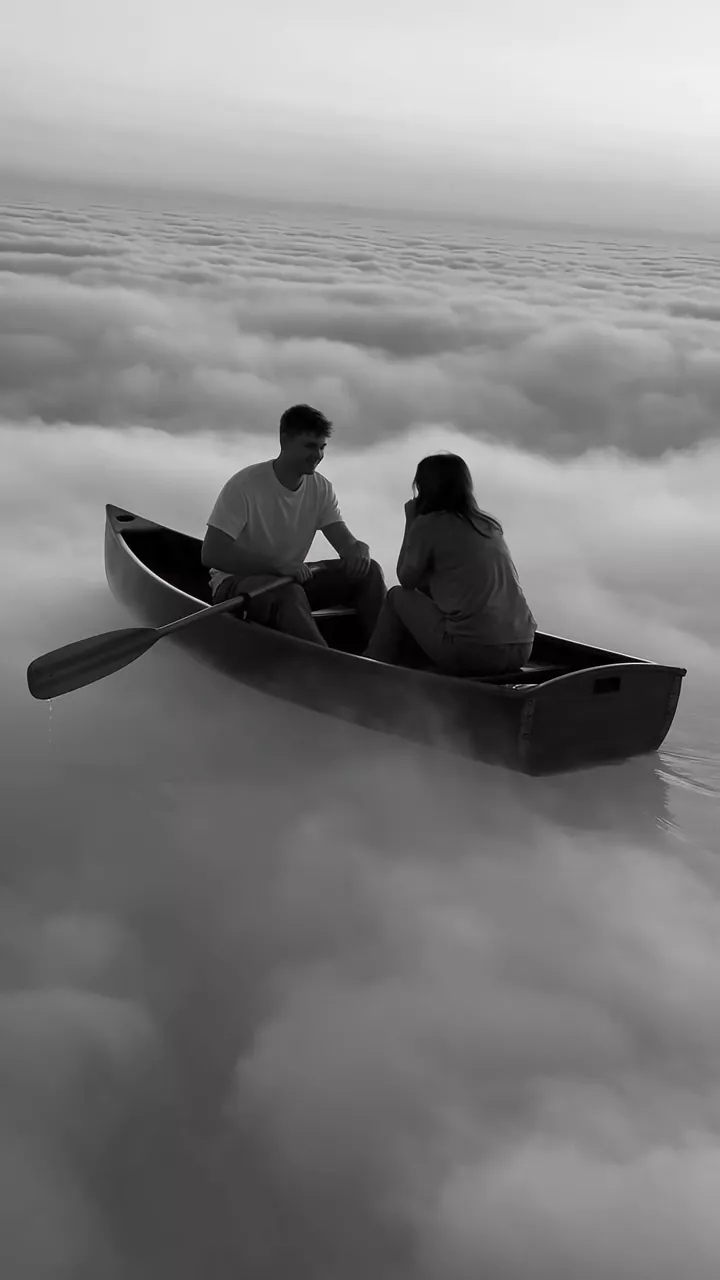
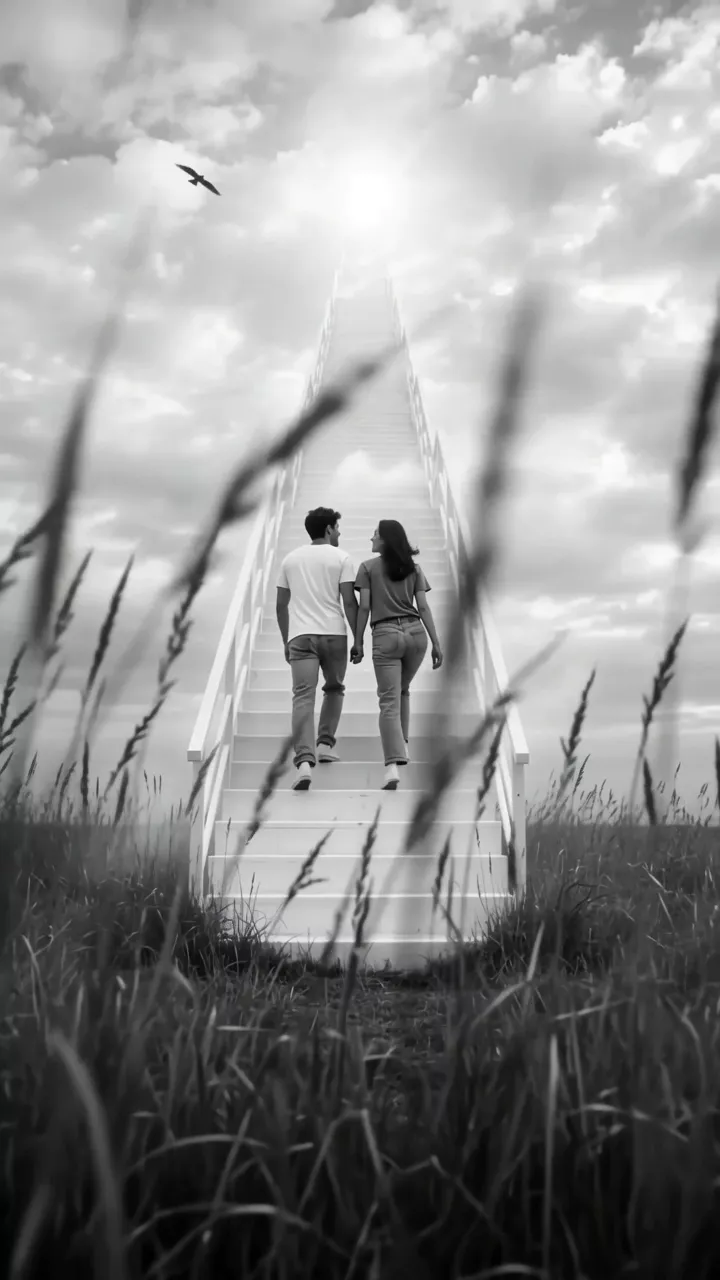
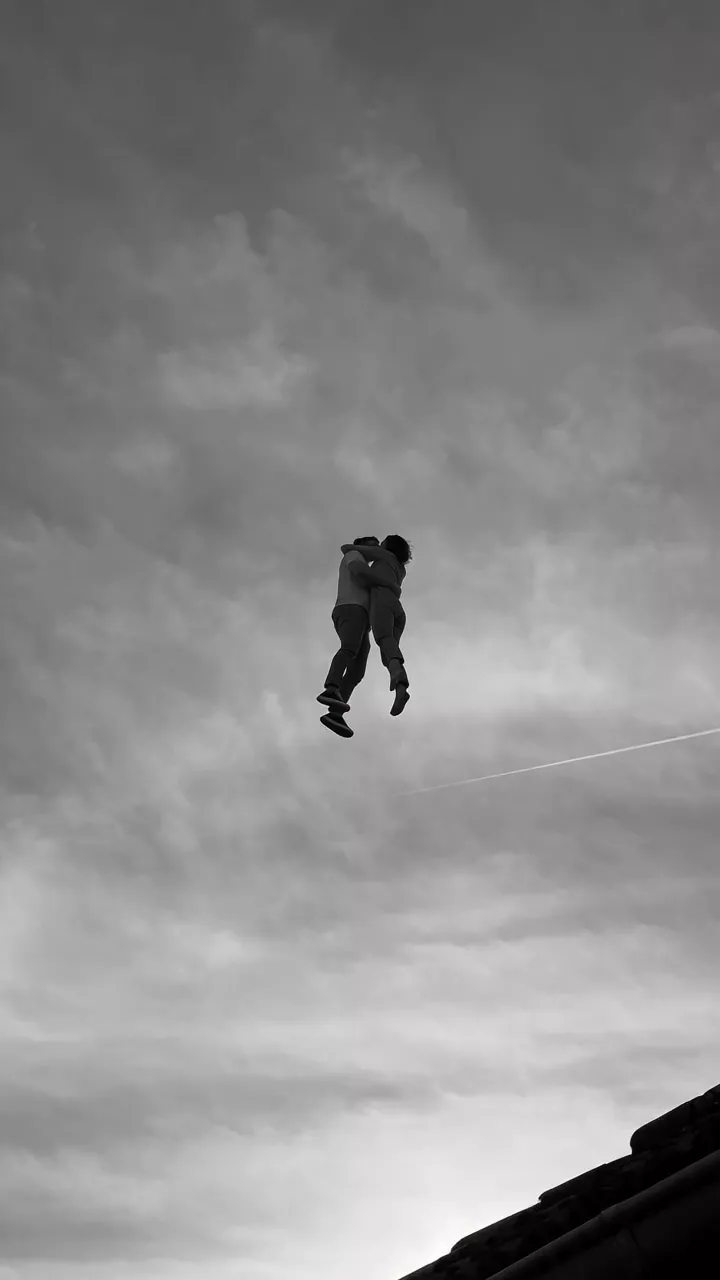
The floating prompt rules out the two ways a floating couple goes wrong: it says they are there "with no lift-off or transition", and it bans "wings, ropes, wires or objects holding them" and any "flying pose".
FORMAT: 9:16 vertical, 5 seconds, one continuous take, 24fps, black and white.

REFERENCE ROLES: @Video1 controls monochrome grade, coarse grain and handheld camera rhythm only. Do not copy its subjects, setting or composition.

STARTING STATE: A vast soft sky of layered clouds and drifting mist, seen from far below and slightly to the side. High in the frame, small against the glowing sky, a young couple in their early twenties floats in mid-air with nothing beneath them, already wrapped tightly in a hug and locked in a slow kiss, seen in distant silhouette and profile so no faces are readable. His arms are around her waist, her arms around his neck, her feet trailing loosely behind her. He wears a white t-shirt and jeans, she wears a faded gray t-shirt and jeans, the fabric of their clothes lifting gently in the air. This has always been the case and is completely normal.

TIMELINE:
0-5s: The couple hangs weightless in the sky, kissing, turning very slowly about a quarter turn as they drift, their hair and shirt hems and jeans cuffs floating softly around them. Thin ribbons of mist pass slowly behind and in front of them and catch the soft light. At 2s she tightens her arms around his neck and her trailing foot swings gently. At 3.5s he shifts one hand up to cradle the back of her head. They drift upward by a small amount over the shot. A single bird crosses far below them. They never separate, never look at the camera and never look down.

CAMERA: Handheld from a long way below, looking up at them like someone standing on the ground who spotted them and stopped to watch. Slightly tilted and off-center. A sudden quick zoom in toward the couple at 2s, then a slow pull back. A small stumble at 3.5s that jolts the frame for a moment, then it recovers. A dark tree branch or rooftop edge intrudes at the corner of the frame as foreground occlusion.

CONTINUITY: Same couple, clothes and embrace throughout. They stay locked together the whole time. Cloud layers and soft light stay consistent from first frame to last.

AUDIO: None.

ENDING STATE: The couple still floating high in the glowing sky, kissing and wrapped together, small and distant among the clouds.

CONSTRAINTS: Exactly one impossible element, the couple floating, present from frame one with no lift-off or transition. Calm, tender and deadpan, with no signs of effort or flying pose. No visible faces. No text. No lens flare. No slow motion. No wings, ropes, wires or objects holding them. No other people.

STYLE: Photoreal black-and-white silver gelatin film photograph, very coarse pushed grain, grain visible in the sky and shadows, high key soft sky with a gentle glowing bloom, deep gray shadows in the clouds, highlights soft and never pure white, slightly soft focus, candid snapshot framing, dreamy, tender, ethereal and nostalgic mood. Camera: aggressive handheld, the frame shaking and lurching with the action, quick reframes and an urgent run-and-gun feel.
Borrow the feeling, not the scene
Four clips in the project start from reference footage and change the situation on purpose. Each prompt opens with a concept line that names what to keep and what to replace: "Instead of copying the rooftop/city setup, the emotional structure stays the same: tiny intimate figures surrounded by a huge night environment."
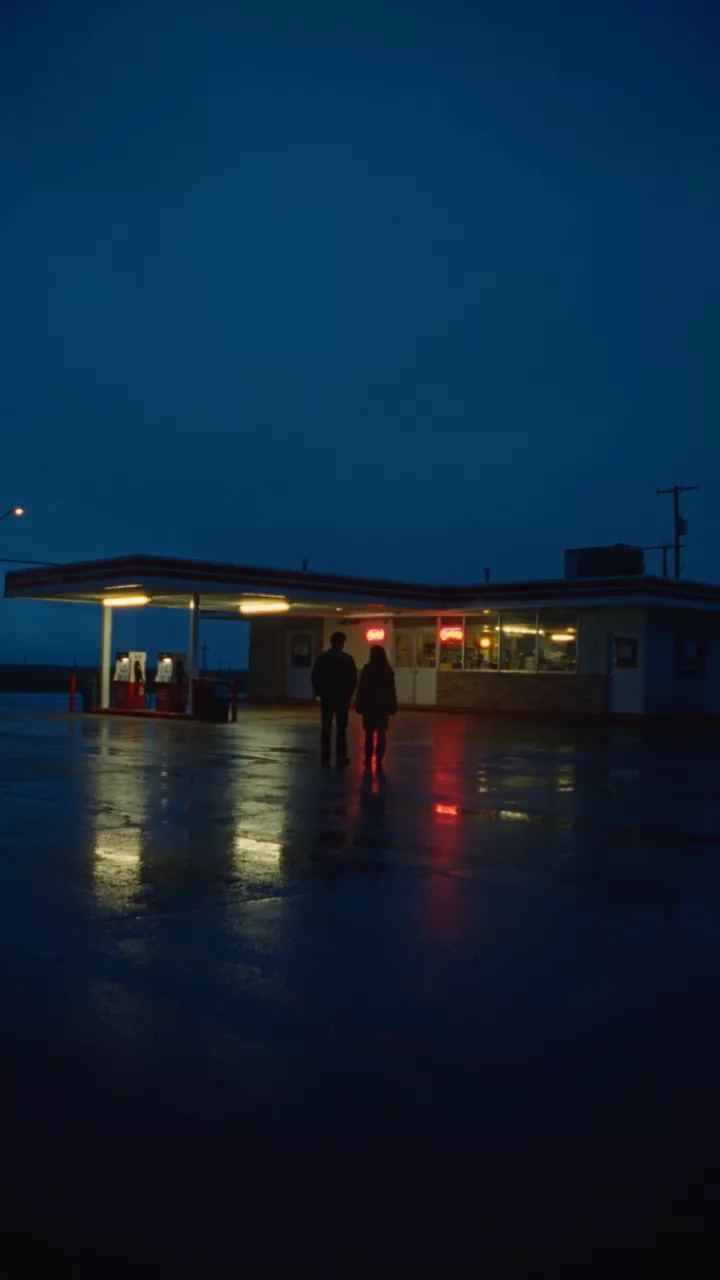
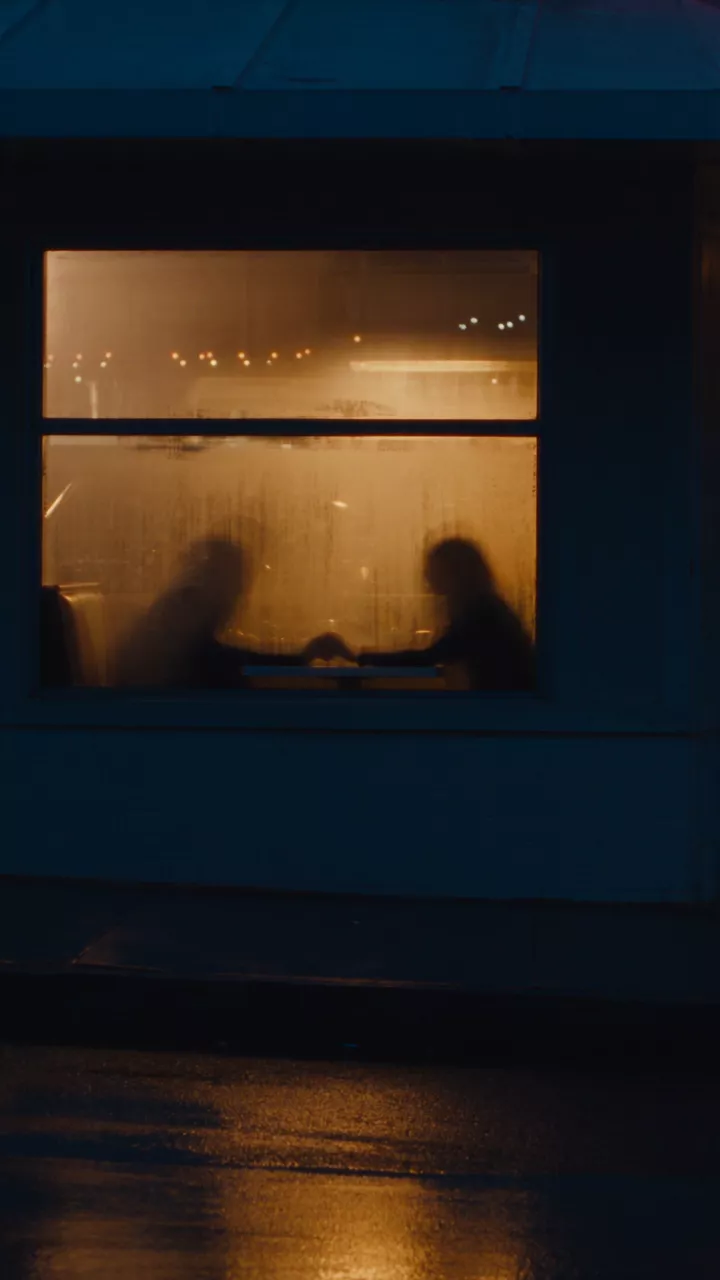
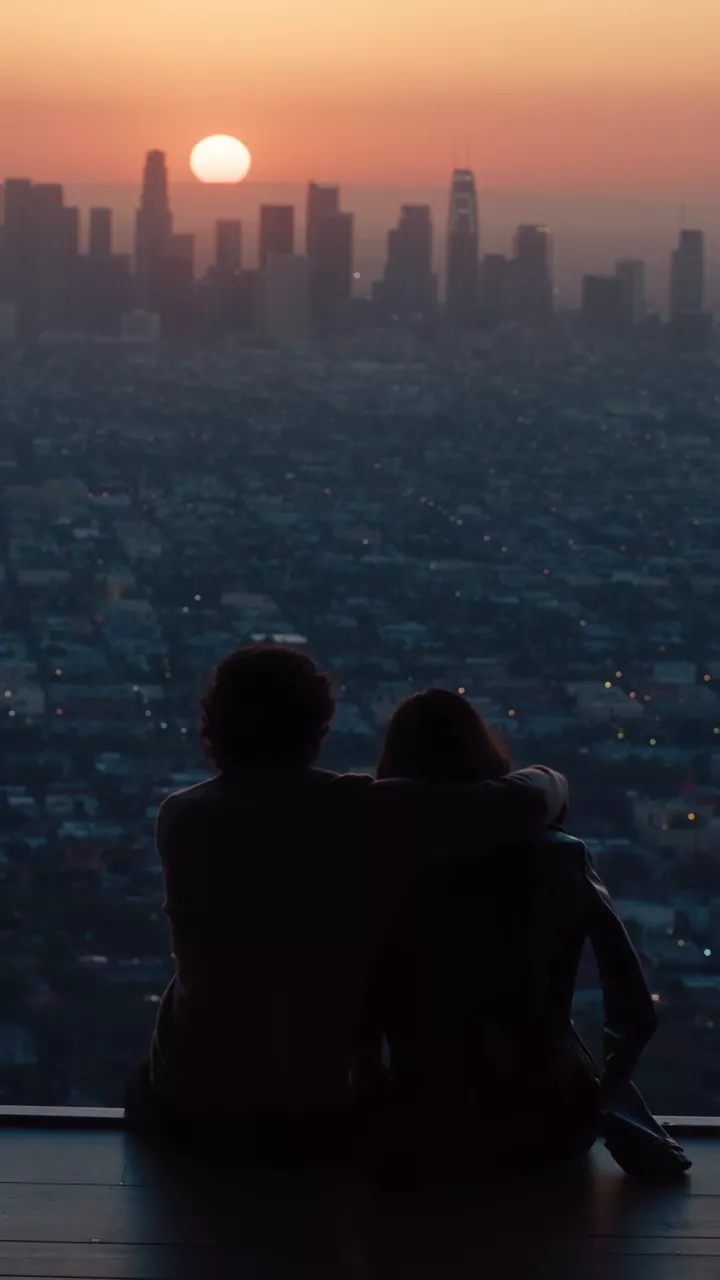
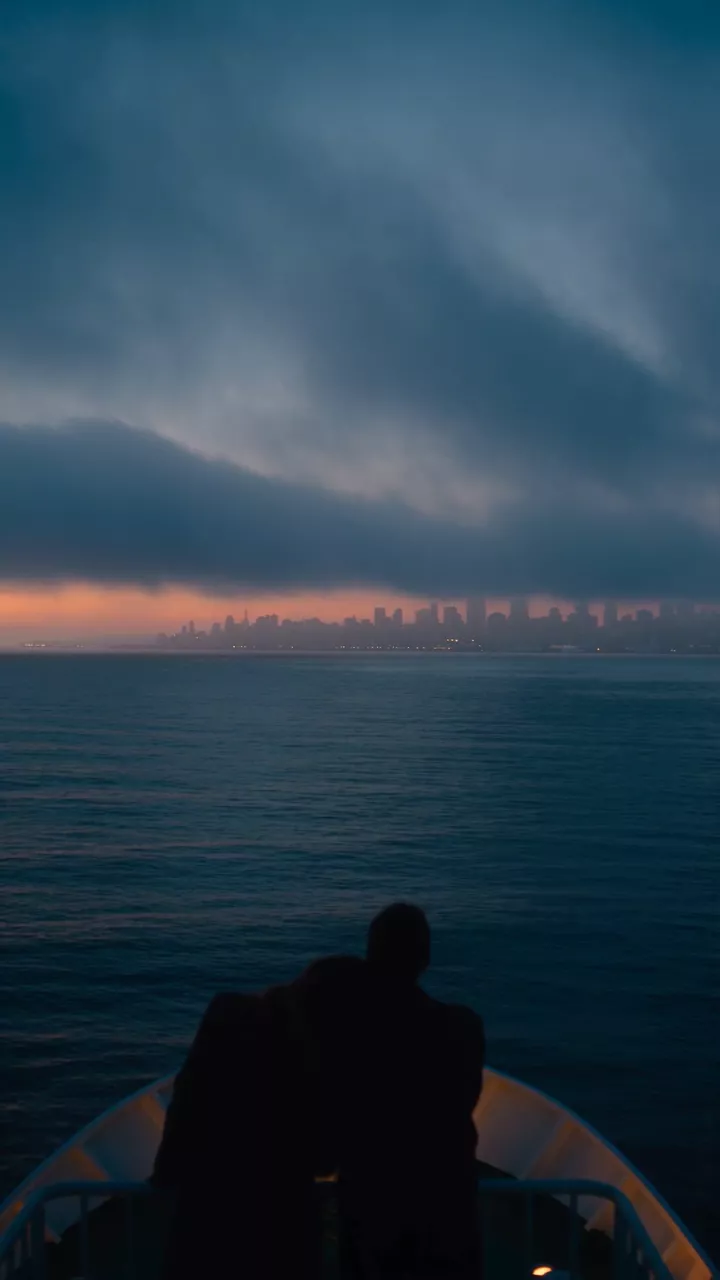
Concept: Two people standing under a lonely gas-station canopy after rain. Instead of copying the rooftop/city setup, the emotional structure stays the same: tiny intimate figures surrounded by a huge night environment.

Prompt:

5-second vertical 9:16 cinematic video. Two young adults stand quietly beside an old isolated gas station at blue hour just after rain, seen from a distance and mostly from behind. The enormous dark surroundings dominate the frame while the two figures remain small near the center. Wet asphalt reflects deep cobalt-blue night tones and a few soft orange and red gas-station lights. Their silhouettes have extremely subtle warm rim light around their shoulders and hair. One person slowly turns their head toward the other, then they gently lean closer together. No exaggerated acting. The environment feels empty, nostalgic and slightly surreal. Soft atmospheric haze, diffused practical lighting, glowing red and amber light sources, subtle halation, gentle bloom around highlights, muted blue shadows, restrained warm highlights, slightly lifted blacks, natural skin and clothing texture, delicate 35mm film grain, soft analog photographic texture, slight focus falloff, imperfect exposure, realistic nighttime atmosphere. The image should feel like a moving photograph from an intimate art film, quiet and emotionally mysterious, not glossy Hollywood cinematography. Very slow natural camera drift, almost imperceptible handheld movement, no dramatic camera move, no stabilization artifacts, no text, no UI, no logos. Camera: aggressive handheld, the frame shaking and lurching with the action, quick reframes and an urgent run-and-gun feel.
Watch for this:These four break the rules, and it shows in what they are. They are one paragraph instead of the blocks, they call themselves a cinematic video, and none has an impossible element. They come out as quiet romance in the same palette, not as dreamlike shots. Use the structure when you want the impossible thing; use a concept line like this when you want variations on a mood.
Film it like a bystander
- Say who is filming and why they are there: a bystander across the street, someone who pulled over and got out, someone who walked into the field and stopped to watch.
- Move sparingly: one sudden quick zoom in, one small stumble that dips the frame and recovers, and optionally one pull back. Constant shake looks like a filter.
- Block the edge of the frame: a car mirror, a utility pole, grass blades, a branch. It makes the footage feel unplanned.
- Use distance for mood: far, low and from behind feels lonely and dreamy; close and across the road feels intimate.
- State the impossible thing as a fact, with a natural consequence: smoke rising from the fire, mist across the steps, reflections on wet asphalt. If it fails on a first try, make it bigger or simpler before adding detail.
- Cast plainly: a young woman and a young man in their early twenties; he in a plain white T-shirt and faded jeans, she in a gray T-shirt and jeans, worn sneakers or barefoot. Wind in their hair sells realism at no cost.
Watch for this:Handheld at Strong says the opposite. Fifteen of the 17 clips carry the Camera move pick Handheld at Strong, which adds "aggressive handheld, the frame shaking and lurching with the action" to the end of the prompt. That contradicts the CAMERA block's one zoom and one stumble. The porch and the billboard were made without it. If your clip shakes the whole time, remove the pick and let the CAMERA block do the work.
Set it up in NOLGIA
Open Video from the Create menu and stay on Text to video. Press Change on the model card and pick Seedance 2.5. Under the prompt, press Add video reference, then Upload video or Pick from library: the clip becomes @Video1, and the REFERENCE ROLES line tells the model what it may take from it. Set the aspect ratio chip to 9:16 and the duration chip to 5s, pick your project in the Project dropdown, paste the prompt and press Generate video. The price is on the button before anything runs.
| Setting | What to pick | Why |
|---|---|---|
| Model | Seedance 2.5 | It follows long, structured briefs and the 0-5s timeline syntax, and takes reference videos |
| Reference | One video, as @Video1 | One style donor; two competing references muddy the grade |
| Aspect ratio | 9:16 | Generate vertical natively; never crop from 16:9 |
| Duration | 5s | Short enough for one impossible thing and three beats |
| Quality | 480p to test, 720p or 1080p to finish | Cheaper tests while you lock the shot; every clip here is 720p |
| Audio | Off for silence | The AUDIO line in the prompt does not switch sound off; the chip does |
A reference clip should show the look you want: the grain, the grade, the halation and the camera rhythm, 5 to 10 seconds in the family you are making. Seedance 2.5 takes reference video of 2 to 30 seconds in total, as MP4 or MOV. Use footage you have the rights to; we do not show the reference clip used here. NOLGIA has no bitrate or frame rate setting for Seedance 2.5; these clips came back at 24 fps.
Watch for this:AUDIO: None does not mean silence. Thirteen prompts here say AUDIO: None, and all 17 clips came back with sound, because the Audio chip was on. To get a silent clip, turn Audio Off in the composer, then lay one quiet music bed under the cut.
Run it, check it, change one block
- Draft the prompt from the template and generate at 480p.
- Check the first 2 seconds: is the impossible thing there and calm from frame one? If it appears or transforms, rewrite STARTING STATE.
- Check the camera: one zoom, one stumble, something at the frame edge, not constant shake.
- Change one block at a time between runs, and note which change fixed which problem.
- When the composition, the impossible thing and the motion are right, make the final at 720p or 1080p.
- In the edit, add grain and halation only if the clip looks too clean, and lay a single quiet music bed with no drops.
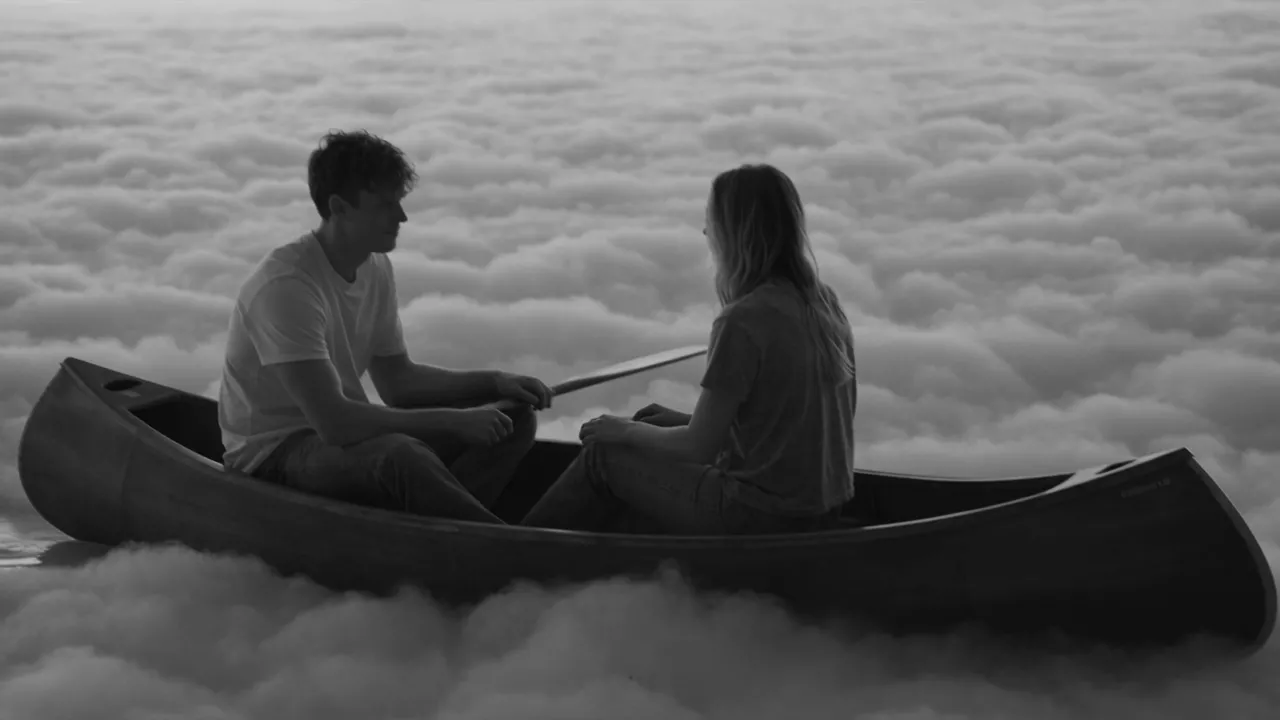
The project took 29 runs in about two hours: 28 on Seedance 2.5 and one on Wan 3.0. Seventeen are in the project. The others were drafts like the elderly porch couple, an earlier version of the moon, and the rowboat that came out landscape.
When it goes wrong
| Problem | Fix |
|---|---|
| Looks like clean CGI or a movie poster | Remove cinematic words. Add candid snapshot framing, imperfect composition and soft focus. Push the grain: coarse like 3200 ISO film pushed two stops |
| The flames look cartoonish | Ragged, unevenly shaped flames that flicker irregularly, with real heat shimmer and sparks; or small, low, realistic flames like a gas burner |
| The impossible thing appears or transforms | Rewrite it in STARTING STATE as already there, and remove begin, appear, rise and grow from TIMELINE |
| People look at the camera or react | Add to CONSTRAINTS: neither of them ever looks at the camera or reacts to the impossible element. Keep them busy with each other |
| The kiss or embrace looks stiff | Unposed, like two people who forgot anyone could see them, and a specific touch at a specific second |
| Floating looks like a superhero pose | Limp and relaxed, like sleepers, no stretched arms or pointed toes; no wings, ropes or wires |
| The staircase looks short or flat | Very long, hundreds of steps, narrowing toward a vanishing point; for white stairs, faint step edges still visible in the glow |
| Monochrome grain is too clean | Grain visible in the sky and in the shadows, like a poor enlargement of a small negative |
| The couple is too big or too small | Give a size: occupies about a tenth of the frame height |
| The camera shakes the whole time | Exactly one zoom, one stumble, one pull back, otherwise steady handheld; and drop the Handheld pick |
| Clothes or positions drift | Strengthen CONTINUITY: name each garment and each hand position that must hold |
Before you generate
- Exactly one impossible element, there at 0 seconds.
- The couple ignores it and never looks at the lens.
- Three beats or fewer, each a specific ordinary action.
- A camera with a who and a where, one zoom, one stumble and one thing at the frame edge.
- Plain clothes, and faces not visible.
- CONSTRAINTS written as statements: no text, no flare, no slow motion.
- The family STYLE line pasted unchanged.
- 9:16, 5s, Audio Off if you want silence.
Ideas for the same world: flame-head couples at a diner booth, a drive-in, a beach at dusk, a bus stop; in monochrome, a rowboat on a sea of clouds, a flooded living room, an endless staircase; at blue hour, a city overlook, glowing figures on a beach, a giant sun over a skyline. Keep the wardrobe, the STYLE line and the camera rules identical across a series, so every clip feels like it came from the same archive.
What it costs
Each clip is priced by model, length and quality, shown on the Generate video button before it runs; testing at 480p costs less than finishing at 720p or 1080p. The live rate:
Seedance 2.5Pro and up
Per 5s clip
480p 26 credits · 720p 56 credits · 1080p 137 credits
1080p renders at 16:9 and 9:16
Read live from the catalog when this page loads. Every price is shown before you generate. See every rate.
Questions and answers
- Which model made these clips?
- Seedance 2.5: 5 seconds, 720p, 9:16, 24 fps. Thirteen prompts address a reference video as @Video1 for the grade, the grain and the camera rhythm; the four variations do not mention one.
- What should the reference video be?
- Five to ten seconds of footage in the look you want, that you have the rights to use. Say in REFERENCE ROLES that it controls only the grade, the grain, the halation and the camera rhythm, and that its subjects, setting and composition must not be copied.
- Why are the faces hidden?
- Backs, silhouettes, profiles and flames avoid uncanny faces and keep the moment anonymous and universal. In a few of the monochrome clips a profile does show; CONSTRAINTS asks for no visible faces, but check every take.
- Do the clips have sound?
- These do, because the Audio chip was on even though each prompt says AUDIO: None. For silence, turn Audio Off in the composer and add one quiet music bed in the edit.
- Can the clips be longer than 5 seconds?
- Yes, Seedance 2.5 makes clips of 4 to 30 seconds and the same approach scales. The rules here are tuned for short shots with one impossible thing and three beats.
- Are the people real?
- No. Everyone in the clips was generated by Seedance 2.5 from the prompts in this guide.
Make your first dreamlike clip
Open the video composerRelated guides
Filmmaking
Creating the viral nostalgic stylized AI videos
How to make viral home-video clips like a grandma petting a panther or a man walking away from an explosion, with every Seedance 2.5 prompt from three real projects.
· 27 min read
Prompting
Camera moves: what each one does and the words that get it
Twelve camera moves in plain words: what the camera does, what it makes people feel, the words to write in your prompt, and the move each one is confused with. Each with a clip made in NOLGIA.
· 25 min read
Prompting
Seedance 2.5: how to prompt it, with a library that was run
How to write for Seedance 2.5 on NOLGIA: text to video, a still as the start frame, a take as @Video1 with its sound, the six aspect ratios, 4 to 30 seconds, and what it refuses.
· 10 min read