

Make a character mashup reel: game fighters in real life
Eight game-style fighters at a rooftop party, a food truck, a laundromat and a pub, in 25 seconds of handheld 9:16. Here are the sheets, the script, the Seedance 2.5 prompts and the cut, from the project's own breakdown and the account that made it.
- 18 min read

A character mashup reel drops fighters who belong in a video game into ordinary places: a food truck line, a laundromat, a late-night store. It only works if each fighter is the same person in every shot, and that doesn't come from a longer prompt. It comes from one reference sheet per character and one short clip per moment.
By the end you'll have a sheet for every character, a script of 4 second moments, a prompt template for the shots and a cut of about 25 seconds at 9:16. The worked example is a 24.9 second reel with eight characters and ten shots, made shot by shot on Seedance 2.5. The method and the templates come from the project's own breakdown. The settings, the takes and the prompts as sent are read from the account that made it.
What you'll do
- Make a character sheet for every character: five views on a plain grey background.
- Save each character on the Characters page, with a description that names the costume.
- Write the script as a list of everyday moments, 4 seconds each.
- Generate each shot as its own Seedance 2.5 clip at 9:16, with only that shot's characters attached.
- Check every take, and make the weak ones again.
- Cut the reel: the shots in order, trimmed, with music under them.
Everything below comes from one real project. Watch the reel first, so you know what you're building.
Watch the reel
The reel runs 24.9 seconds at 9:16: ten shots, eight characters, each shot on screen for about 1 to 4 seconds. Each shot puts fighters who look like they walked out of a game into a completely ordinary place.
In plain words, the joke is the contrast. The work is making it look like someone filmed it on a phone.
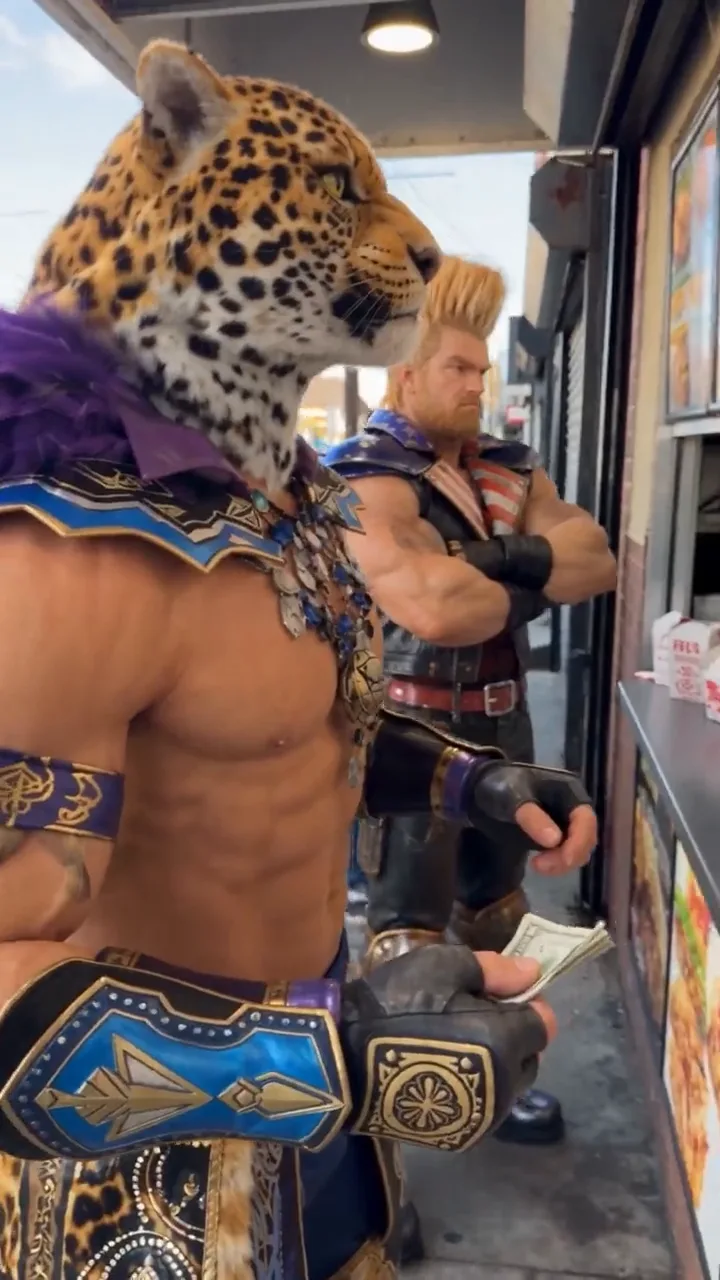
The project's own breakdown names three things that sell the realism:
- Consistent characters. Every character looks the same in every shot, because each clip is generated from the same character sheet.
- A camera that feels like a person is holding it. Third-person handheld, a slight stumble and drift, never a locked tripod.
- Light that belongs to the location. Sunlight outdoors, flat fluorescent tubes in the store and the laundromat, warm bulbs in the bar and on the rooftop.
Make a five-panel sheet for each character
A character sheet is the single source of truth for a character's face, hair, costume and build. Seedance 2.5 reads it as a reference on every shot, so the better the sheet, the more consistent the video.
Put simply, it's the one picture every shot points at, so the same fighter turns up each time.
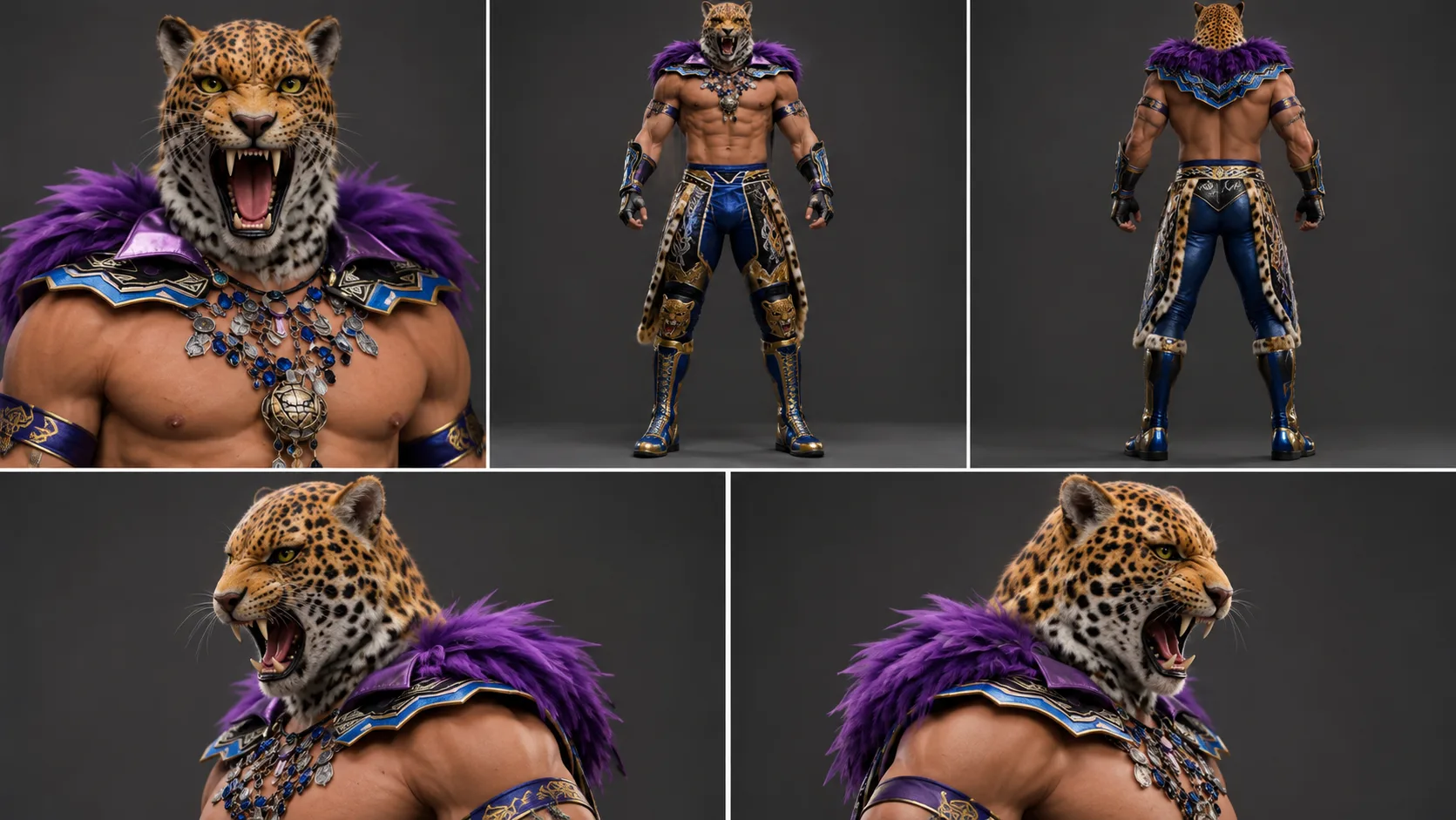
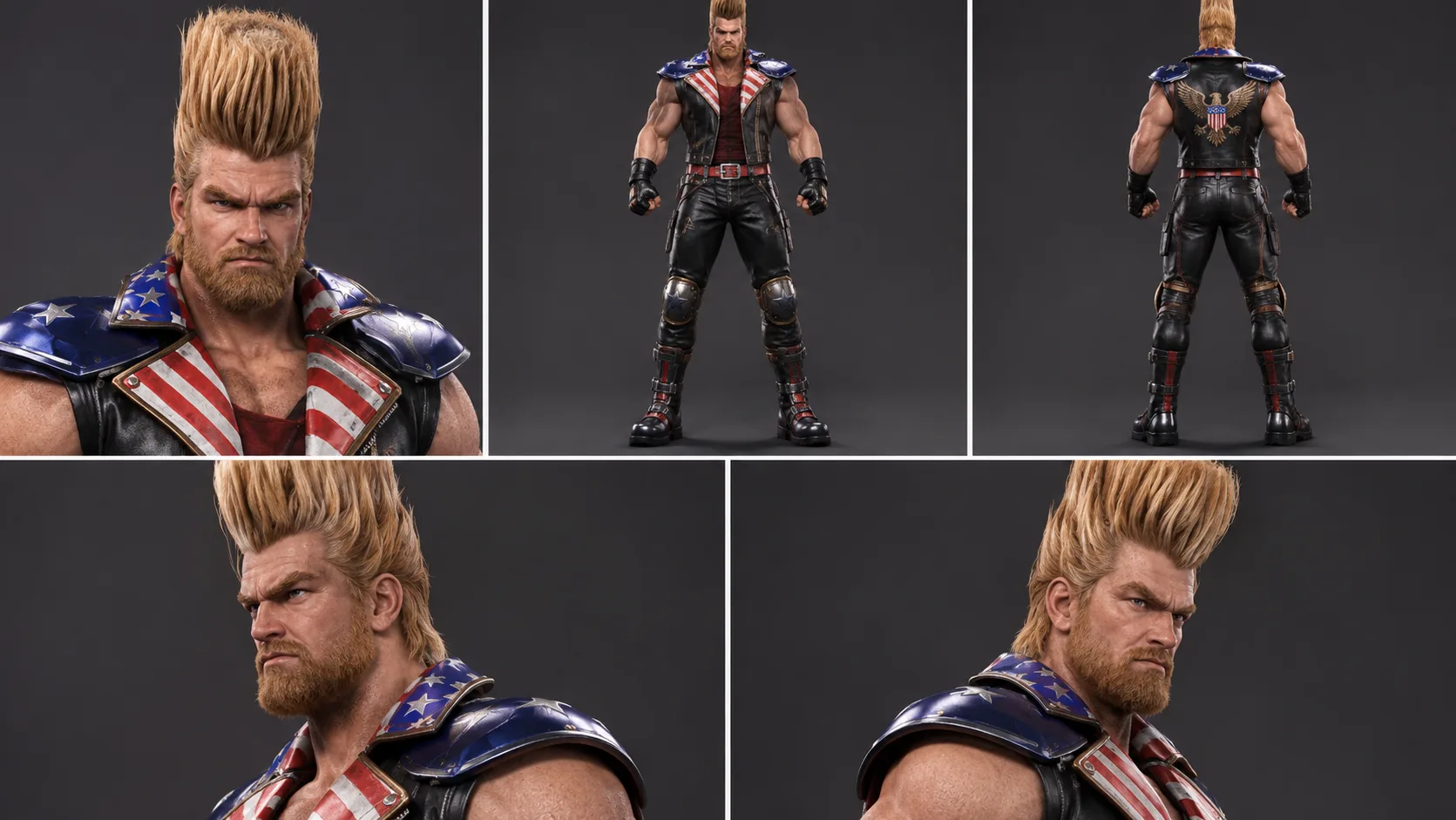
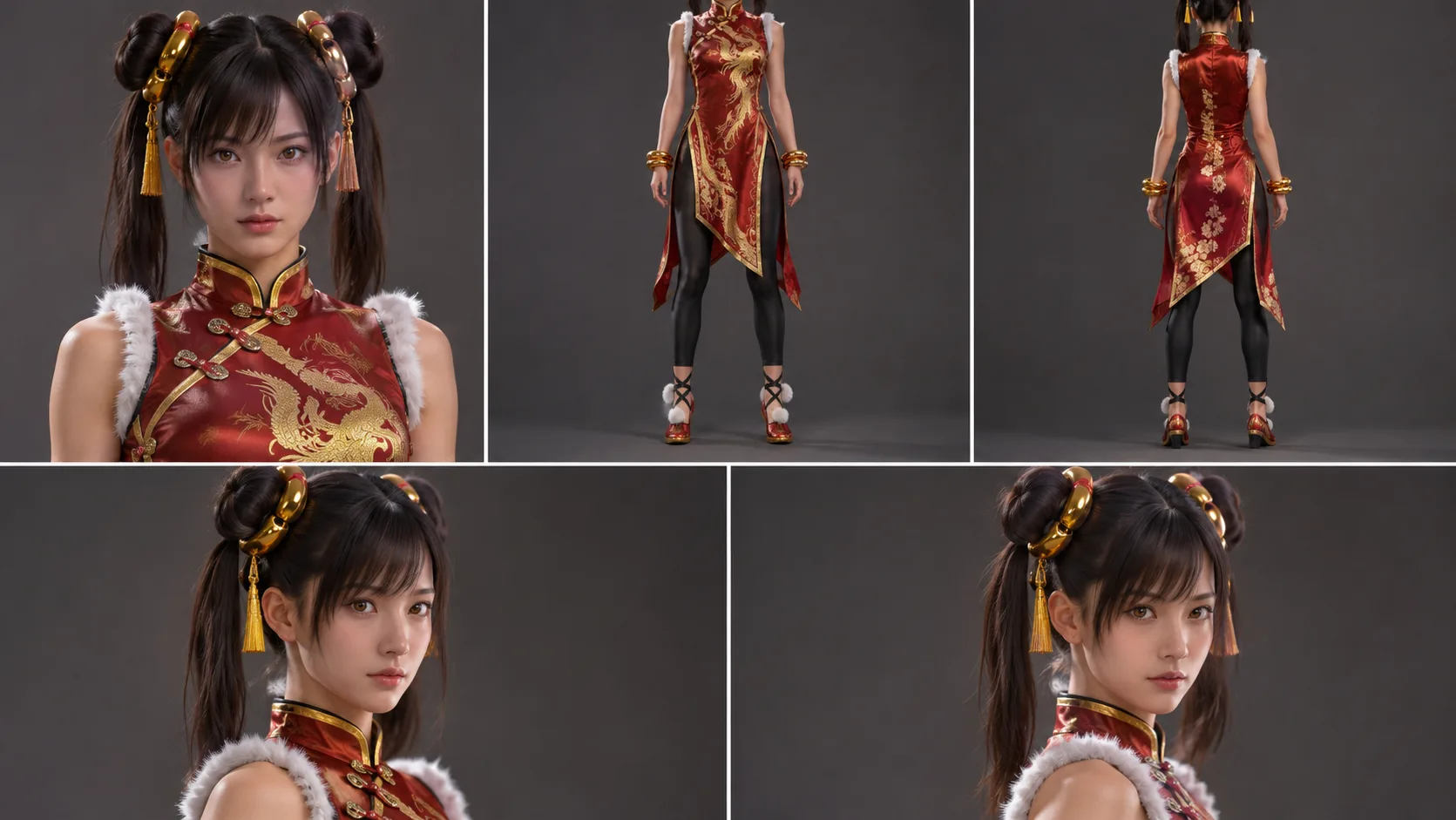
The breakdown's template has five panels. Here is what each one shows and why it matters:
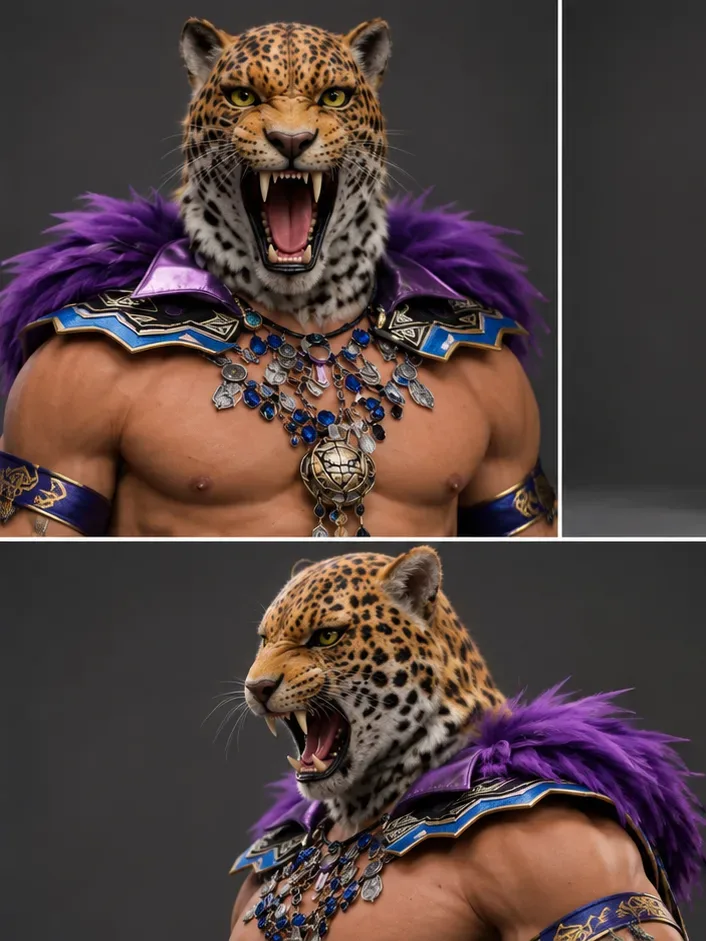
- Front portrait close-up. Head and shoulders, facing camera, neutral or in-character expression. Locks the face, eyes, hair and skin detail.
- Front full body, no head. Neck to feet, standing straight, arms slightly away from the body. Locks the whole outfit, shoes, gloves and proportions without fighting the face panel.
- Back full body. Full body from behind, same stance. Locks hair shape from behind and costume backs: prints, sashes, logos.
- Left 3/4 portrait. Head and shoulders turned to the left, roughly one-third view. Shows the model the face turned to the side, for turns and shots at an angle.
- Right 3/4 portrait. The same, turned to the right. Covers the other side: scars, hair parting, asymmetric details.
Use the same plain charcoal-grey backdrop and soft, even light on every sheet.
Ask NOLGIA Agent for a five-panel sheet of your character, or write it yourself in the image composer. The breakdown's pick for sheets is Seedream 5.5, and this is its base prompt. Fill in the bracketed parts for each character and keep everything else the same, so every sheet in the project matches.
Character reference sheet, photorealistic, 5 panels on a plain charcoal-grey studio backdrop, soft even studio lighting, sharp detail, no text, no logos.

Top row (3 panels):
1) front portrait close-up, head and shoulders, facing camera
2) front full body from the neck down (head cropped out), standing straight, arms slightly away from the body, feet visible
3) back full body, same stance, head and hair visible from behind
Bottom row (2 panels):
4) left three-quarter portrait, head and shoulders
5) right three-quarter portrait, head and shoulders

Character: [age, build, skin tone, face shape, expression]
Hair: [colour, length, style]
Outfit: [top, bottoms, footwear, gloves, accessories, colours, patterns]
Identical character, outfit and lighting in every panel.
- Describe the costume in concrete terms: materials, colours, where the pattern sits. Vague outfits drift between shots.
- Keep the background plain grey. A busy background can leak into the video.
- Regenerate until all five panels show the same person. One off-model panel causes flicker later.
- Check hands, gloves and footwear. These are what viewers notice in action shots.
- Name each sheet after its character, so you can find it quickly when you build a shot.
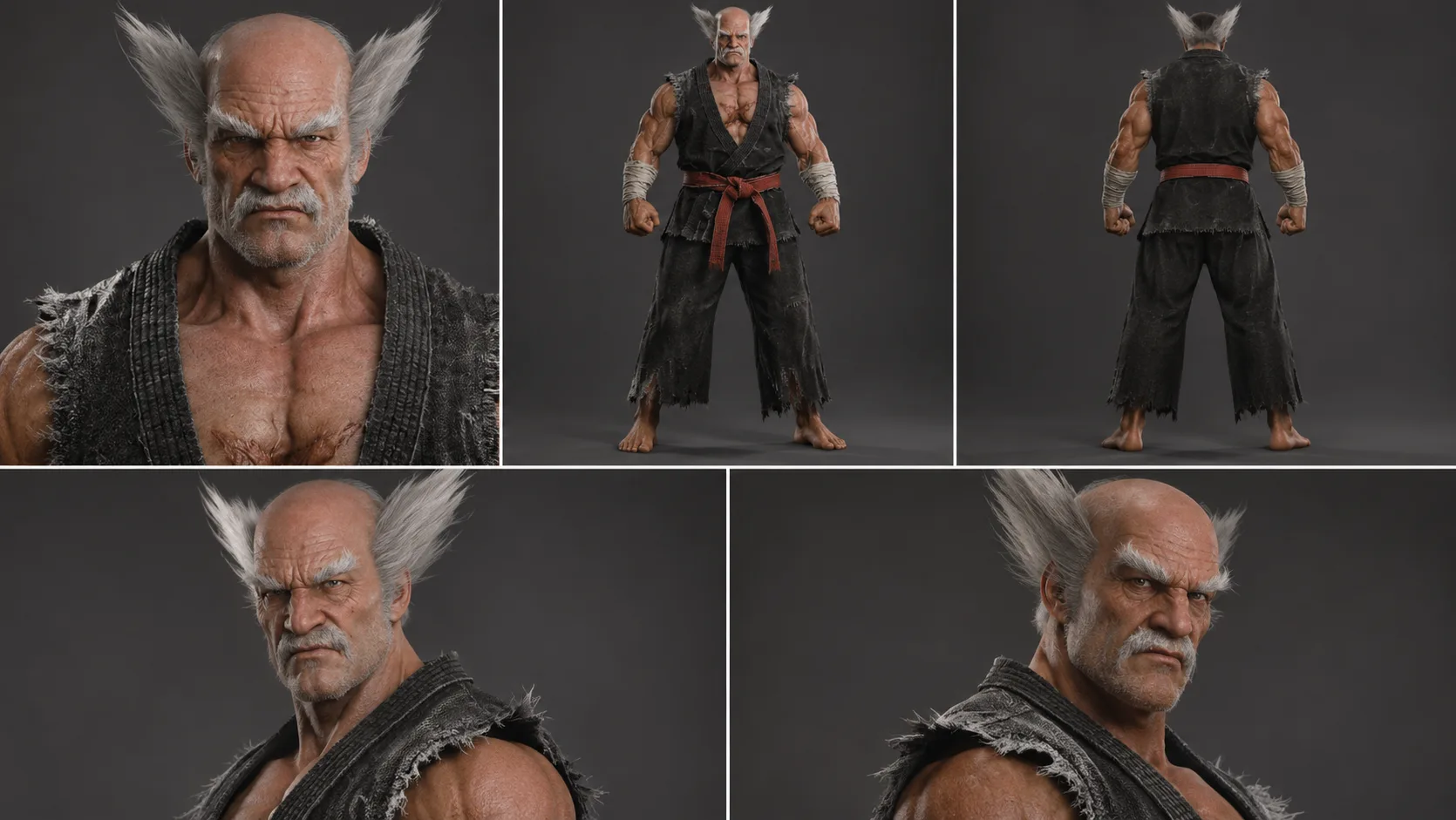
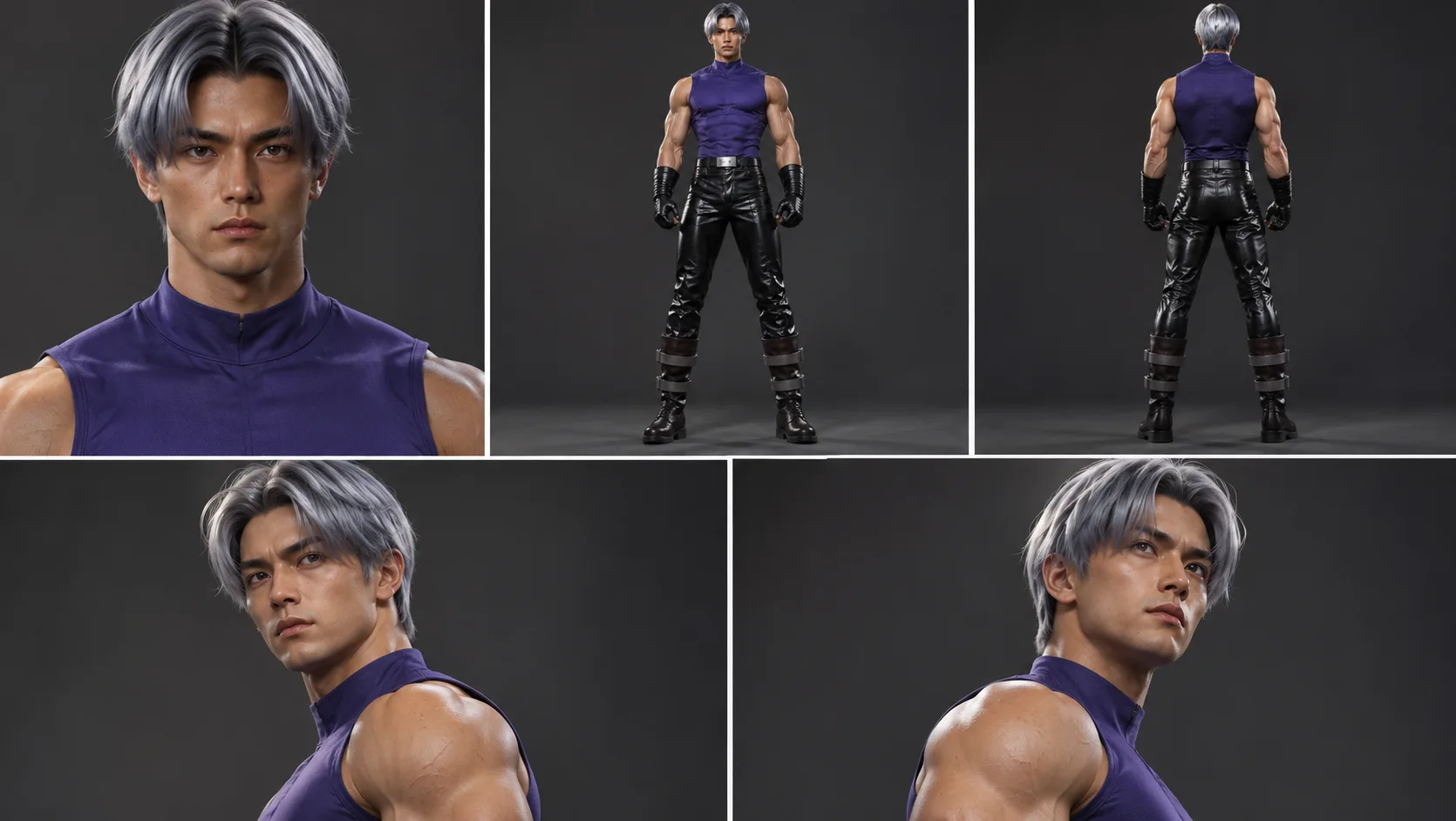
The sheets in this reel were uploaded to the project as finished images. To show the breakdown's pick at work, here is a five-panel sheet that Seedream 5.5 did make on the same account, for the silver-haired fighter, from a reference picture of the character. It came back at 2496 by 1664.
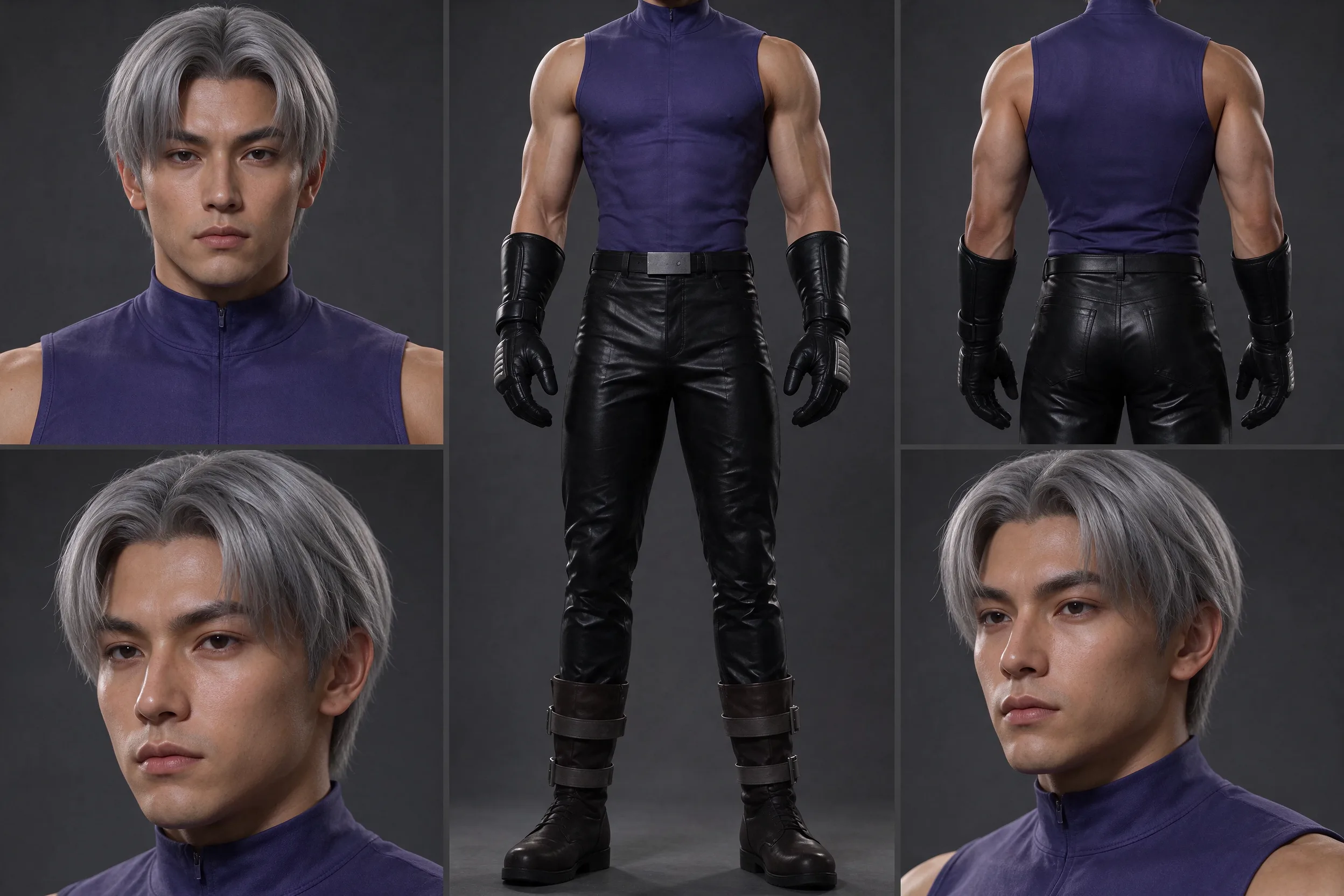
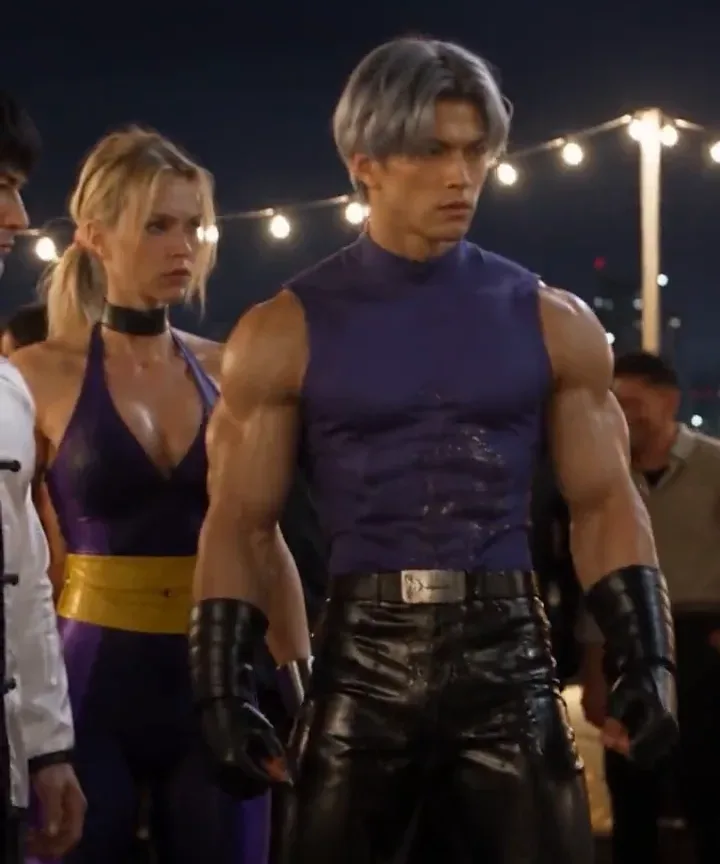
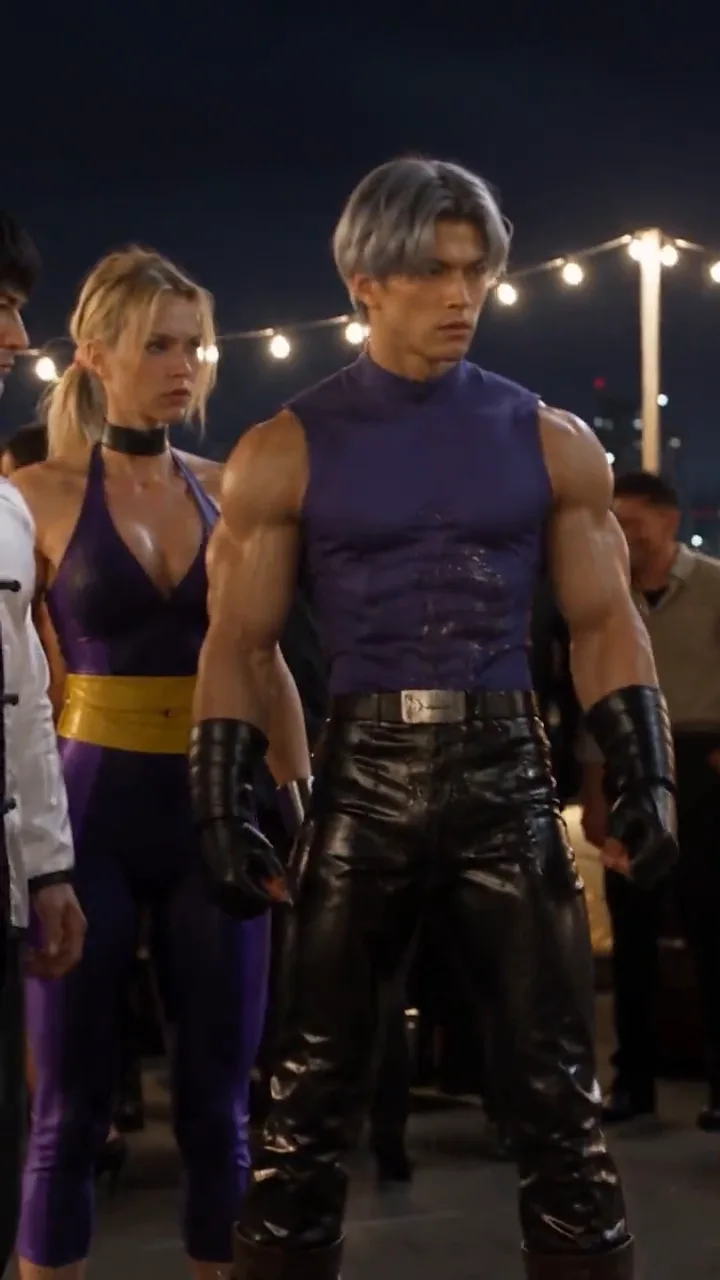
Create an extremely photorealistic five-panel production character design sheet of the exact man in the reference. He must look like a real adult human actor photographed in a studio, not CGI, not a game render, not illustration. Preserve the exact silver-gray layered medium-length hair, youthful angular face, intense dark eyes, muscular athletic physique and costume: fitted sleeveless deep-purple high-neck shirt, black leather trousers, black glossy padded fighting gloves/forearm guards, wide black belt and tall black boots with multiple dark straps and buckles. Real natural human skin with visible pores, fine texture, subtle blemishes, slight facial asymmetry, lifelike eyes, realistic hair strands, believable muscle anatomy, natural joints and proportions. Realistic leather grain, stitching, creases, worn edges and fabric texture. Uniform dark charcoal gray studio background (#3a3a3c), subtle thin panel dividers, consistent soft cinematic studio lighting, no labels or text. EXACT five-panel layout: top-left straight-on medium close-up portrait from chest up; top-middle full-body front view with head completely cropped out at the neck, showing full outfit to boots; top-right full-body rear view with head cropped out at the neck, showing back of shirt, leather pants, arm guards and strapped boots; bottom-left face close-up at one-third angle from the left; bottom-right face close-up at one-third angle from the right. Same exact person, face, hair, build and outfit in all five panels. Neutral standing pose in full-body views, arms relaxed, no raised fists, no props, no weapons, no eyewear, no extra people, no extra panels, no text, no watermark. Photographic realism, natural skin response to light, physically accurate materials, no plastic or waxy appearance.
Tip:Name every garment. That prompt doesn't say "his usual outfit". It lists a fitted sleeveless deep-purple high-neck shirt, black leather trousers, padded fighting gloves, a wide black belt and tall boots with straps and buckles. The more of the costume you put into words, the less of it the model has to guess.
Save each character
A saved character is a name, a description and its reference images kept together, so a shot can call the whole character by name.
In plain words: save the sheet once, and you stop uploading it for every shot.
Open Characters and press New character. Fill in Name and Description, add the sheet under Add reference images, then press Create character. This is the description saved with the wrestler:
Photorealistic live-action jaguar-masked professional wrestler, muscular human body, realistic spotted jaguar head with feline muzzle and whiskers, purple feathered shoulder mantle, ornate blue-and-gold wrestling gear, gemstone-and-metal chest ornaments, matching arm accessories and boots. Keep the feline head and costume consistent; no accompanying woman.
When a saved character is in a shot, NOLGIA attaches its sheet and adds a line to the end of your prompt that names it, in this form: Cast: @Image1 is [name]: [description]. So the description rides on every shot that character is in. Write it once and write it well.
Tip:Put the rules in the description. The wrestler's description ends with what to keep and what to leave out: "Keep the feline head and costume consistent; no accompanying woman." If your takes keep adding something you don't want, say so in the description and every shot carries the rule.
A character page can also make the sheet for you: Generate character sheet, then Turnaround under Sheet layout, gives five panels with the front, the body, the back and both sides of the face.
Write the script as 4 second moments
For this kind of reel the script is a shot list, not a story: one line per moment, saying who is in it, where it is, what they're doing and how the camera moves.
Put simply, decide the gags before you generate anything.
These are the ten shots in the reel, in the order of the cut. Each line ends with the length of the take and how much of it the cut keeps:
- Rooftop party at night, string lights. A guest spills a drink on the silver-haired fighter, and the fighter in the white jacket punches the guest into a stack of chairs. Take: 5 s. Kept: about 3.5 s.
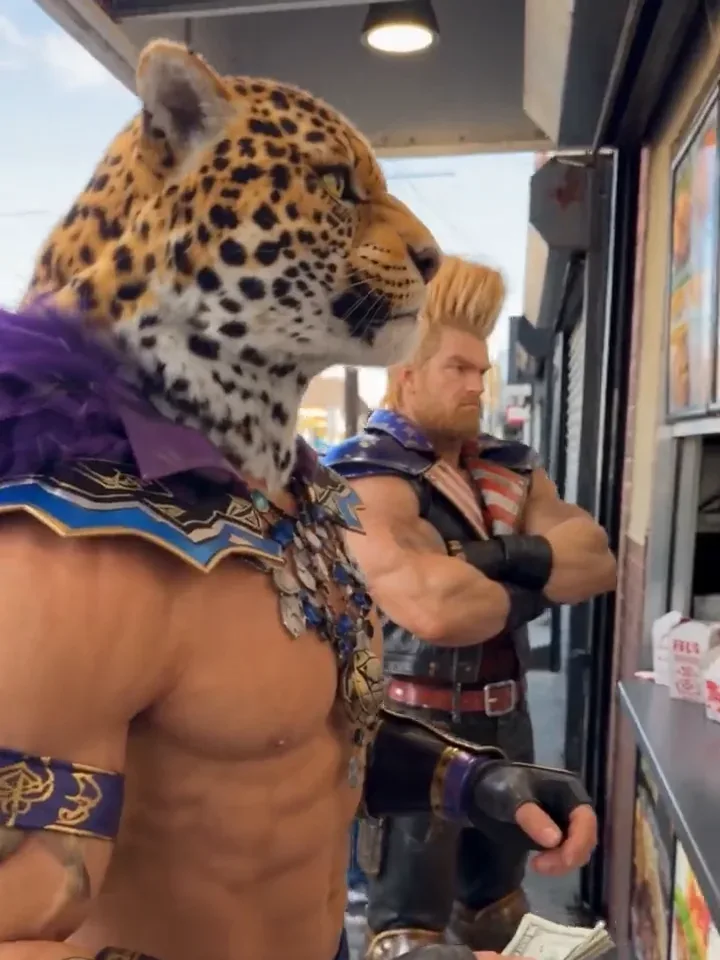
- Food truck window, daylight. The wrestler pays at the window with the blond fighter waiting behind. A man cuts into the line, and the wrestler grabs the man by the collar. Take: 4 s. Kept: about 2.8 s.
- Laundromat, daylight and fluorescent tubes. The fighter in purple stretches while a man crouched behind sneaks a photo, and the man ends up on the floor. Take: 4 s. Kept: about 3 s.
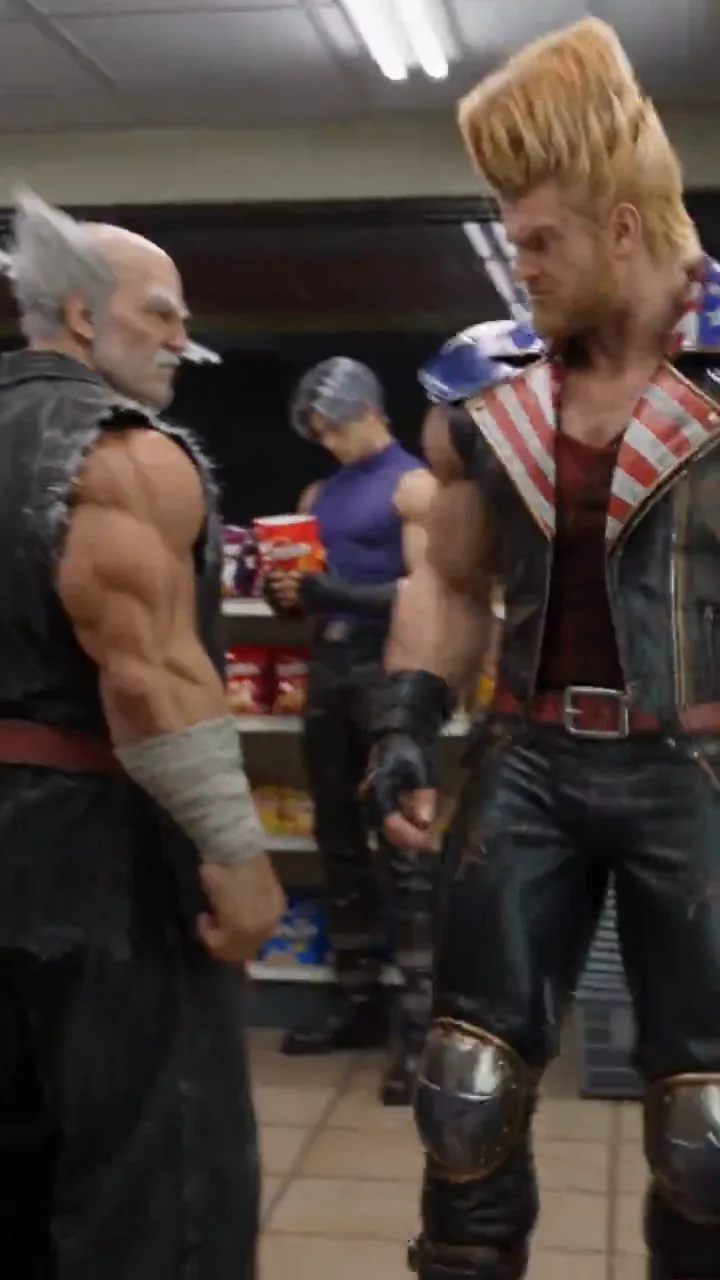
- Convenience store, late night, fluorescent tubes. The old master kicks the blond fighter into the shopping baskets. Take: 4 s. Kept: about 1.8 s.
- Under an overpass, daylight. A dancer in yellow and green drops into a floor spin inside a ring of people filming. Take: 4 s with sound. Kept: about 1.3 s.
- Pub, warm bulbs. The old master downs a huge beer in one go. Take: 4 s with sound. Kept: about 2.7 s.
- Concrete alley, daylight. The wrestler runs up the wall and kicks a man into a stack of cardboard. Take: 4 s with sound. Kept: about 2.2 s.
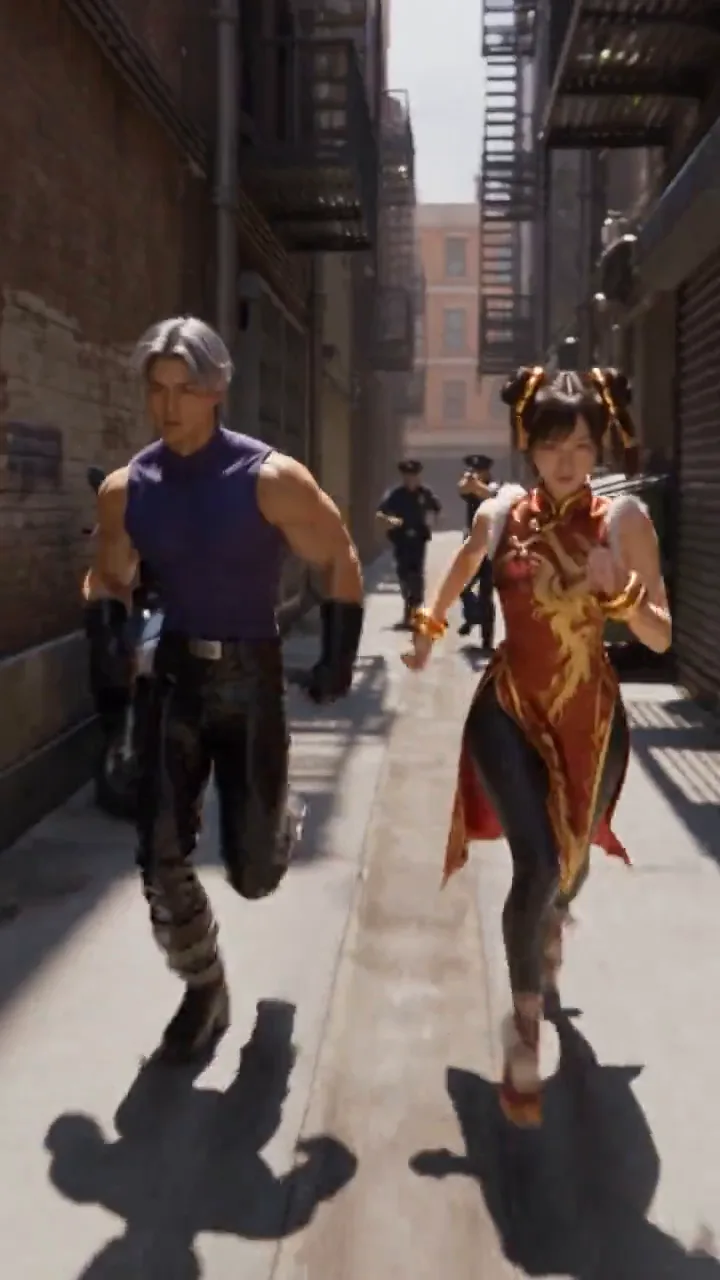
- Brick alley, hard sun. The silver-haired fighter and the fighter in the red dress sprint toward the camera. Take: 4 s. Kept: about 2.3 s.
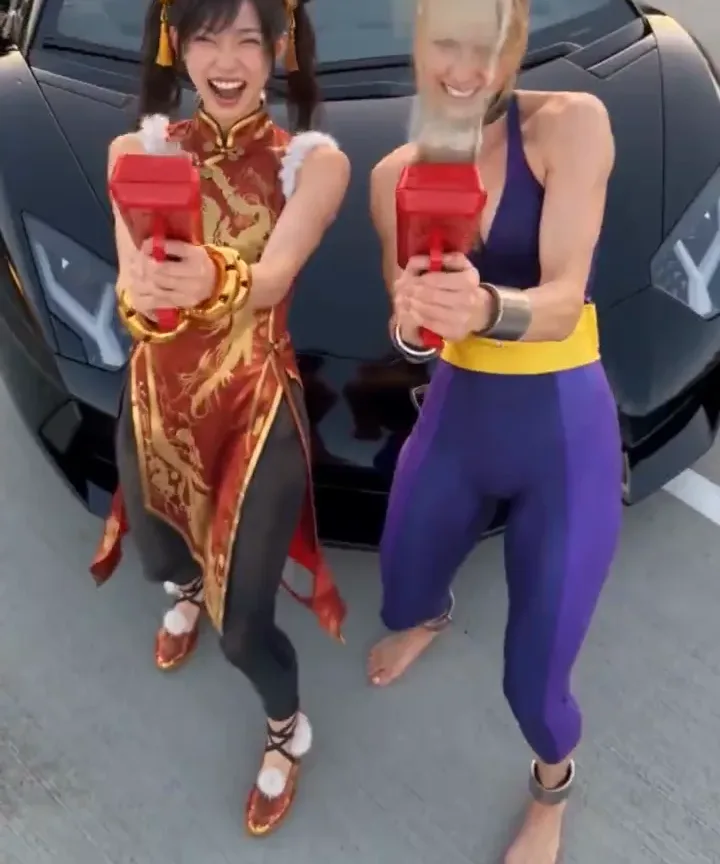
- Parking lot, daylight. Two fighters fire money guns in front of a black supercar. Take: 4 s with sound. Kept: about 1.2 s.
- Highway, open sun. The supercar passes the camera with three of the cast in it. Take: 4 s with sound. Kept: about 4 s.
All of this is read from the account that made the reel. Every take is Seedance 2.5 at 720 by 1280.
The breakdown's rules for a script like this:
- Plan for 6 to 10 shots for a 20 to 30 second reel. Short, punchy moments beat long ones.
- Mix shot sizes: a group wide, a close-up, a reaction, a running shot. Variety keeps viewers watching.
- Open with your strongest image. The first 1 to 2 seconds decide whether people keep scrolling.
- Limit each clip to 1 or 2 main characters. More characters in one 4 second shot means more chance of drift.
- Reuse locations for two shots in a row to make the edit feel connected.
Watch for this:Three characters in a shot costs takes. This reel breaks the breakdown's own rule four times: the rooftop, the laundromat, the store and the highway each carry three saved characters. The laundromat needed seven takes before one was kept.
Generate each shot as its own clip
Each line of the script becomes one Seedance 2.5 generation: one prompt, the sheets of the characters in that shot, 4 seconds, 9:16. Four seconds is short enough to stay consistent and long enough for one clear action.
In plain words: one shot at a time, and only the people who are in it.
With NOLGIA Agent: open NOLGIA Agent, say which saved characters are in the shot and paste the shot's prompt. Ask for a 4 second Seedance 2.5 clip at 9:16.
In the video composer: open the video composer and pick Seedance 2.5. Press Characters and choose who is in the shot. A sheet you haven't saved as a character goes under Reference images, with Upload or Library. Then set:
- Aspect ratio: 9:16. Every take in this reel is 720 by 1280, vertical from the first frame.
- Clip duration: 4 seconds. Nine of the ten takes are 4 seconds and the rooftop is 5.
- Quality: 720p.
- Audio: on for the natural sound of the place, with no music. The music goes in during the edit. Five of the ten takes were made with sound.
Now the prompt. The breakdown's rules for writing it:
- Name which reference is which character, for example "@Image1 is the jaguar-masked wrestler". For saved characters NOLGIA adds that line for you.
- Describe the location and its real light source.
- Describe how every character moves during the 4 seconds. Nobody stands frozen.
- Describe the camera: third-person handheld, slight stumble, real-time.
- Stick to what the script says. Don't pile on extra action the shot doesn't need.
[@Image1] is [character name]. [@Image2] is [character name].
Location: [place], [time of day], lit by [real light source].
Action (4 seconds, real time): [character] [does what], [other character] [reacts how]. Background people [what they do].
Camera: third-person handheld at [eye/chest] height, subtle natural shake and small stumble, slight drift, real-time speed, no slow motion.
Look: photoreal phone footage, light sensor noise and grain, natural colour.
Keep faces and outfits exactly as in the references. No music, no subtitles.
The camera and look that make it read as phone footage, also from the breakdown:
- Third-person handheld. The camera is held by someone standing nearby, at roughly eye or chest height.
- Subtle stumble. Small natural shake, a little drift and re-framing, as if the operator is walking or reacting.
- Real-time motion. Normal speed. No slow motion, no speed ramps.
- Light noise and grain. Like a phone or small camera, not a polished cinema lens.
- Realistic lighting for the place. Direct sunlight outside, fluorescent tubes in a store or laundromat, warm practical bulbs in a bar.
- Ordinary background people who react naturally: filming on phones, staring, ignoring them.
This is the camera paragraph of the laundromat prompt, exactly as it was sent to Seedance 2.5. You can reuse it as it is:
One continuous real-time handheld consumer-camcorder take, vertical 9:16. Imperfect aggressive natural shake, reactive reframing, slight autofocus hunting, subtle exposure breathing, realistic motion blur and analog softness/compression. Real-time speed only, no slow motion or speed ramps. Natural restrained color, real daylight shadows and believable reflections. No gimbal, no Steadicam, no drone, no polished commercial camera movement.
Worked example: the food truck shot
Here is one shot from prompt to cut. The breakdown writes the food truck shot like this, with the wrestler's sheet as @Image1 and the blond fighter's as @Image2:
@Image1 is the jaguar-masked wrestler (purple fur collar, blue and gold gear).
@Image2 is the blond man with the tall flat-top and stars-and-stripes vest.
Location: city street beside a food truck, late afternoon, direct sunlight.
Action (4 seconds, real time): @Image1 leans into the service window and hands over folded cash, head turning slightly as he checks the menu. @Image2 waits behind him with arms crossed, shifting his weight. A few customers queue.
Camera: third-person handheld over @Image1's shoulder at chest height, natural shake, small step forward, real-time speed.
Look: photoreal phone footage, light grain, natural daylight colour.
Keep faces and outfits exactly as in the references. No music, no subtitles.
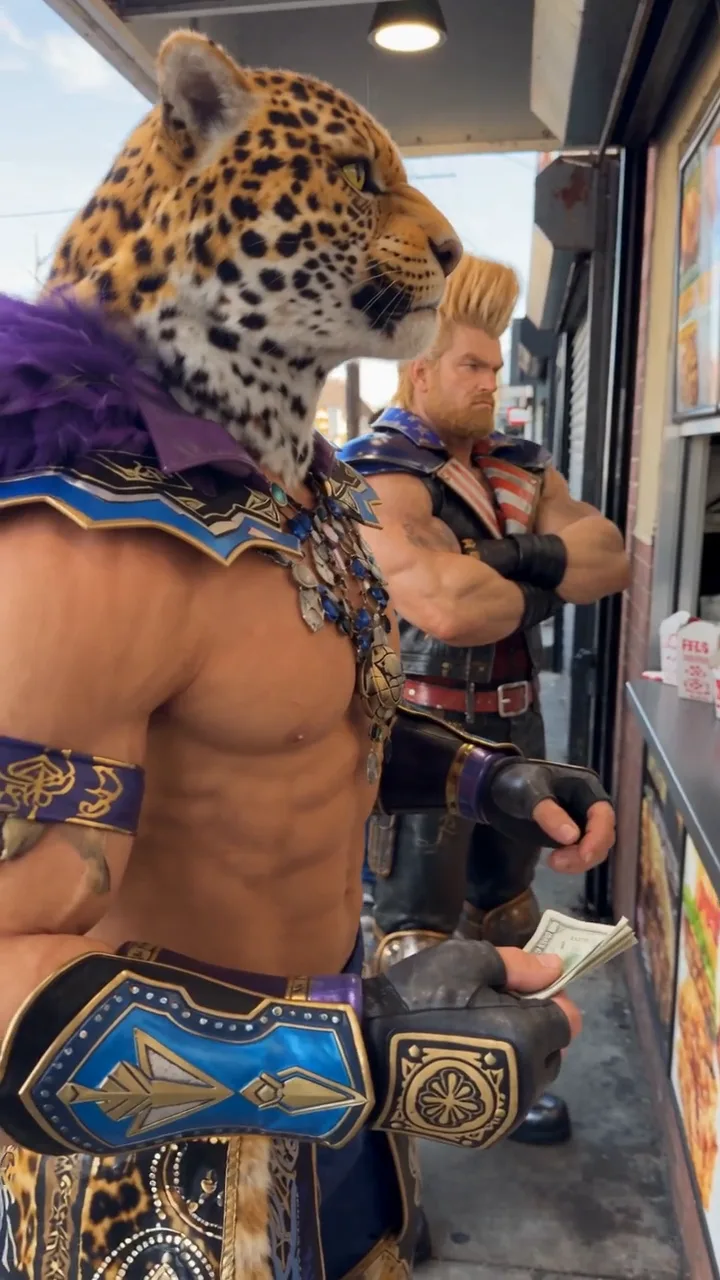
Tip:What to notice. The mask, the mantle and the gear match the sheet from the first frame, and the camera stands in the line like a phone held by the next customer. The cut keeps the first 2.8 seconds, from the payment to the grab, and leaves the rest of the throw out.
The prompt that was sent for this take is longer than the breakdown's version. Both fighters were saved characters, so NOLGIA named them. It scripts the whole beat: a rude customer cuts in, and the wrestler grabs him by the collar and drops him onto the pavement. In its words: "One clean collar-grab-and-drop action, no punches, no prolonged beating". Then it sets the camera and the look. Those two parts, exactly as they were sent to Seedance 2.5:
The camera is close, shoulder-height, operated by a person standing in the queue; imperfect reactive handheld shake, abrupt reframing, slight autofocus breathing, natural motion blur and exposure shifts, no stabilization.
Photographed real human beings, authentic skin pores and fine lines, natural eyes and facial asymmetry, individual hair strands, realistic fabric folds and real-world materials. Looks like actual footage captured by a consumer handheld camera, not a movie set or game. Absolutely photoreal live action: no CGI, no 3D render, no video-game graphics, no animation, no synthetic/plastic skin, no cartoon proportions, no stylized game look. No text, subtitles, logos, watermarks, music or graphic overlays.
Three more takes as they came back, before any trimming:
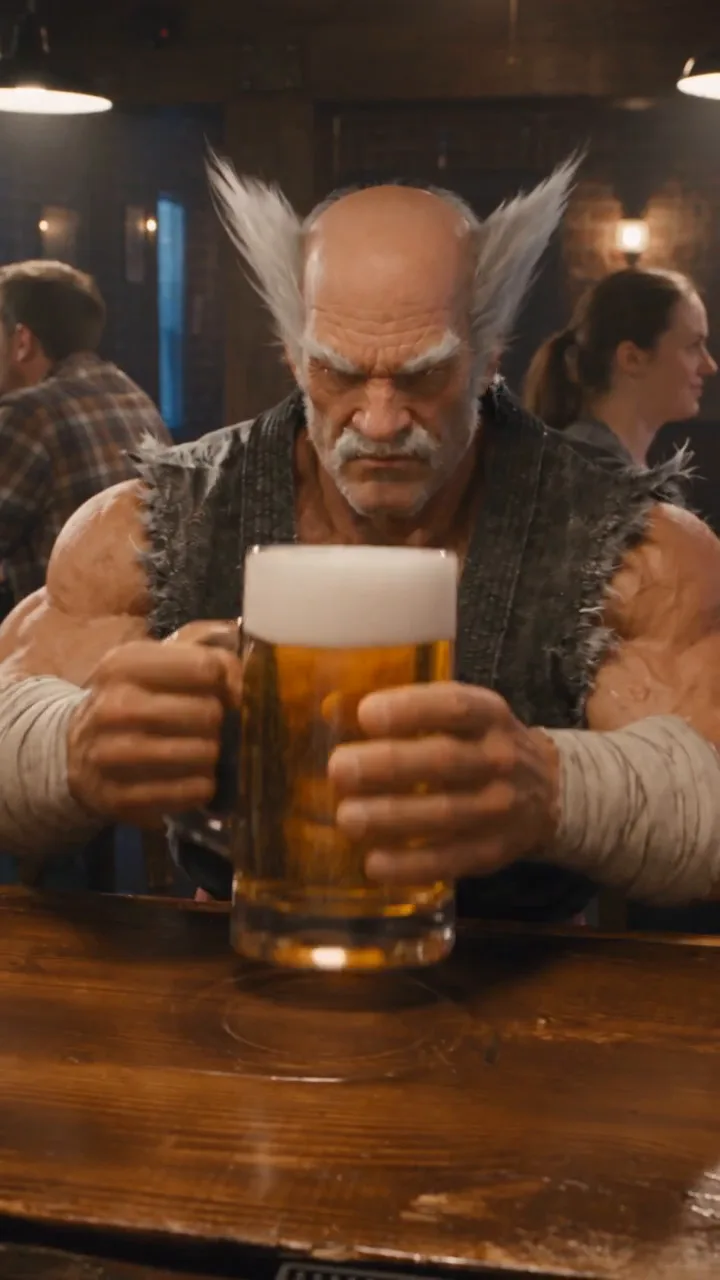
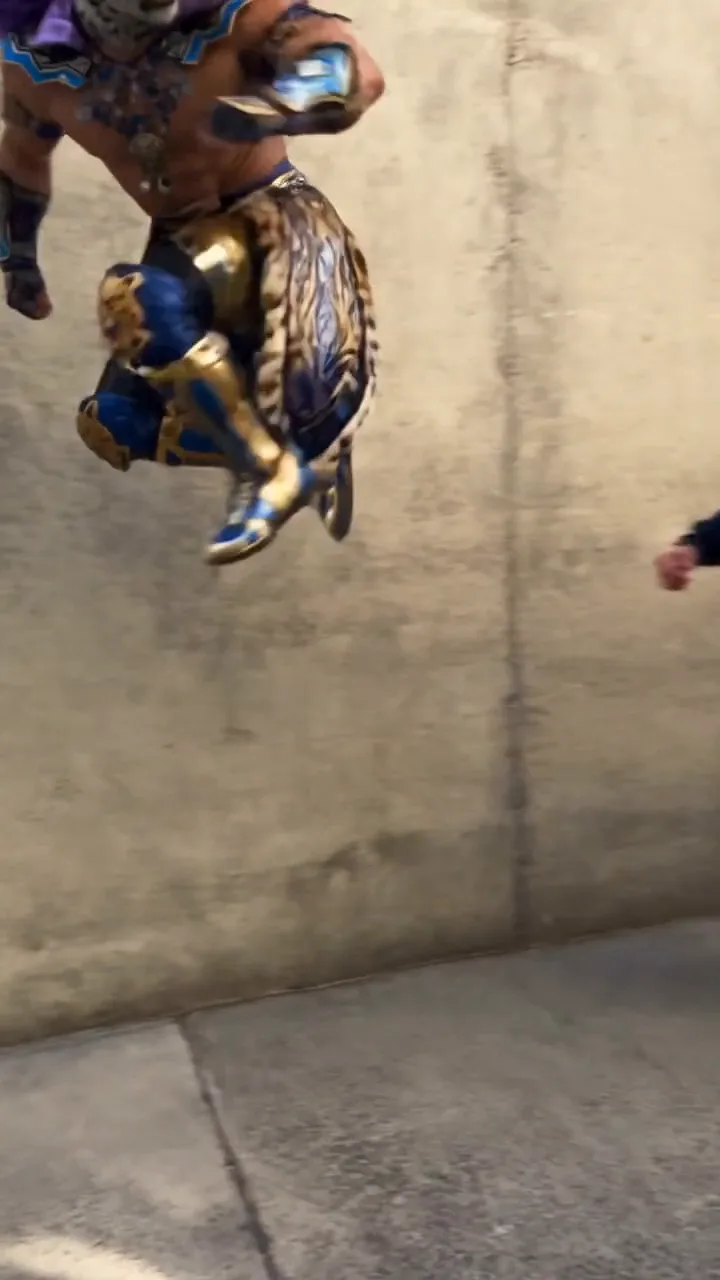
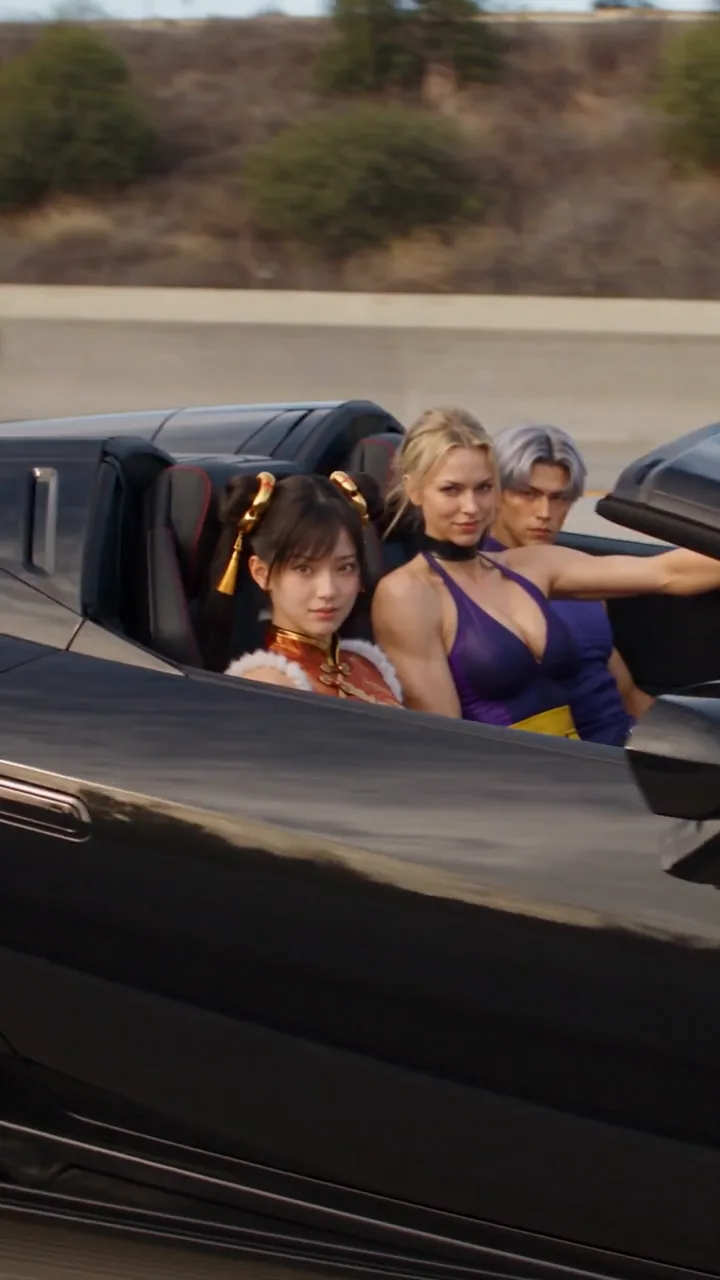
The dancer's shot was built the other way: two reference images added by hand and named in the prompt as @Image1 and @Image2, with no saved character. Both routes work. Saved characters are less typing when the same fighter is in several shots.
Check every take, and make the weak ones again
Every take is new: the same prompt never gives the same clip twice. So judge each one on its own before you move on. The breakdown's checks:
- Faces and costumes match the sheets: hair shape, colours, accessories.
- Motion is real-time and the camera feels handheld, not floaty or slow.
- Light matches the location, with no studio-grey look carried over from the sheet.
- Hands, feet and objects (cash, glasses, snacks) look physically right.
- If one thing is off, regenerate that clip only. Keep the clips that already work.
The account shows 25 finished Seedance 2.5 takes from the session that made this reel, and ten are in the cut. The laundromat took seven. In takes three to six the fighter in purple stands still for the first second or two, which reads as a frozen frame.
The seventh prompt gave the opening its own paragraph. It writes the stretch move by move: both arms overhead, fingers interlocked, a lean from side to side, one arm down to fix the ponytail. Then it adds: "Do not show her standing motionless at any point in the opening." It also gives both background characters a job from the first frame: "They must be visibly performing these tasks from the beginning, with natural small movements; neither stands idle."
Tip:When someone stands frozen, write what they're doing. Give every character in the frame an action for the whole 4 seconds, in order, and say that it starts at the first frame. That is what the laundromat's seventh prompt added, and the seventh take is the one in the reel.
Cut the reel
The edit puts the takes in script order, trims each to its strongest moment, joins them with hard cuts and lays one music track under all of it.
In plain words: in order, short, and never lingering.
With NOLGIA Agent: you don't have to drag every clip by hand. Ask NOLGIA Agent to build the edit, and it lays the clips out on a Studio timeline in script order. The breakdown's message:
Put all the clips from this project on the timeline in script order (rooftop, food truck, laundromat, store, bar, alley, highway).
Vertical 9:16, about 25 seconds total. Trim each clip to its strongest moment, use hard cuts, and add an upbeat track underneath.
By hand: open Timeline and press New timeline. In the Media column, open Library and add the shots in order with their + buttons. Trim each clip, add your music, then press Export video.
What the breakdown says you can adjust afterwards:
- Order and pacing: trim clips, swap shots, tighten the cuts so the reel never lingers.
- Sound: add a music track, keep or lower the ambient audio, add hits or whooshes on cuts.
- Colour: a light shared grade so outdoor and indoor shots feel like one video.
- Text: add titles or captions if you want, placed where they won't cover the action.
- Longer versions: generate more 4 second clips and ask the agent to append them to the timeline.
Tip:Trim harder than feels right. Look at the shot list again. The reel keeps 1.2 seconds of the money guns and 1.3 of the dancer, and only the last shot plays in full. Ten takes add up to 41 seconds; the cut is 24.9.
One note on this reel: its own cut was finished outside NOLGIA and uploaded to the project as one file, 1080 by 1920 at 30 frames a second. Every shot in it is one of the ten Seedance 2.5 takes above.
Check it before you post
The breakdown's checklist:
- One character sheet per character, all with the same five-panel template and grey backdrop.
- The script written as a list of 4 second moments: who, where, action, camera.
- Every shot uses a third-person handheld camera, a subtle stumble, real-time speed and light grain.
- Lighting written for each location: sunlight, fluorescent, warm bulbs.
- Clips generated in Seedance 2.5 at 4 seconds and 9:16, with the character sheets as references.
- NOLGIA Agent assembles the clips on the timeline; you trim, add music and export.
Watch for this:Mind character rights before monetizing. From the breakdown: if your characters are close copies of existing game or film characters, or resemble a real person, platforms may restrict monetization or the owners may file claims. Original designs built on the same template avoid this.
That's the method: a sheet per character, a script of short moments, one take per shot, then a hard trim. NOLGIA keeps the cast the same from shot to shot, so your time goes into the gags.
What it costs
Seedance 2.5 made every shot in the reel. It's priced by quality and length, and the composer shows the price of a take before you run it. A reel like this is ten kept takes plus the ones you make again. Live rates for Seedance 2.5, and for Seedream 5.5 if you make your sheets with it:
Seedance 2.5Pro and up
Per 5s clip
480p 31 credits · 720p 66 credits · 1080p 160 credits · 4K 202 credits
1080p renders at 16:9 and 9:16
4K renders at 16:9 and 9:16
Seedream 5.5Every plan
Per image
1K 1 credit · 1.5K 1 credit · 2K 2 credits
Read live from the catalog when this page loads. Every price is shown before you generate. See every rate.
Questions and answers
- Do I need a paid plan?
- Seedance 2.5, which made every shot, needs a Pro plan or above. Seedream 5.5, the breakdown's pick for the sheets, runs on Starter and above.
- How long should each shot be?
- Seedance 2.5 makes 4 to 30 seconds in one take. This reel uses 4 second takes, and one of 5, because a short clip with one clear action stays consistent and is quick to make again.
- How many characters can one shot carry?
- Up to four saved characters in one shot. The breakdown's advice is 1 or 2 main characters per clip; this reel runs three in four of its shots, and one of those took seven takes.
- Were the sheets made on NOLGIA?
- The sheets in the reel were uploaded to the project as finished images, so this guide doesn't name the model that made them. The Seedream 5.5 sheet in the sheets step was made on NOLGIA, on the same account. All ten shots were made on NOLGIA with Seedance 2.5.
- Was the reel cut on NOLGIA?
- No. Its cut was finished outside NOLGIA and uploaded as one file. The cut step shows how to make the same edit with NOLGIA Agent or by hand in Studio.
- Can I monetize a reel like this?
- Check first. The breakdown's advice: if your characters are close copies of existing game or film characters, or resemble a real person, platforms may restrict monetization or the owners may file claims. Original designs built on the same template avoid this.
Make your own character reel
Open NOLGIA AgentRelated guides
Filmmaking
Keep characters and locations consistent across shots
A character sheet laid out to hold, a saved location and one sentence per prop: what held across five shots of one film, and two checks for every sheet.
· 17 min read
Prompting
Seedance 2.5: how to prompt it, with a library that was run
How to write for Seedance 2.5 on NOLGIA: text to video, a still as the start frame, a take as @Video1 with its sound, the six aspect ratios, 4 to 30 seconds, and what it refuses.
· 10 min read
Filmmaking
Make a 30 second cinematic vertical scene on NOLGIA
Make a 30 second cinematic 9:16 scene on NOLGIA: cast sheets, a four-view location pack, a prop, a timed brief, one Seedance 2.5 take, then the fixes.
· 15 min read