Script to storyboard and shot list, with the NOLGIA Agent
A storyboard is the cheapest place to be wrong. NOLGIA does not have a storyboard product; it has an agent that can read a script, write the shot list and make a frame for each row with an image model. This guide shows one script through that path, with the transcript and the six frames exactly as they came back.
- 10 min read
This guide follows one 63 word script, The Locksmith, from text to a six row shot list and six frames. Everything below is the real output of one agent session on the company's own account: the request we sent, the table the agent wrote back, and the frames it made with Nano Banana 2. The people in it are fictional.
Say plainly what is a tool and what is a workflow. The video composer, the image composer and Studio are tools. A storyboard on NOLGIA is a workflow run by the agent, and this guide is the workflow.
What goes wrong
| Mistake | Why it fails | Fix |
|---|---|---|
| Asking for "a storyboard" with no count | The agent picks a number, usually too many, and the frames stop telling one story | Say how many shots: six for a one-scene script, eight for an action beat |
| Describing a character once | Each frame is its own image request; a character described in the first prompt only drifts by the third | Ask the agent to repeat the same written description of each character in every frame prompt |
| Letting the model add signs and labels | Image models write words on machines, doors and shop fronts, sometimes real brand names | Say "no readable text or signs anywhere", and check every frame at full size |
| Taking the frames without the table | A frame shows what a shot looks like; the shot list says how to make it | Ask for the table first, then the frames, and keep both |
| Reading a frame as the film | A storyboard frame is a plan, not a promise of what the video model will render | Treat the frame as the reference you will animate from, and expect to regenerate |
Before you start
- A script or a scene, 50 to 150 words, with the characters named.
- One line describing each character the way a costume department would: age, hair, glasses, the one garment that identifies them.
- A hosted NOLGIA Agent, which comes with Studio plans. Open Agent to see yours.
- A number of shots in mind, and the frame shape. We asked for six shots at 16:9.
INT. LOCKSMITH KIOSK, NIGHT. Rain. A tiny kiosk lit by one green neon tube. MARA, sixties, cuts keys with steady hands. A YOUNG MAN in a soaked suit slides a photograph of a key across the counter. No key, just the photo. She studies it. She cuts one from memory. He tries it in the kiosk's own door. It opens. She was expecting him.
Send the script and the request to the agent
Open Agent and start a new chat. The message does four jobs: it asks for the shot list as a table with named columns, it fixes the number of frames and the image model, it gives the character descriptions the agent must repeat in every frame prompt, and it forbids text and signs. Then the script goes at the end.
Turn this short script into a storyboard. First write a numbered shot list as a table with these columns: shot, size (wide, medium, close up, insert), camera move, who is in frame, action, seconds. Keep it to six shots. Then generate exactly one storyboard frame per shot, six frames in total, 16:9, on the Nano Banana 2 image model, one image per request. Use the same written description of Mara and of the young man in every frame prompt so the frames read as one story: Mara is a woman in her sixties with cropped grey hair, round steel glasses and a dark green work apron; the young man is in his twenties, in a soaked navy suit with rain on his face. The kiosk is lit by one green neon tube. Photoreal, cinematic, rain, night, no readable text or signs anywhere. Do not make any video. Do not upscale. When the six frames are done, reply with the shot list table and one line per frame saying what it shows.
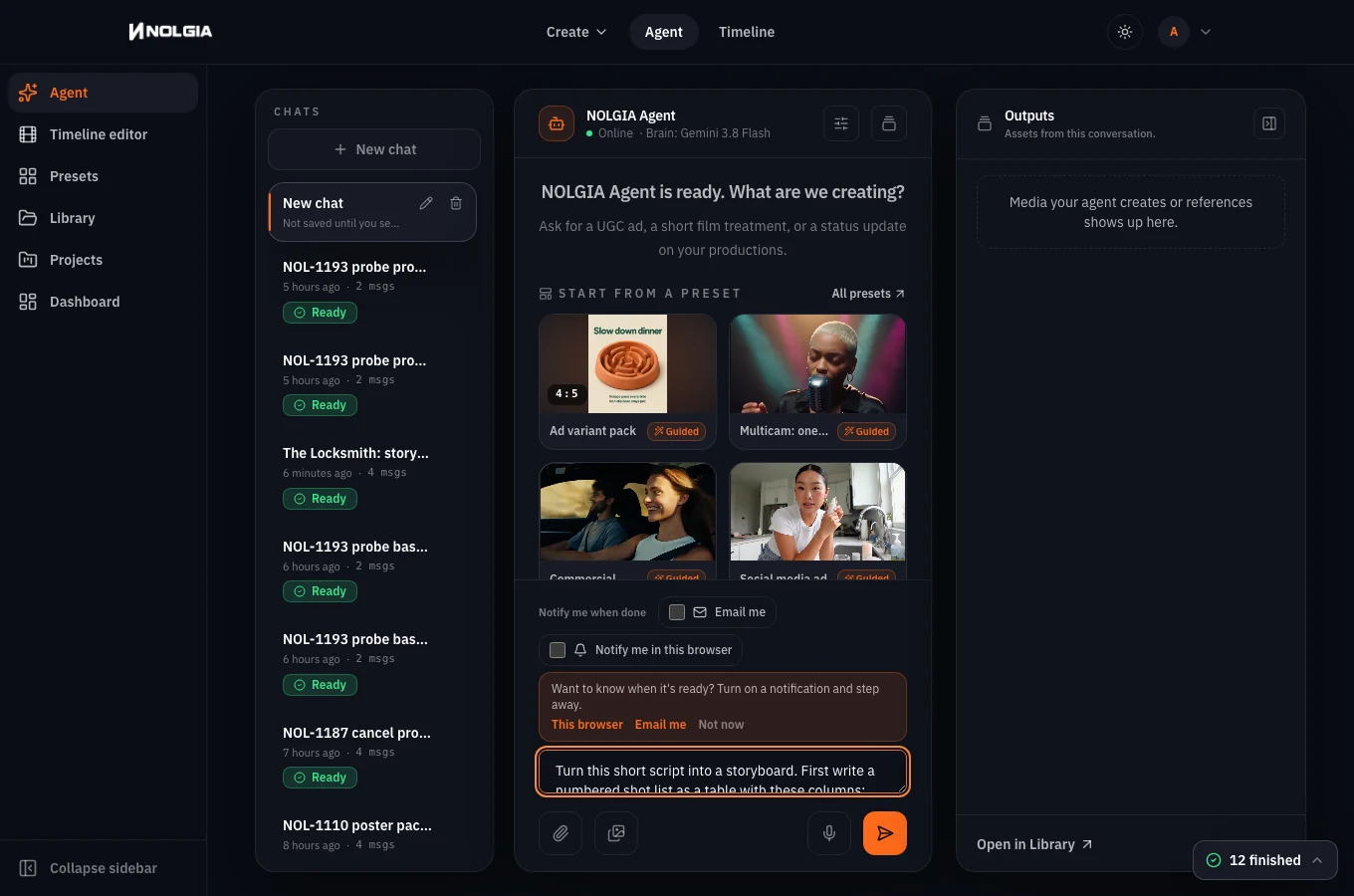
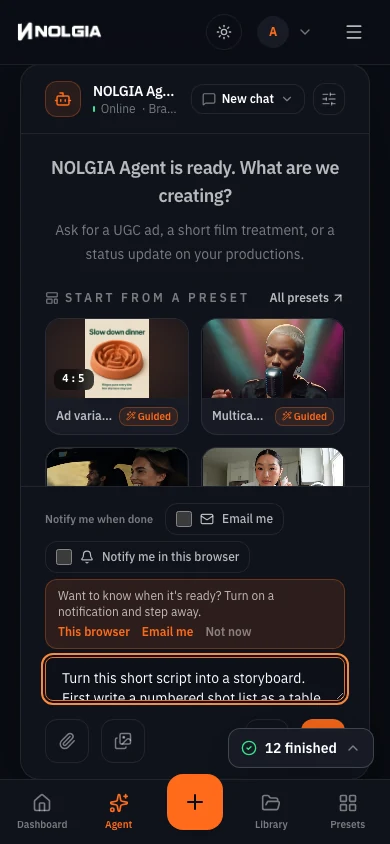
Tip:Say the model and the count, or the agent chooses. Left to itself the agent picks an image model and a number of frames. Naming Nano Banana 2 and six frames is what made the run cheap and made the reply comparable to this page.
Read the shot list it wrote
The reply came back in one turn: the table first, then a line per frame with a link to each image. This is the table exactly as the agent wrote it.
| Shot | Size | Camera move | Who | Action |
|---|---|---|---|---|
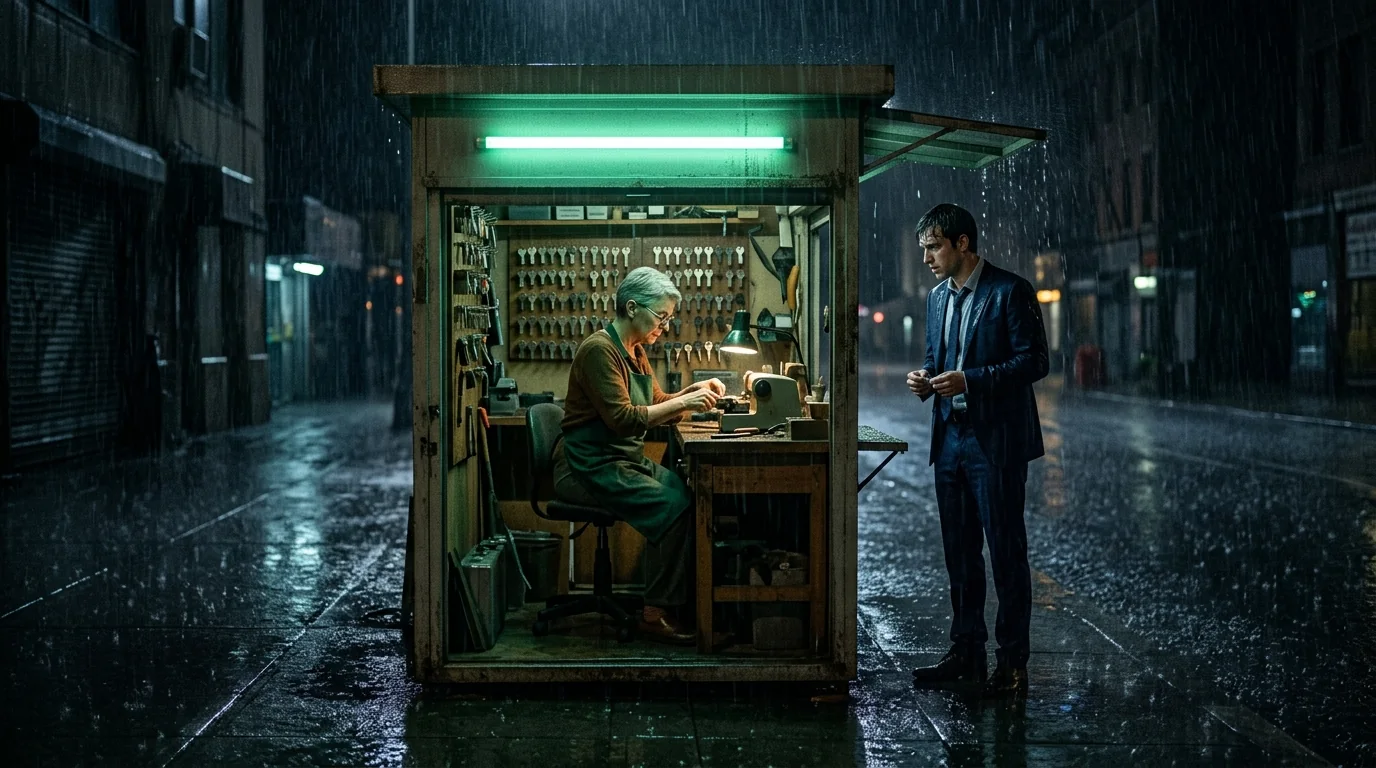
| 1 | Wide | Static | Mara | Mara cuts keys with steady hands at her workbench inside the kiosk in the pouring night rain (4 s) |
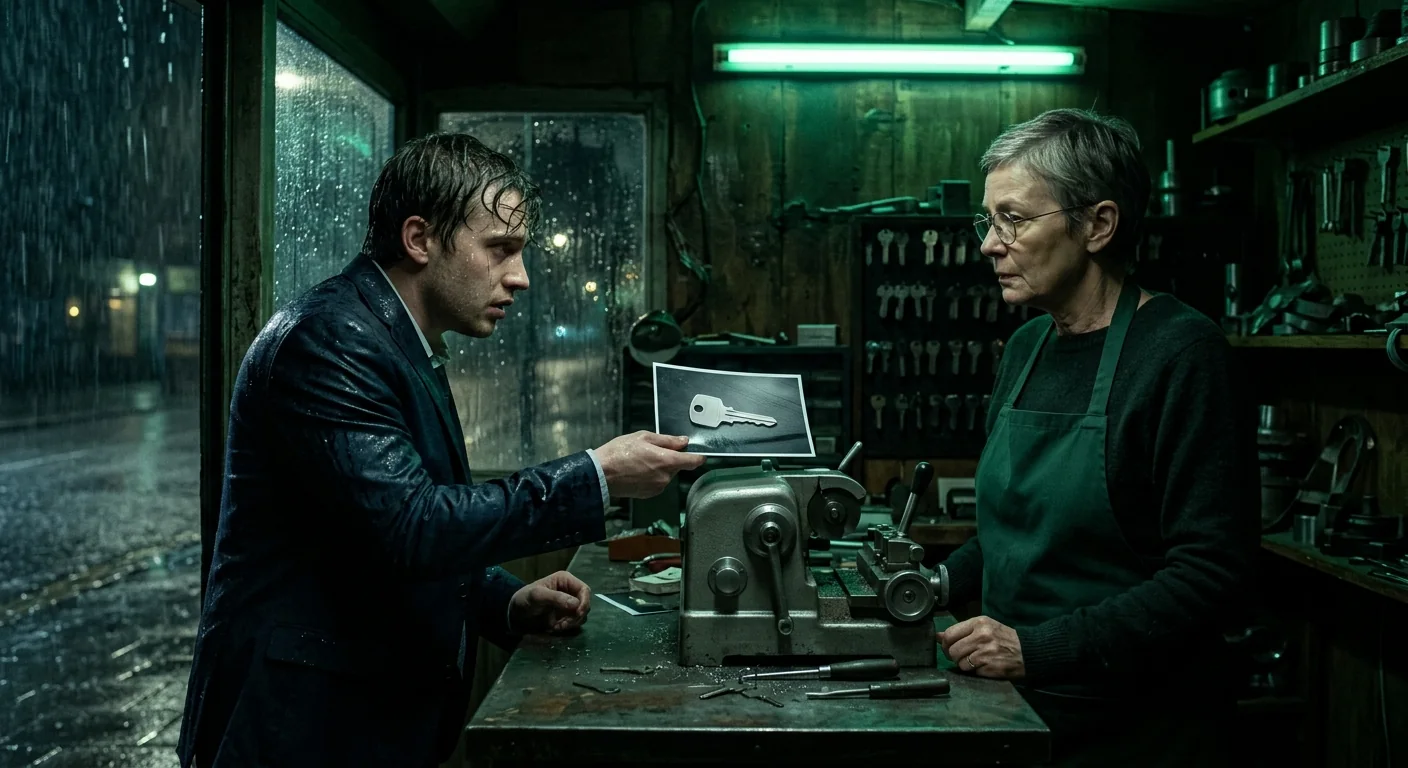
| 2 | Medium | Slow push in | Mara, Young Man | The soaked young man slides the photograph of a key across the counter toward Mara (3 s) |
| 3 | Insert | Static | Hands | A glossy photo of a key rests on the scratched metal counter as rain drips from his fingertips (2 s) |
| 4 | Close up | Slow drift | Mara | Mara studies the photo closely with calm, sharp eyes and cuts a key from memory (4 s) |
| 5 | Medium | Pan follow | Young Man | The young man inserts the freshly cut key into the lock of the kiosk door (3 s) |
| 6 | Medium close up | Static | Mara, Young Man | The door swings open and Mara looks at him with quiet, knowing expectation (4 s) |
Look at every frame at full size
Each frame is one Nano Banana 2 request, and each prompt carried the same two character descriptions. Here are the six, in the agent's order, with what we checked on each.
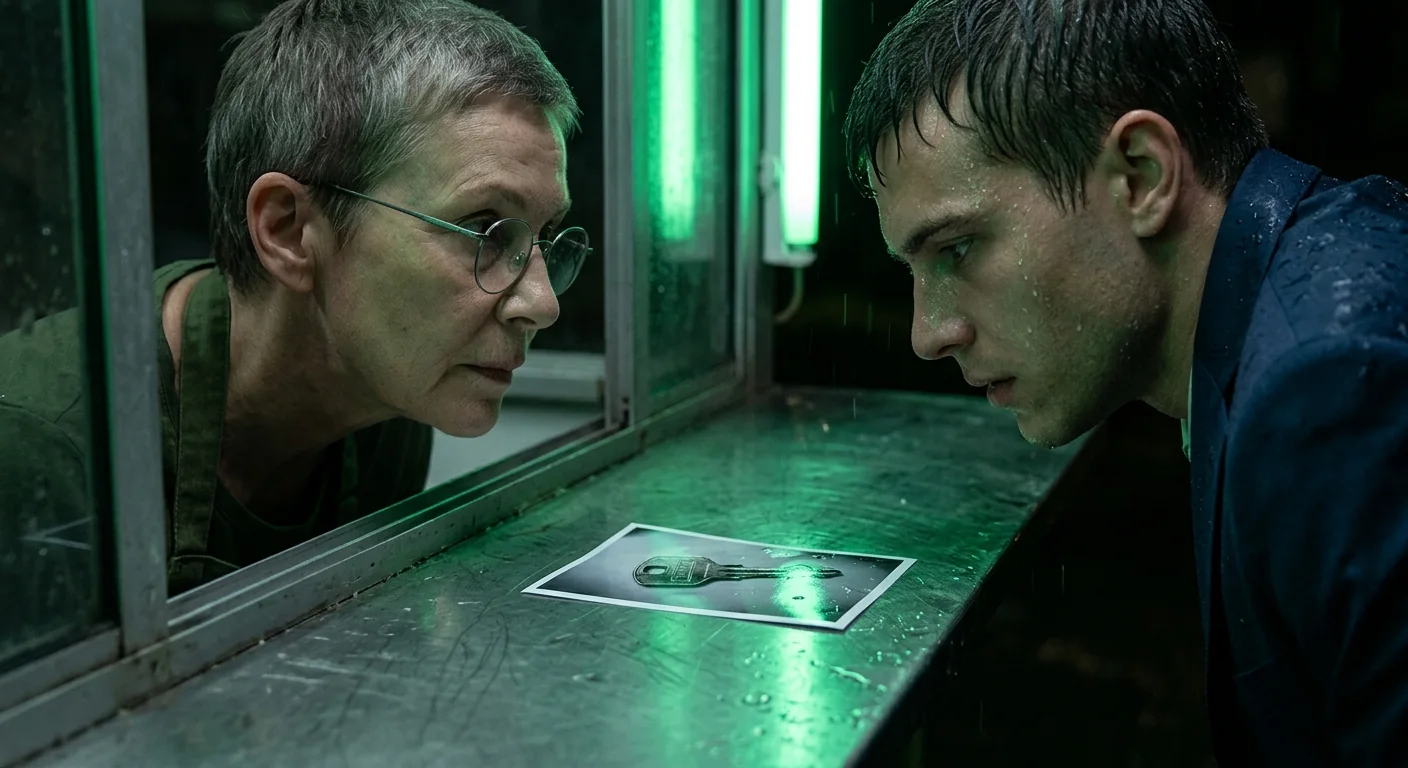
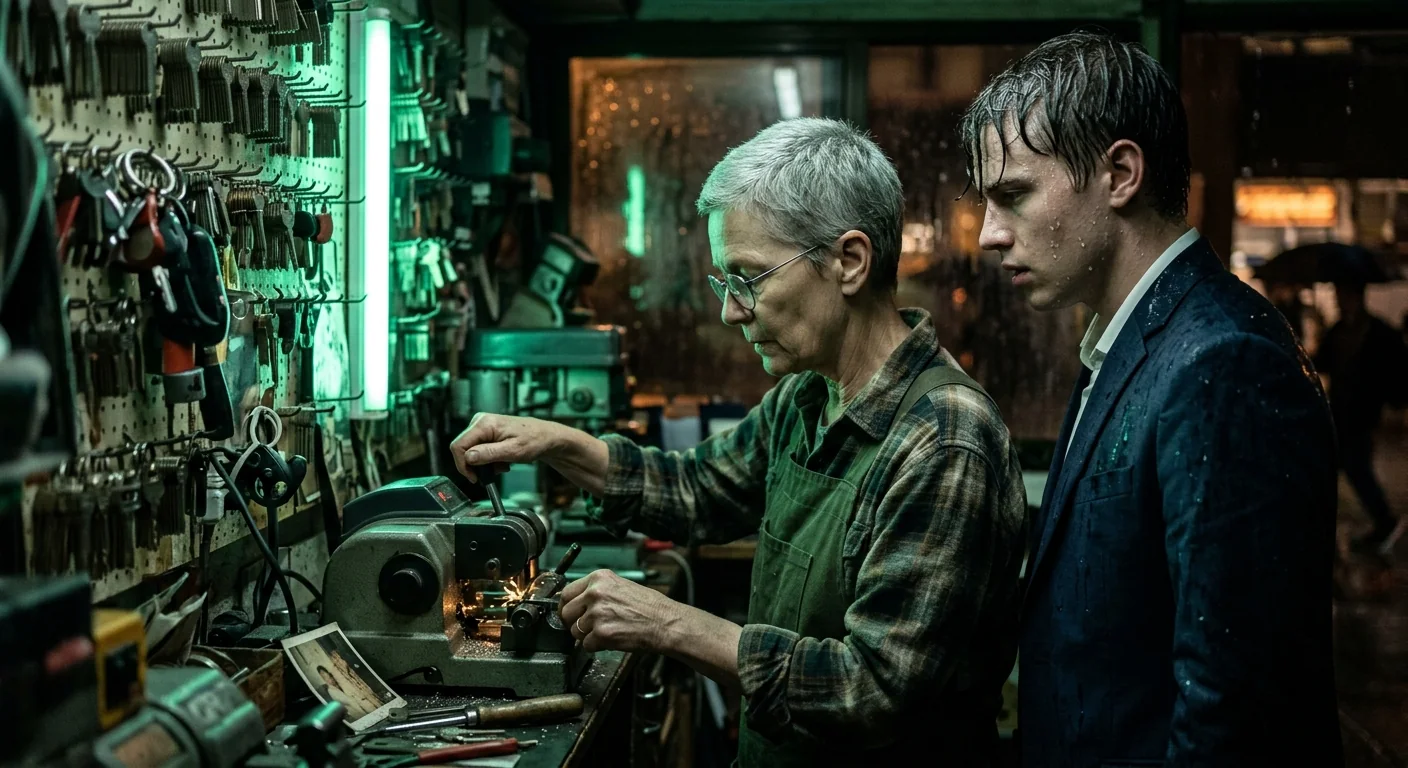
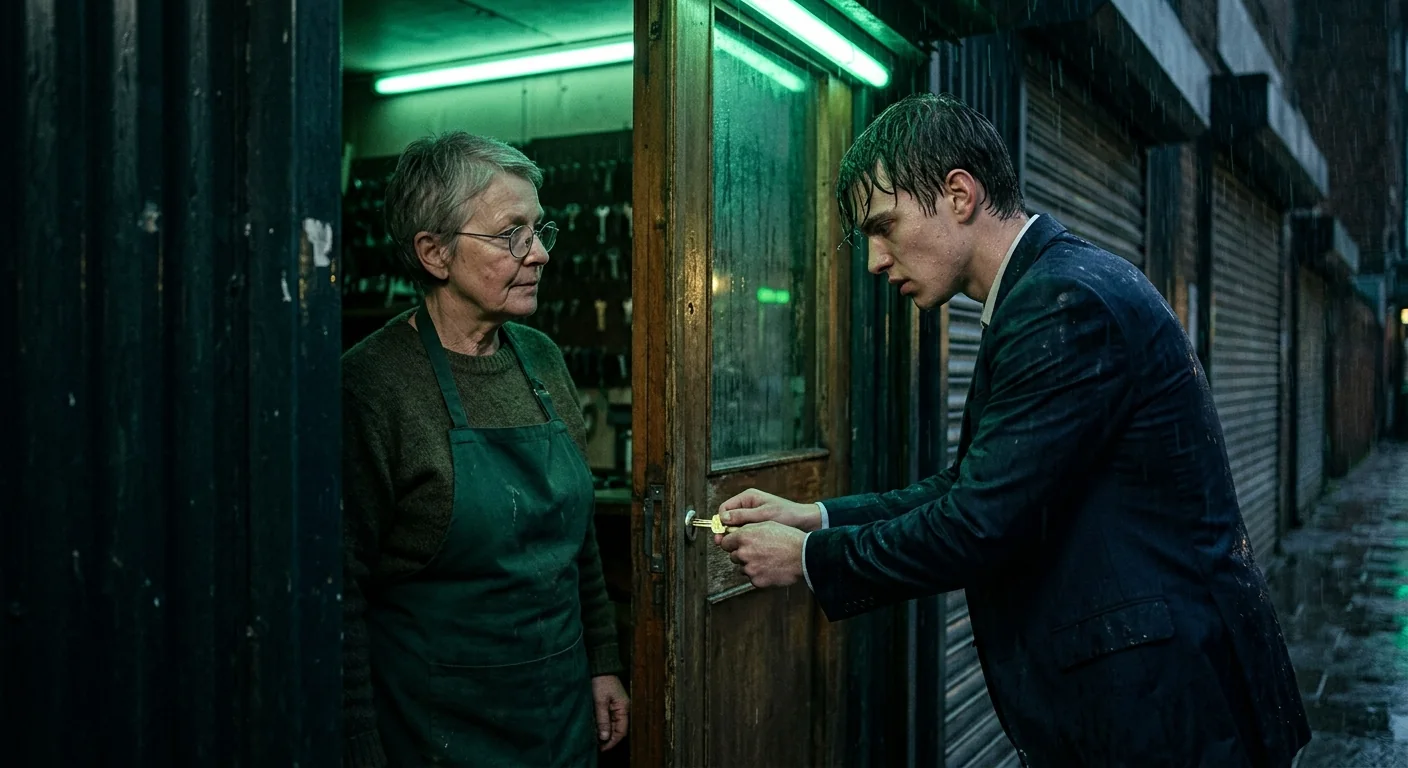
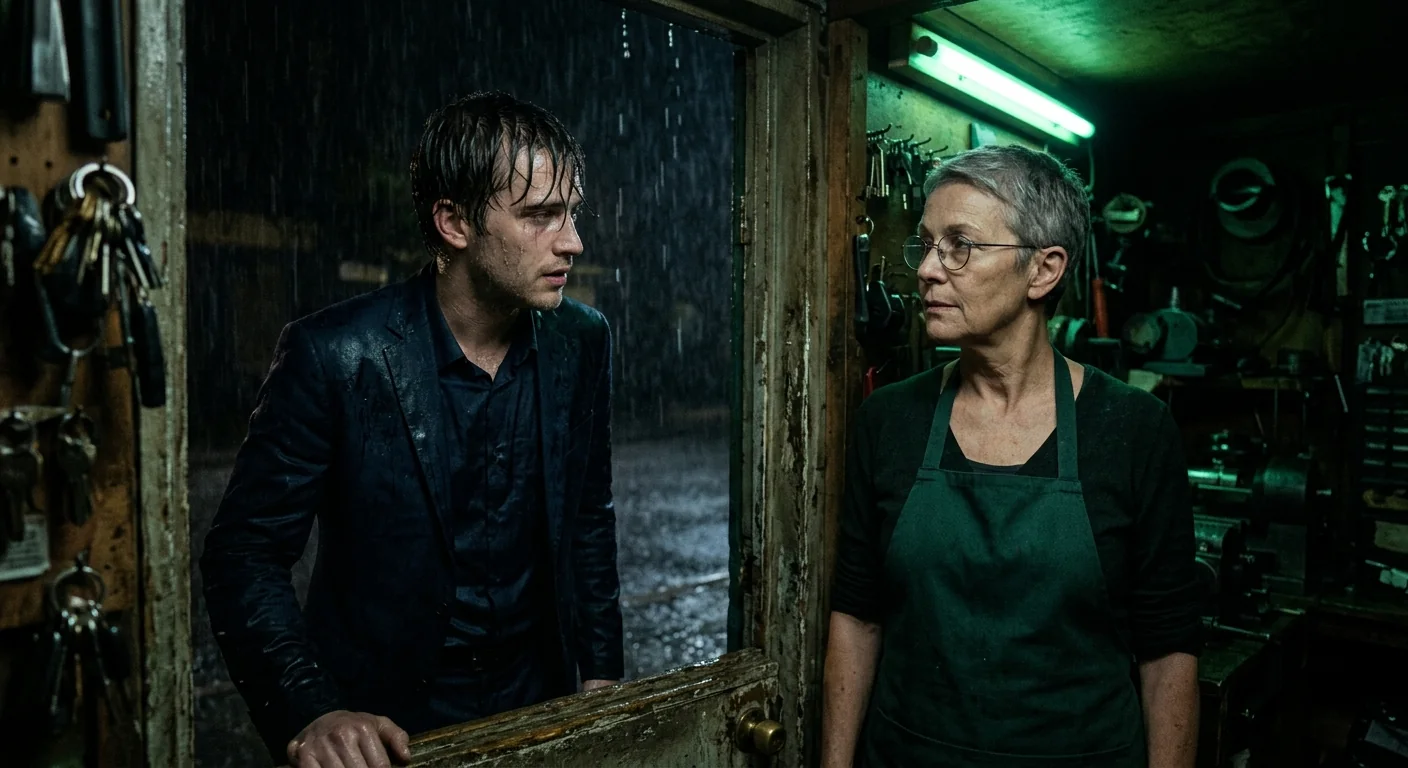
Watch for this:The same words do not make the same face. Repeating a character description keeps the hair, the glasses and the apron in every frame. It does not make the model draw the same person, and we have not measured how close the faces are, so we do not claim it. For a character who has to be one person across shots, save a character and attach it; the consistency guide measures what that holds.
Fix one frame without redoing the board
Frame 2 came back with a real manufacturer's name printed on the key-cutting machine. A frame with a brand on it cannot be published, so we replied in the same chat and asked for that one frame again, unmarked. One turn, one image, and the other five stayed as they were.
Frame 2 (the medium shot of the young man sliding the photograph across the counter) has a readable brand name printed on the key-cutting machine. Please regenerate only Frame 2, one image on Nano Banana 2, 16:9, with the same shot description and the same written descriptions of Mara and the young man, and make sure there is no lettering, logo, label or brand name anywhere in the frame: the machine is plain unmarked metal. Do not regenerate the other frames. Reply with one line saying what the new frame shows.
Which tool for which job
| Job | Where | What it is |
|---|---|---|
| Shot list and one frame per shot from a script | NOLGIA Agent | A workflow: the agent writes and then calls the image model |
| One frame you want to art-direct yourself | Image composer | A tool: your prompt, your model, a character and a location attached |
| A frame that has to show a saved character or place | Characters, Locations, then the image composer | Reference images ride with the prompt |
| Turning a frame into a shot | Video composer, Animate an image | The frame becomes the first frame of the clip |
| Keeping the board next to the cut | Studio's Library column | Frames sit beside the clips they became |
Where you still regenerate
- Words in the picture. One of six frames carried a brand name despite "no readable text". Check every frame at full size before it goes anywhere.
- Beats the model reads literally. The insert of the photograph shows a photograph, which is right; an insert of "his fingertips" might have shown the hand. Say what the lens sees.
- Frames are not sequence-aware. Each frame is its own request. The same description holds the wardrobe and props; it does not hold the face, and we do not claim it does.
- Long turns cost more. An agent turn that makes six images is a long turn; ours was priced at the flat rate plus a usage charge, itemised in the account's usage history.
What it costs
Two things are charged: the agent turn, at the flat rate plus a usage charge on long turns, and each frame at the image model's rate. The live rate for the model we asked for is below. The redo was a second, shorter turn and one more image.
Nano Banana 2Every plan
Per image
Native 4 credits · 2K 17 credits · 4K 54 credits
Nano Banana ProEvery plan
Per image
Native 8 credits · 2K 21 credits · 4K 58 credits
GPT Image 2.5 FlareEvery plan
Per image
Native 8 credits · 2K 21 credits · 4K 58 credits
Read live from the catalog when this page loads. Every price is shown before you generate. See every rate.
Checklist
- Script pasted in full, characters described once in the message, the same words for every frame.
- Number of shots, image model and frame shape named in the message.
- "No readable text or signs anywhere" in the message, and every frame checked at full size anyway.
- The shot list saved as the working document; the frames as its illustration.
- One frame redone in the same chat, not the whole board.
Try it yourself
Start a new chat with the message above and your own script under it. The reply will be a different table and different frames, because the agent writes them fresh each time; the shape of the reply, a table then one line per frame, is what this recipe produces.
The six frames
- Frame 1, wideWebP image · 1376x768 · 150 KBDownload
- Frame 2, medium (the redo)WebP image · 1408x768 · 105 KBDownload
- Frame 3, insertWebP image · 1408x768 · 95 KBDownload
- Frame 4, close upWebP image · 1408x768 · 143 KBDownload
- Frame 5, mediumWebP image · 1408x768 · 99 KBDownload
- Frame 6, medium close upWebP image · 1408x768 · 99 KBDownload
Questions and answers
- Is there a storyboard tool on NOLGIA?
- No. A storyboard here is the agent writing a shot list and calling an image model once per shot. This guide is that workflow, with a real transcript.
- Will the same character look the same in every frame?
- The wardrobe and props hold when the same description is repeated in every prompt. The face is not something we have measured, so we do not claim it. Save a character and attach it when one person must carry across shots.
- How many frames should I ask for?
- Six for a one-scene script like this one, eight for an action beat, four for a dialogue scene. Ask for one frame per row of the shot list.
- A frame is wrong. Do I redo the board?
- No. Reply in the same chat naming the frame and what is wrong, and ask for that one frame again. Ours took one short turn and one image.
- Can the frames become the video?
- Yes. Each frame can be the first frame of a shot in the video composer's Animate an image mode. The short film guide does exactly that.
- What does a storyboard cost?
- One agent turn, priced at the flat rate plus a usage charge when the turn is long, and one image per frame at the model's rate shown in the cost block.
Give the agent your script
Open the AgentRelated guides
Filmmaking
Make a video from a script, step by step
Split a 60 to 90 word script into shots, generate each one in the video composer with a camera move, record the narration, cut it in Studio and export. Every step run for real.
· 12 min read
Agent
The NOLGIA Agent cookbook: what to say, and what happens next
Ten messages you can send the NOLGIA Agent, what it does with each one and the preset behind it, from product photos and a listing set to a hook score and a graded cut.
· 5 min read
Filmmaking
Focal length for AI video: 24mm, 70mm, 135mm and 200mm
What 24mm, 70mm, 135mm and 200mm do to a frame, how to prompt each in Seedance 2.5, and how the focal length reel was made, with every prompt as it was sent.
· 15 min read