
Write the light: describe what it does, not the equipment
On a film set, a book light, a China ball and an octabox are tools that stay out of the shot. In a prompt, the model draws them into the picture. Here is what each one turned into on real runs, the wording that fixed it, and the light words that are safe to use.
- 10 min read
 Equipment drawn
 Light described
 No lamp
 Safe names
What you make, in order. Tap one to jump to its step.
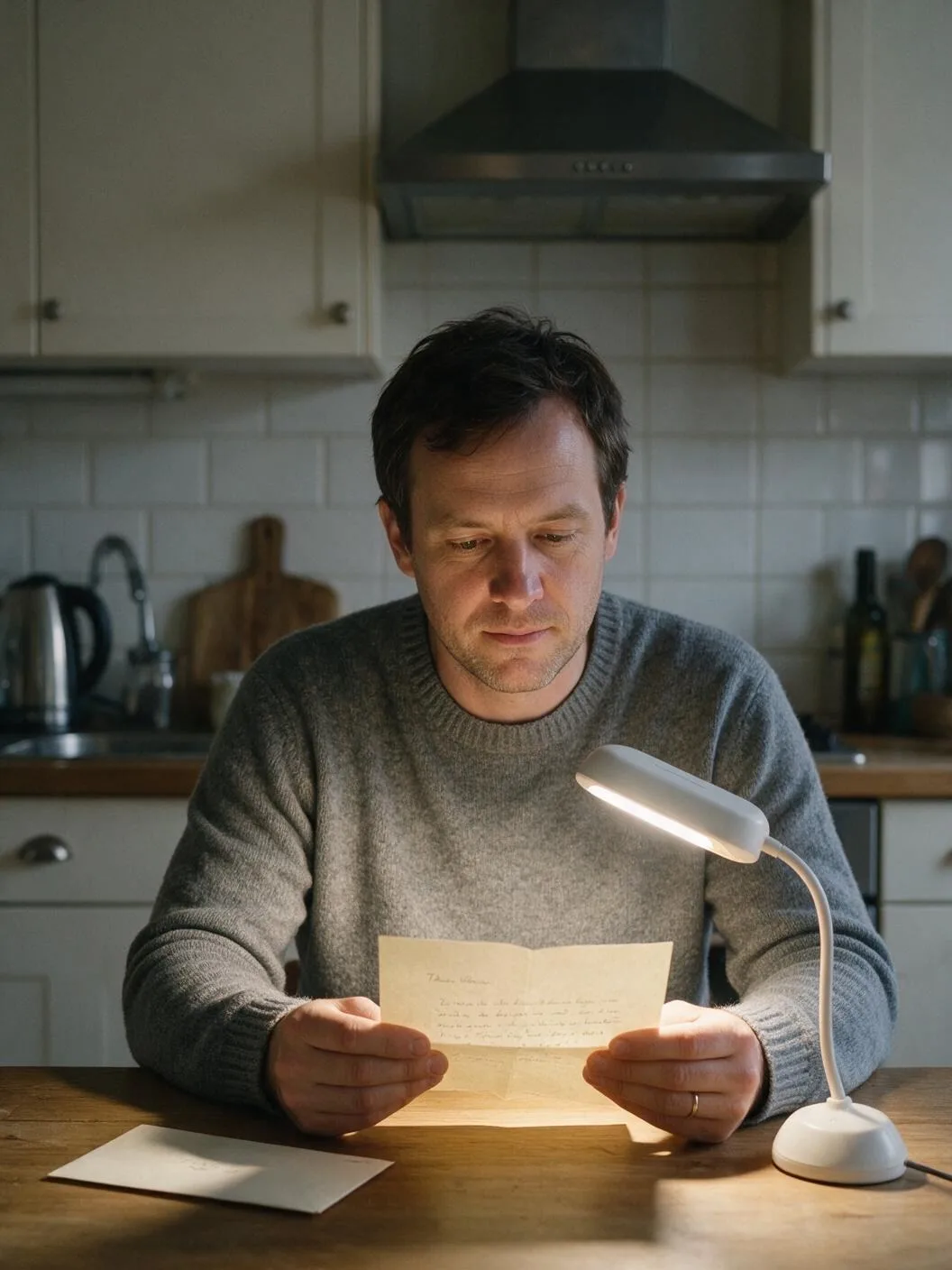
To get the light you want, describe what the light does, not the equipment that makes it. On a film set a book light or a China ball is a tool that stays out of the shot. An image model reads the name as a thing to draw, and draws it.
Every picture below is a real run on NOLGIA with Aura off. Most use one plain scene, a man reading a letter at a kitchen table, with only the light line changed.
Write this, not that
| Instead of | Write | In our runs |
|---|---|---|
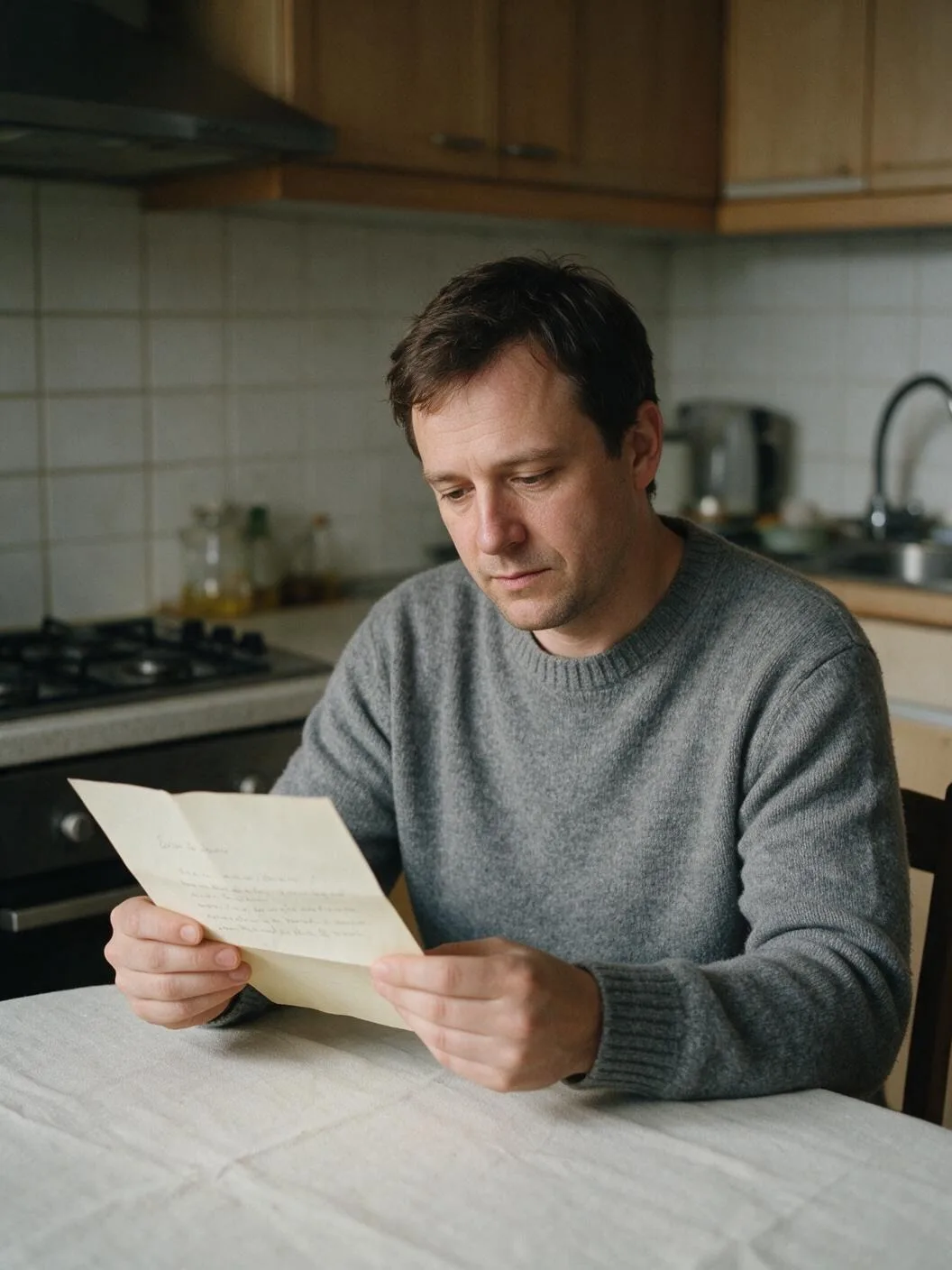
| Lit with a book light. | A very soft, wrapping light comes from camera left; the source is out of frame. | Named: a reading lamp on the table. Written out: no lamp in 2 of 2. |
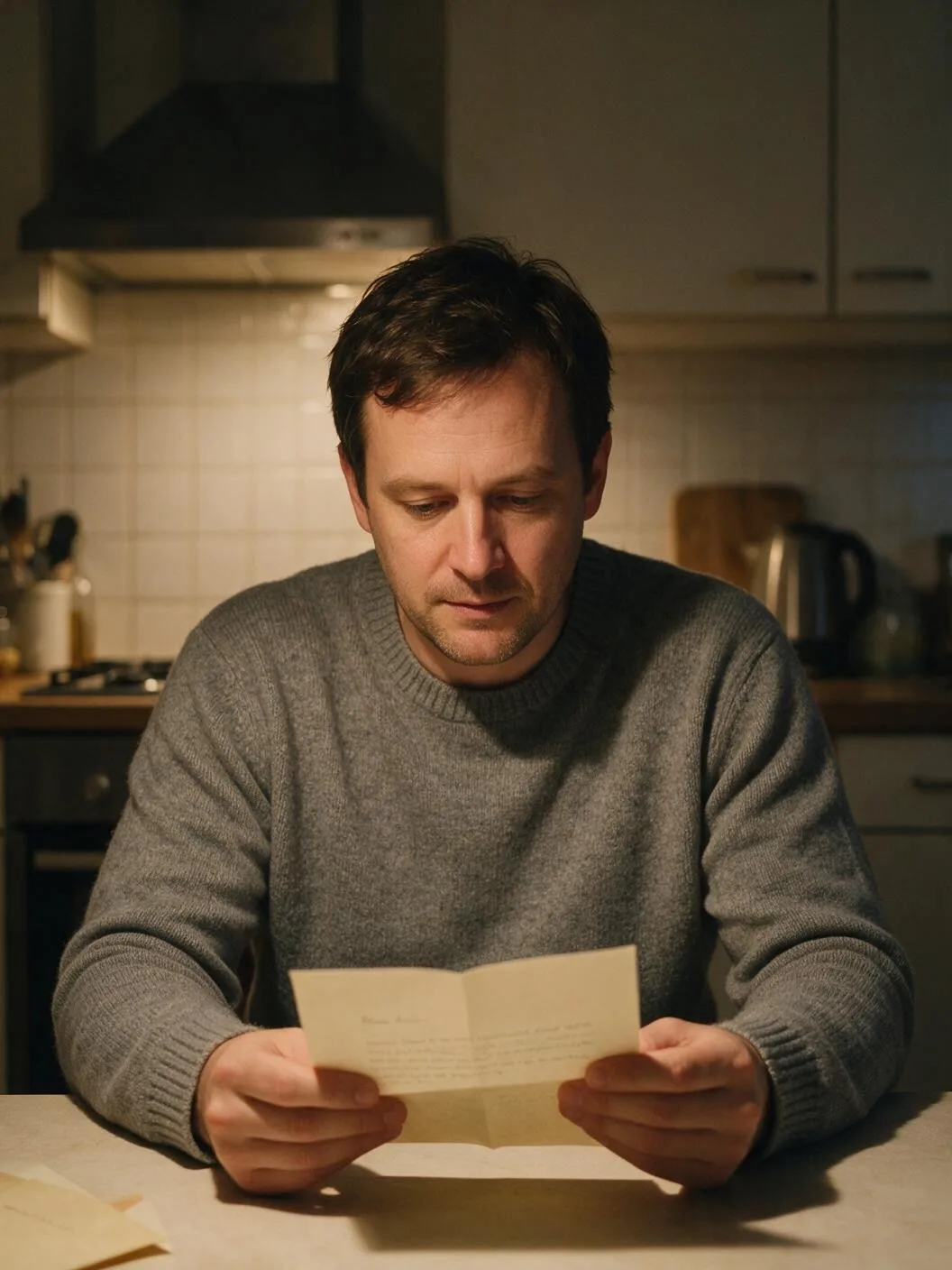
| Lit by a China ball. | Soft, warm light at about 2700 K comes from in front of him and a little to camera left; the source is out of frame. No lamps or bulbs anywhere in the picture. | Named: a bulb or a paper lantern. Written out: no lamp in 2 of 2. |
| one 1.5 m octabox camera left | one large, soft key from out of frame, camera left at 45 degrees | Named: the octabox in the picture, 2 of 2. Written out: none, 2 of 2. |
| a black 4x4 solid camera left as negative fill | the camera-left side of the room is dark and nothing bounces light back | Named: a black panel in the picture, 2 of 2. Written out: none, 2 of 2. |
| cinematic lighting | One light: its side, how soft it is, its color, what it falls on | A light with a side gives a lit side and a shadow side. |
Mistake 1: naming the equipment
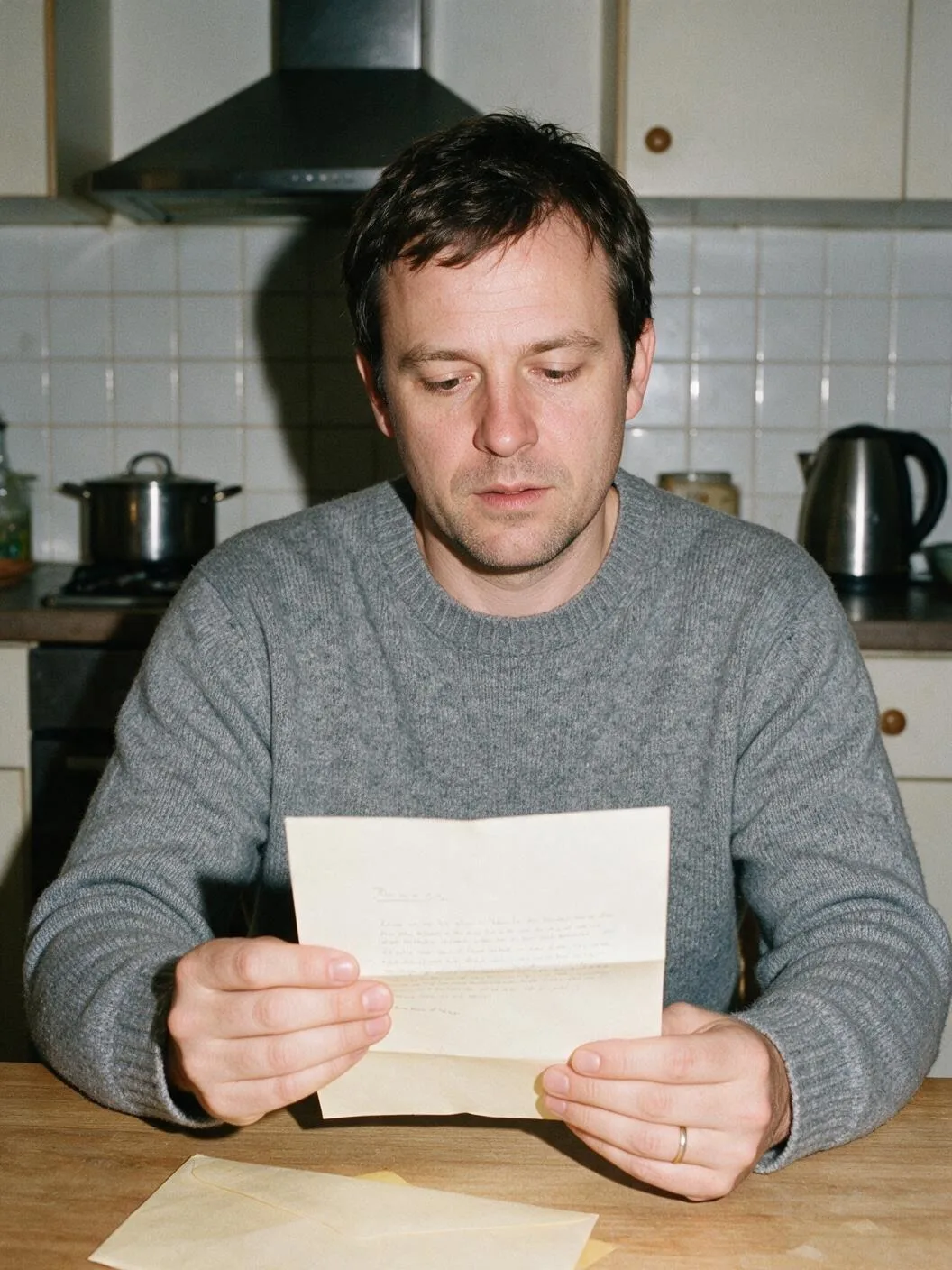
Each picture below is the same prompt with one sentence added in the brackets. The sentence names a piece of lighting or camera equipment, and the model drew it.
Unretouched photograph of a 35-year-old man reading a letter at a kitchen table, an ordinary face, a grey sweater, medium shot at eye level. [one sentence] Natural colour, low saturation.
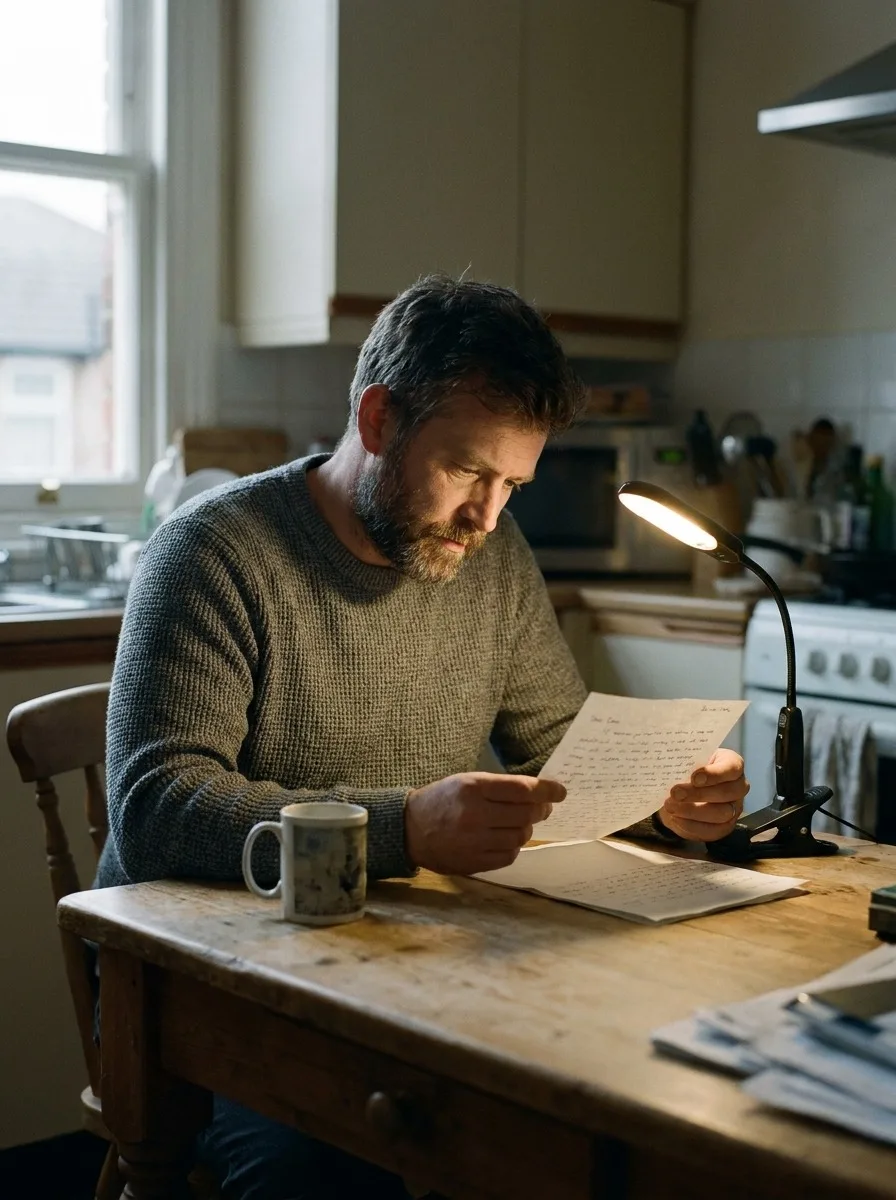
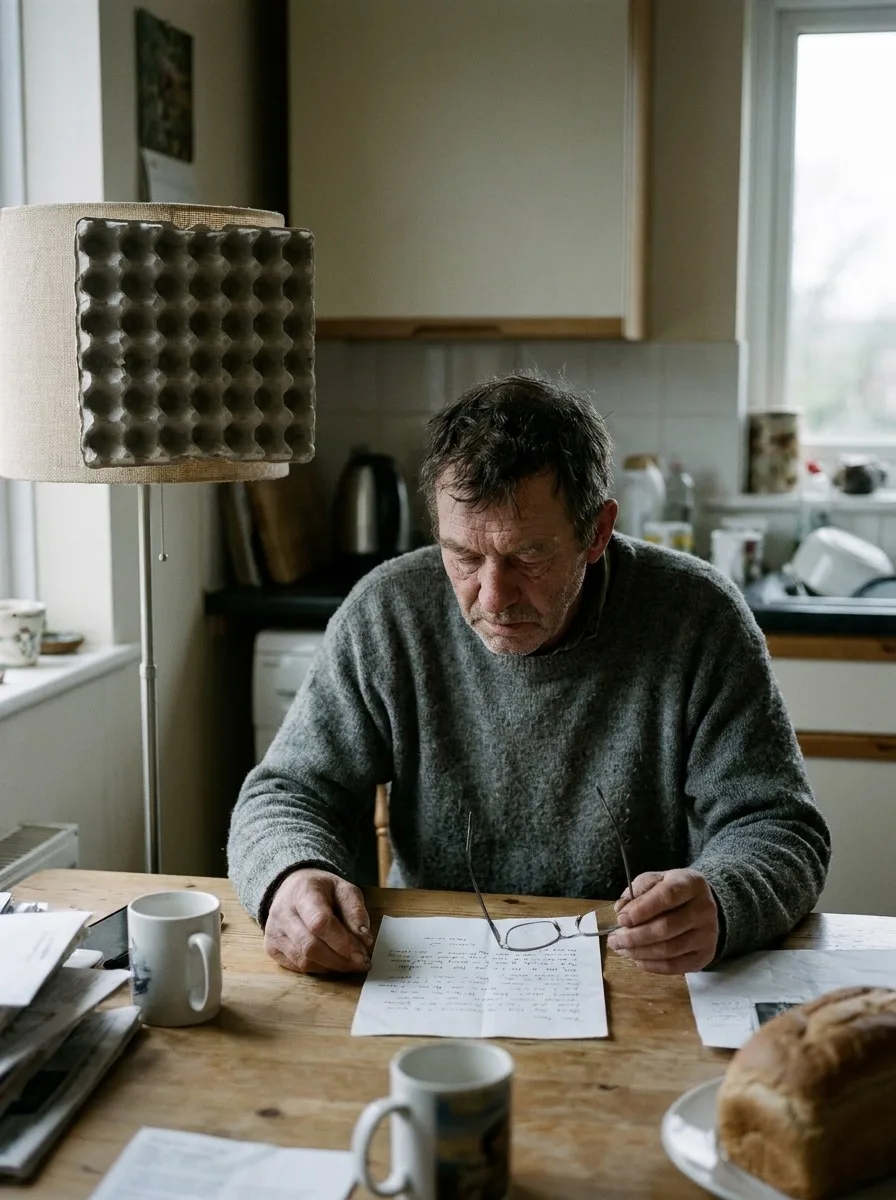
Fix 1: write what the light does
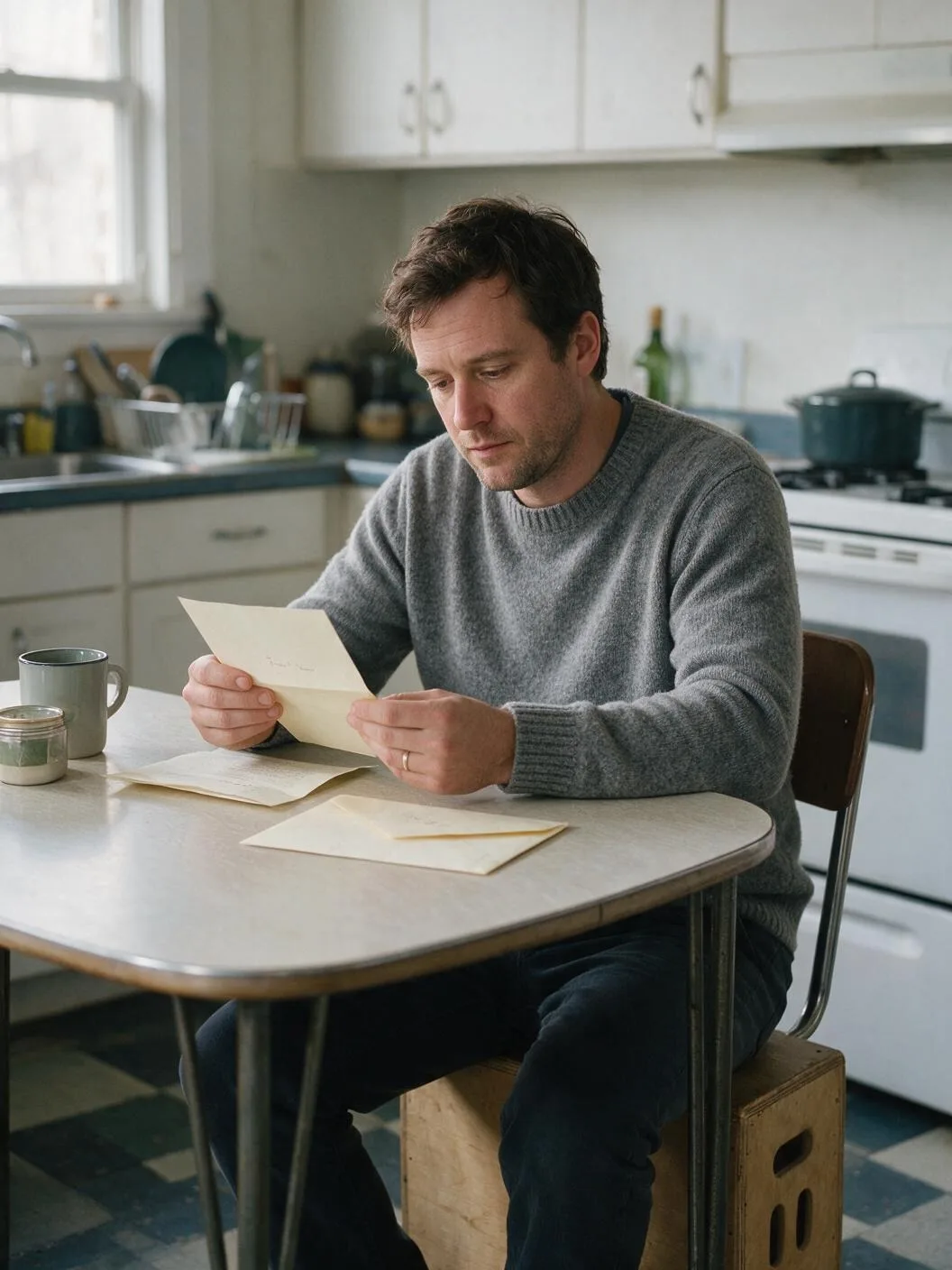
Describe the light the equipment would give you: where it comes from, how big and soft it is, what it falls on, and that the source is out of frame. There's nothing left to draw.
Unretouched photograph of a 35-year-old man reading a letter at a kitchen table, an ordinary face, a grey sweater, medium shot at eye level. Lit with a book light. Natural colour, low saturation.
Unretouched photograph of a 35-year-old man reading a letter at a kitchen table, an ordinary face, a grey sweater, medium shot at eye level. A very soft, wrapping light comes from camera left; the source is out of frame. It falls across his face and the letter and leaves only a faint, soft-edged shadow on the right side of his face. Natural colour, low saturation.
"Lit with a book light."
The light described
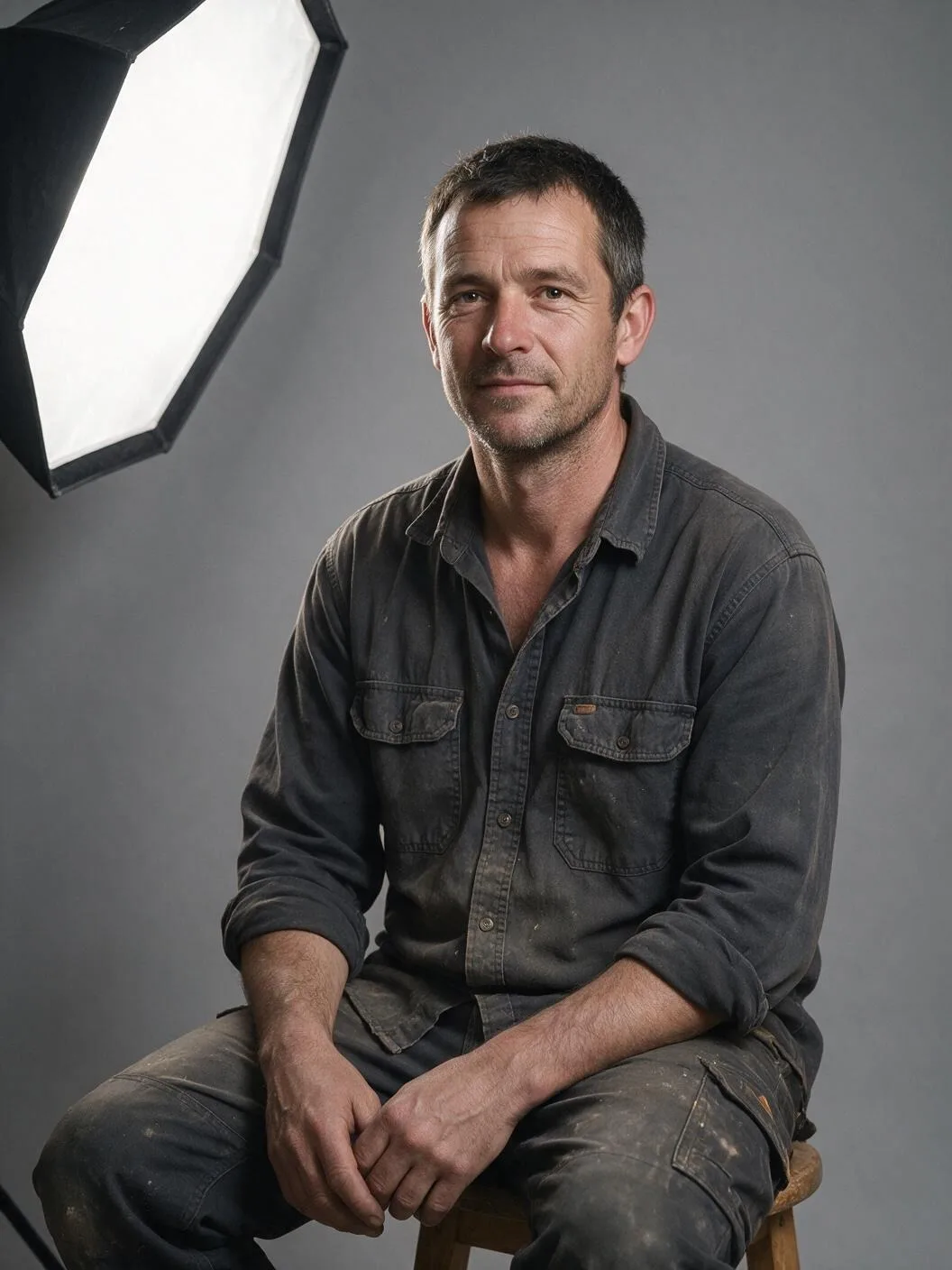
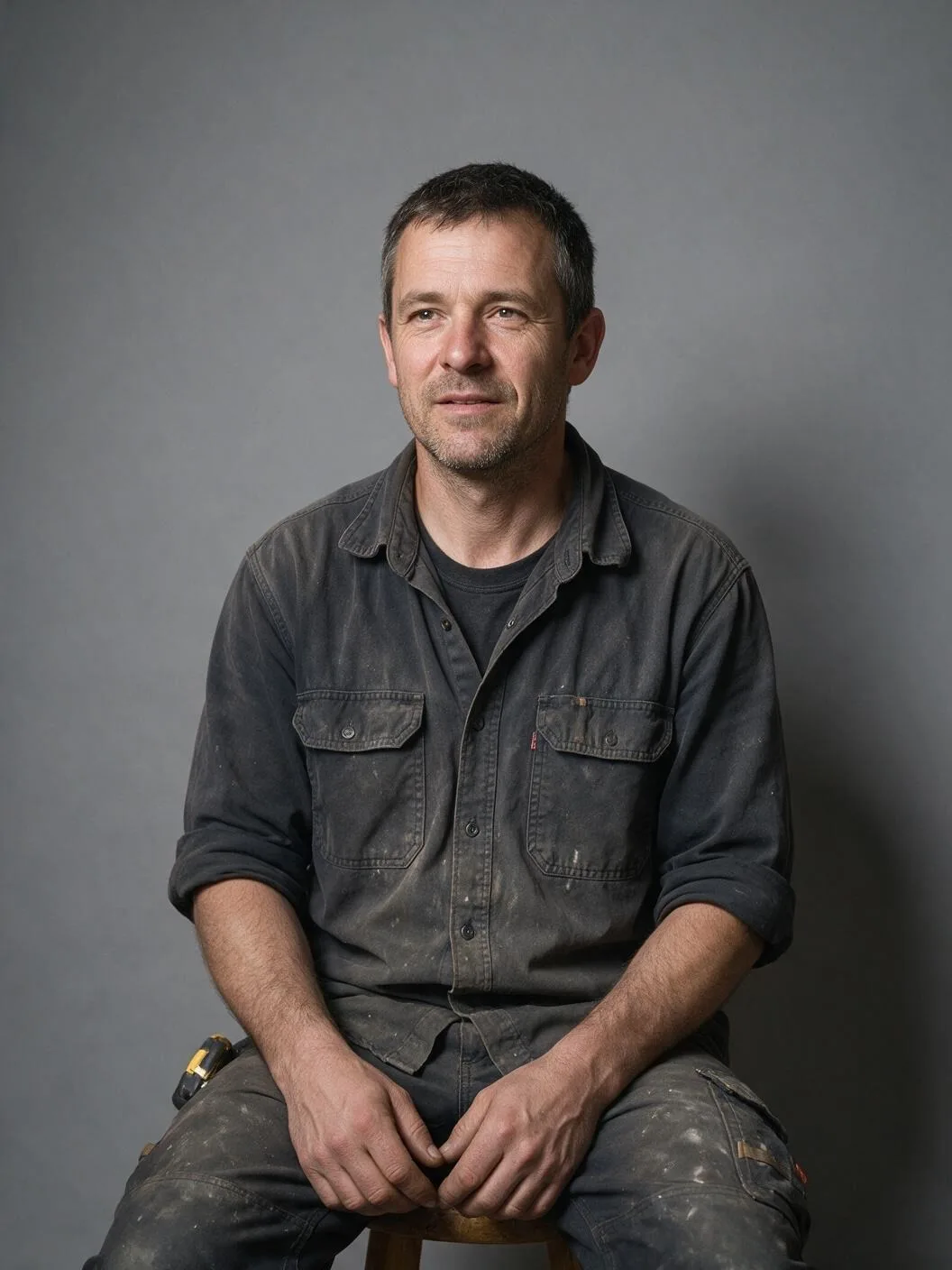
The same works in a studio. The two prompts below differ only in the light line.
Unretouched studio portrait photograph of a 38-year-old carpenter, not a model: an ordinary face with fine lines at the eyes, uneven skin with visible pores, short dark hair with some grey, a little stubble, a faded charcoal work shirt, no jewelry, no makeup. He sits on a wooden stool against a mid-grey seamless backdrop, half-length from the waist up, looking just past the lens. LOOK: mid-grey backdrop #7D7F82 about 55%, charcoal shirt #3A3B3D about 25%, skin about 20%; low saturation, soft contrast, true blacks. CAMERA: a full-frame camera with an 85 mm lens at f/4 from 1.8 m, eye level, vertical frame. LIGHT: one 1.5 m octabox at 5500 K camera left at 45 degrees, a little above eye level, two stops over the shadow side; no other light. FORBIDDEN: teal, coloured light, smoothed or plastic skin, glossy highlights on the face, readable text or logos.
Unretouched studio portrait photograph of a 38-year-old carpenter, not a model: an ordinary face with fine lines at the eyes, uneven skin with visible pores, short dark hair with some grey, a little stubble, a faded charcoal work shirt, no jewelry, no makeup. He sits on a wooden stool against a mid-grey seamless backdrop, half-length from the waist up, looking just past the lens. LOOK: mid-grey backdrop #7D7F82 about 55%, charcoal shirt #3A3B3D about 25%, skin about 20%; low saturation, soft contrast, true blacks. CAMERA: a full-frame camera with an 85 mm lens at f/4 from 1.8 m, eye level, vertical frame. LIGHT: one large, soft key at 5500 K from out of frame, camera left at 45 degrees and a little above eye level; it wraps softly round the near side of his face and leaves a soft-edged shadow on the far cheek and a soft shadow on the backdrop behind him to camera right; the lit side two stops over the shadow side; the source is out of frame; no other light. FORBIDDEN: teal, coloured light, smoothed or plastic skin, glossy highlights on the face, readable text or logos.
"one 1.5 m octabox"
The light described
Mistake 2: adding "out of frame" next to the equipment
Saying the light is off frame doesn't help while the equipment is still named. The model still draws it. Take the name out and write what it does instead.
Unretouched photograph from a documentary interview series about people who keep old ferries running. A 52-year-old ferry mechanic, not a model: a broad weathered face, deep lines at the eyes and forehead, uneven sun-darkened skin with visible pores, grey stubble, short grey hair, a little oil on his fingers. He wears a faded navy work jacket over a grey T-shirt, no jewelry, no watch. He sits on a steel stool in his workshop, his head turned a few degrees toward camera right, mid-answer; an ordinary moment, not posed. Behind him, 3 m back: a workbench with tools and a vice, two bench lamps, a limewashed wall. LOOK: weathered walnut #5A3E2B about 35%, warm limewashed wall #CBB89A about 30%, charcoal shadow #2A2724 about 25%, faded navy #2F3B52 about 10%; low saturation, soft contrast, true blacks; skin stays skin coloured. CAMERA: a full-frame documentary camera, a 58 mm lens at T2, medium close-up from mid-chest at seated eye level from 1.6 m, locked off; a little sensor noise in the shadows. LIGHT: a soft key at 5600 K from camera right at 45 degrees, a little above eye level, on the short side of his face (the side turned away from the camera), so the cheek nearer the camera falls into soft shade; the key is 1.5 stops over the shadow side; a black 4x4 solid camera left as negative fill; the two bench lamps in the background at 2700 K, two stops under his face. Every light is off frame: no light stands, softboxes, cables or fixtures visible anywhere in the picture. FORBIDDEN: teal, cyan or green spill, coloured light on the walls, teal and orange, RGB accent lights, smoothed or plastic skin, readable text or logos.
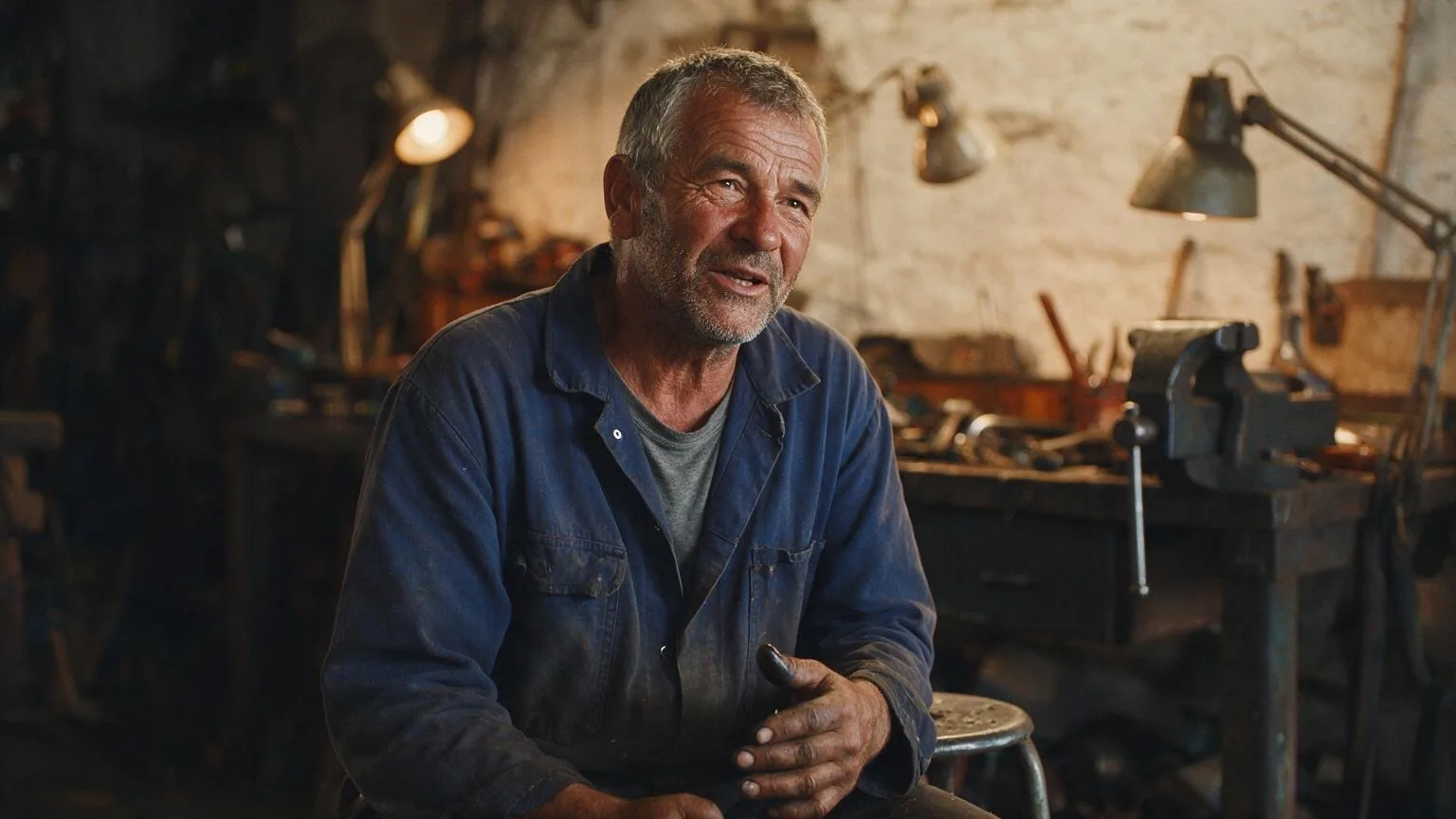
Unretouched photograph from a documentary interview series about people who keep old ferries running. A 52-year-old ferry mechanic, not a model: a broad weathered face, deep lines at the eyes and forehead, uneven sun-darkened skin with visible pores, grey stubble, short grey hair, a little oil on his fingers. He wears a faded navy work jacket over a grey T-shirt, no jewelry, no watch. He sits on a steel stool in his workshop, his head turned a few degrees toward camera right, mid-answer; an ordinary moment, not posed. Behind him, 3 m back: a workbench with tools and a vice, two bench lamps, a limewashed wall. LOOK: weathered walnut #5A3E2B about 35%, warm limewashed wall #CBB89A about 30%, charcoal shadow #2A2724 about 25%, faded navy #2F3B52 about 10%; low saturation, soft contrast, true blacks; skin stays skin coloured. CAMERA: a full-frame documentary camera, a 58 mm lens at T2, medium close-up from mid-chest at seated eye level from 1.6 m, locked off; a little sensor noise in the shadows. LIGHT: a soft key at 5600 K from out of frame, camera right at 45 degrees, a little above eye level, on the short side of his face (the side turned away from the camera), so the cheek nearer the camera falls into soft shade; the key is 1.5 stops over the shadow side; the camera-left side of the room is dark and nothing bounces light back, so the shadow side of his face stays deep; the two bench lamps in the background at 2700 K, two stops under his face. FORBIDDEN: teal, cyan or green spill, coloured light on the walls, teal and orange, RGB accent lights, smoothed or plastic skin, readable text or logos.
"a black 4x4 solid" + off frame
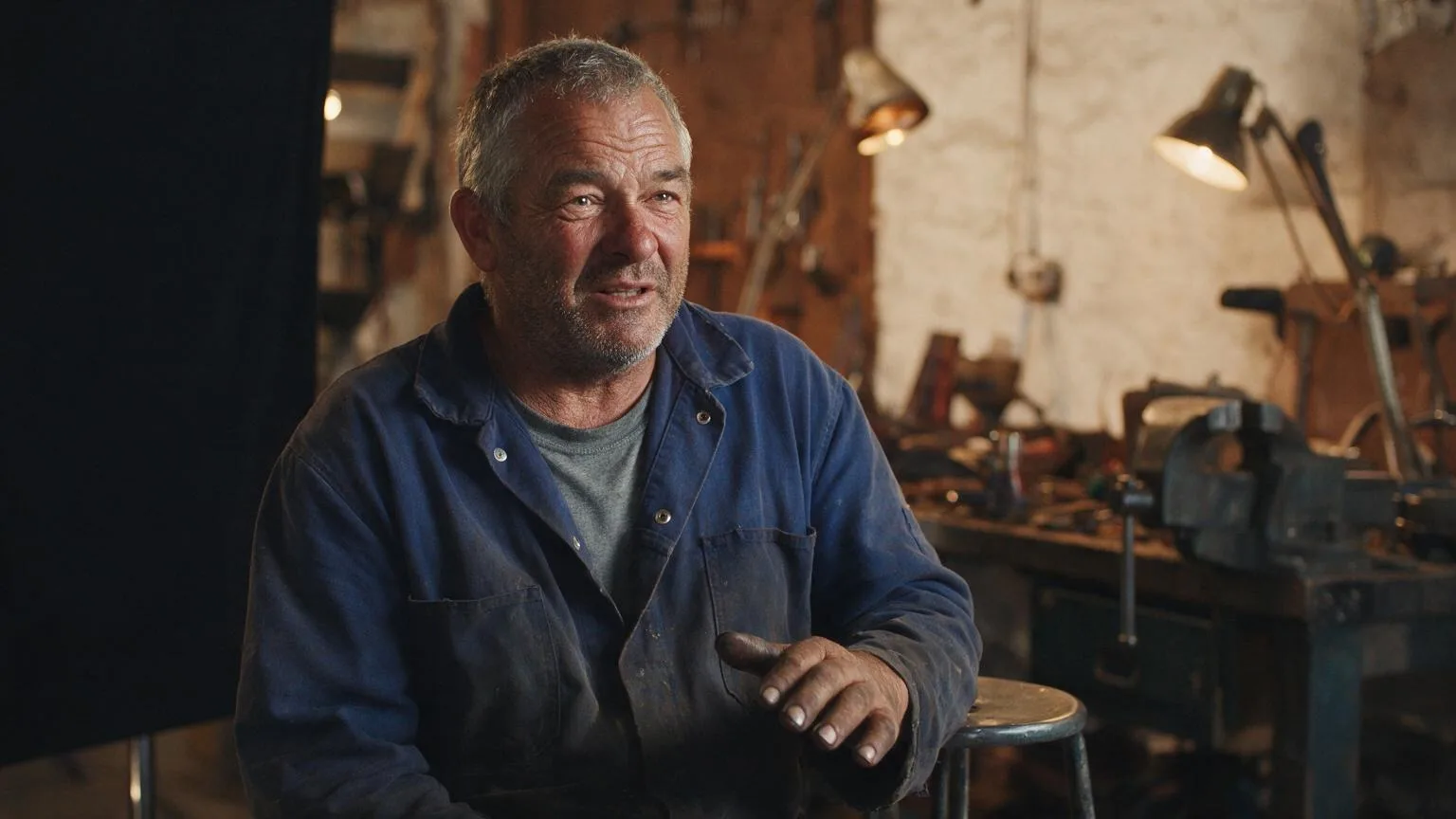
The light described
Fix 2: when a lamp still shows up
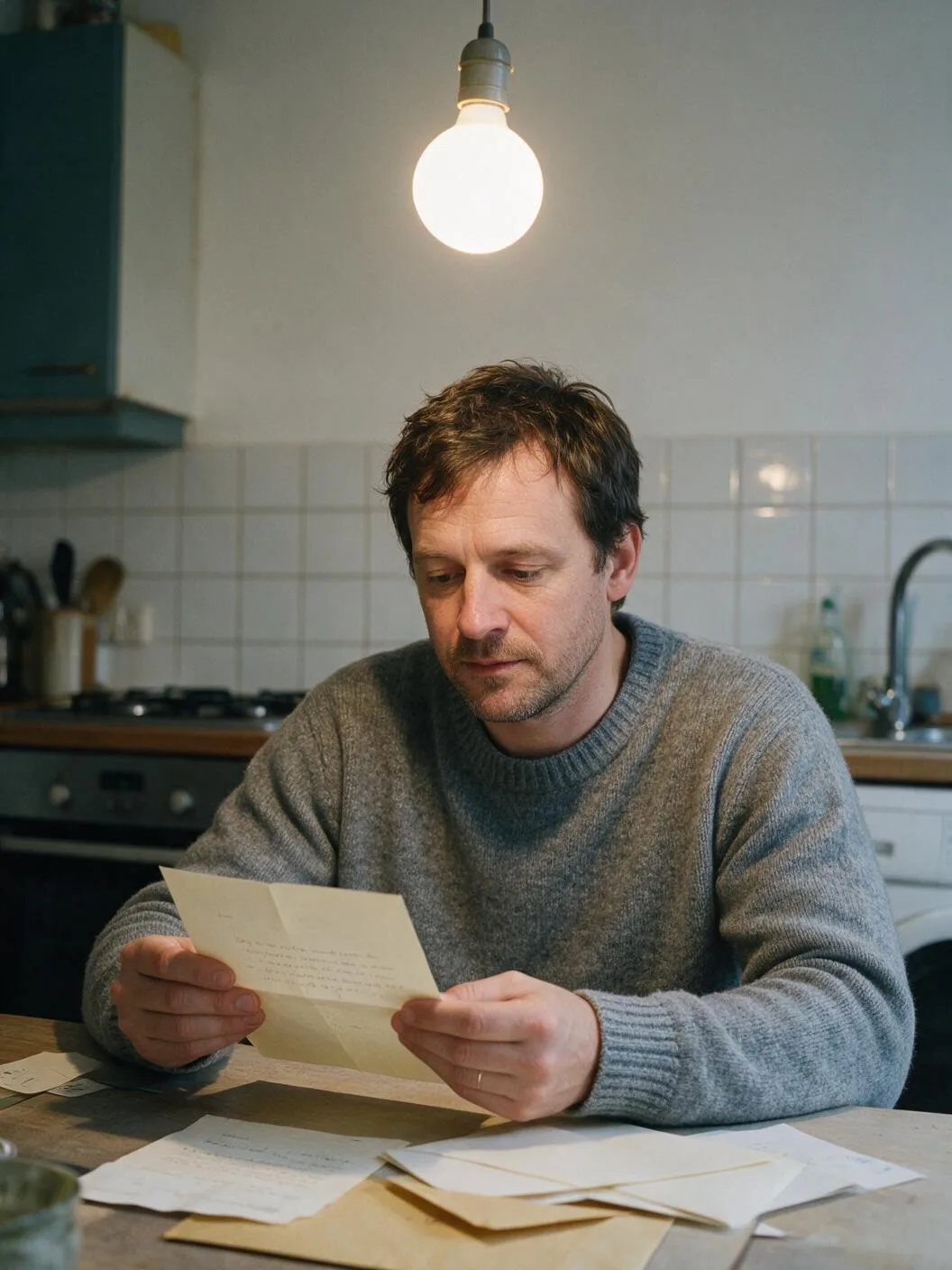
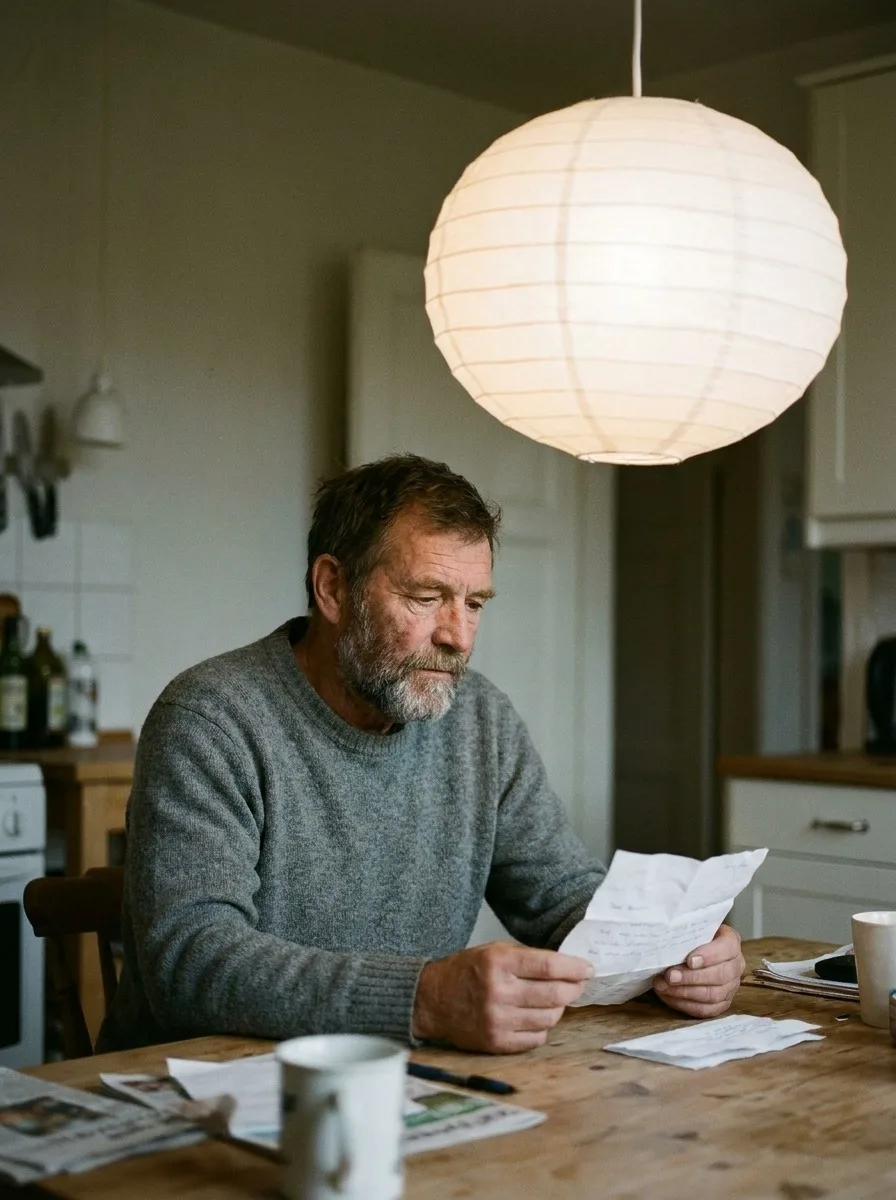
A China ball is a paper globe that gives soft, warm light from above. We wrote exactly that, and a ceiling lamp crept into the top of the picture in both runs: warm light from above a kitchen table reads as a ceiling lamp. Moving the light to the front cleared it in one run of two. Adding one last line, no lamps or bulbs anywhere in the picture, cleared it in two of two.
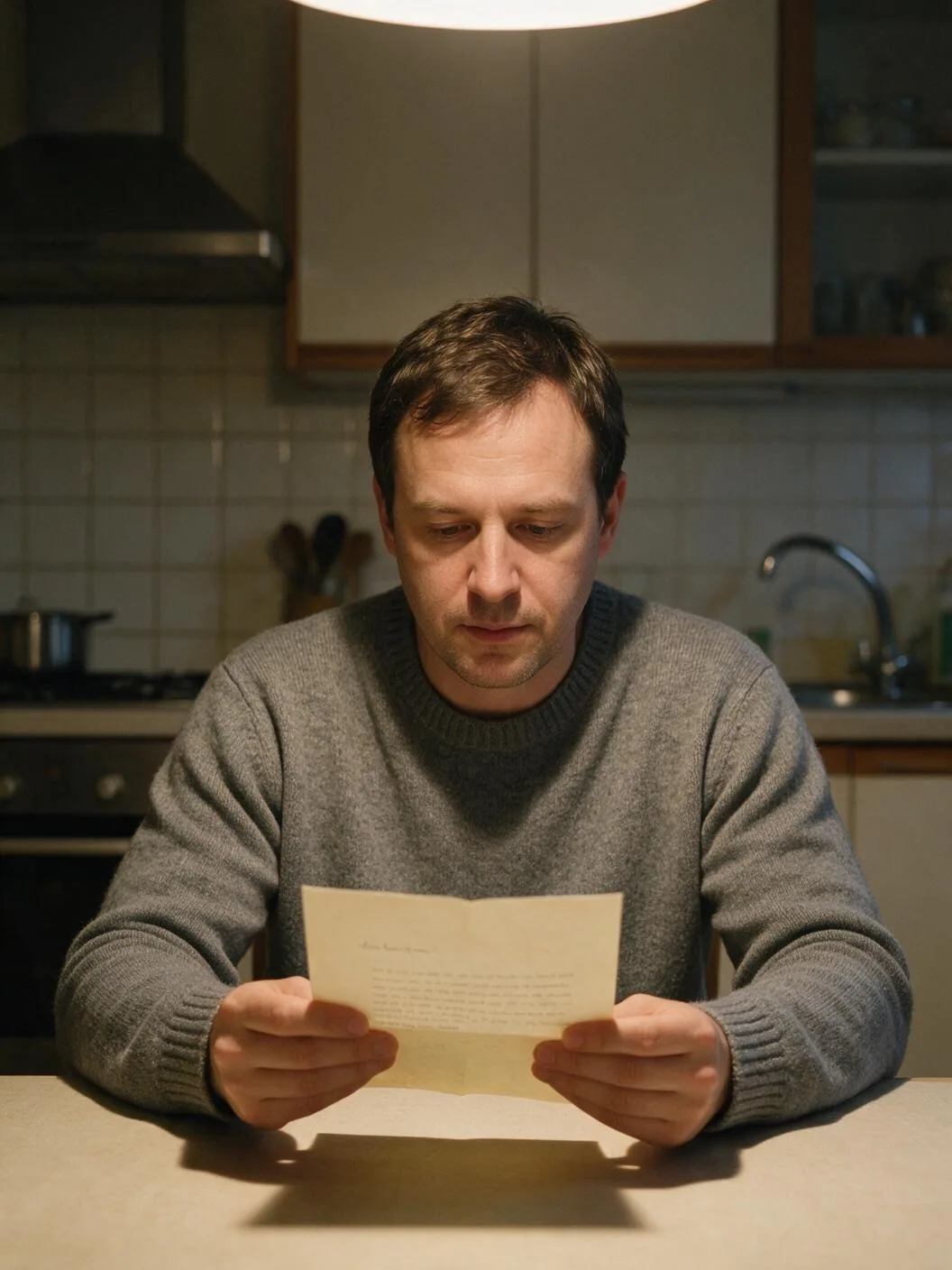
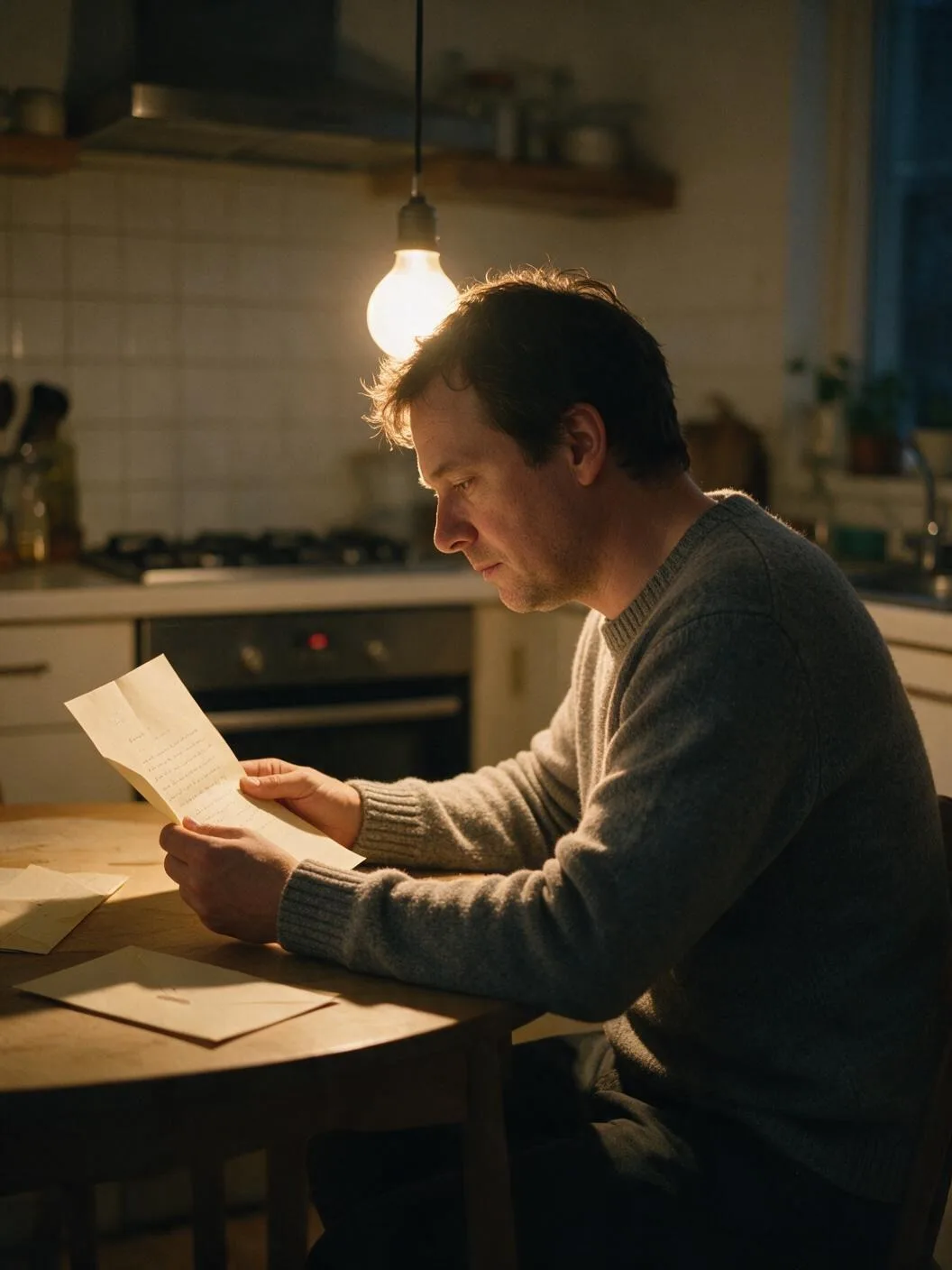
Unretouched photograph of a 35-year-old man reading a letter at a kitchen table, an ordinary face, a grey sweater, medium shot at eye level. Lit by a China ball. Natural colour, low saturation.
Unretouched photograph of a 35-year-old man reading a letter at a kitchen table, an ordinary face, a grey sweater, medium shot at eye level. Soft, warm light at about 2700 K comes from in front of him and a little to camera left, from just above his head height; the source is out of frame. It wraps round his face, his shoulders and the letter with gentle, soft-edged shadows. No lamps or bulbs anywhere in the picture. Natural colour, low saturation.
"Lit by a China ball."
Described, plus no lamps
Tip:One line, not a list. If a lamp keeps appearing, add one short line: no lamps or bulbs anywhere in the picture. Don't add a list of equipment to keep out. Every name in that list is one more thing for the model to draw.
Light words that are safe: setups, times of day and lamps in the scene
Some light words are safe because they name a look, not an object: a lighting setup, a kind of flash, a time of day. A lamp you want to see is safe too: write it as part of the scene. Each picture below is the kitchen scene with one light line in the brackets.
Unretouched photograph of a 35-year-old man reading a letter at a kitchen table, an ordinary face, a grey sweater, medium shot at eye level. [light line] Natural colour, low saturation.
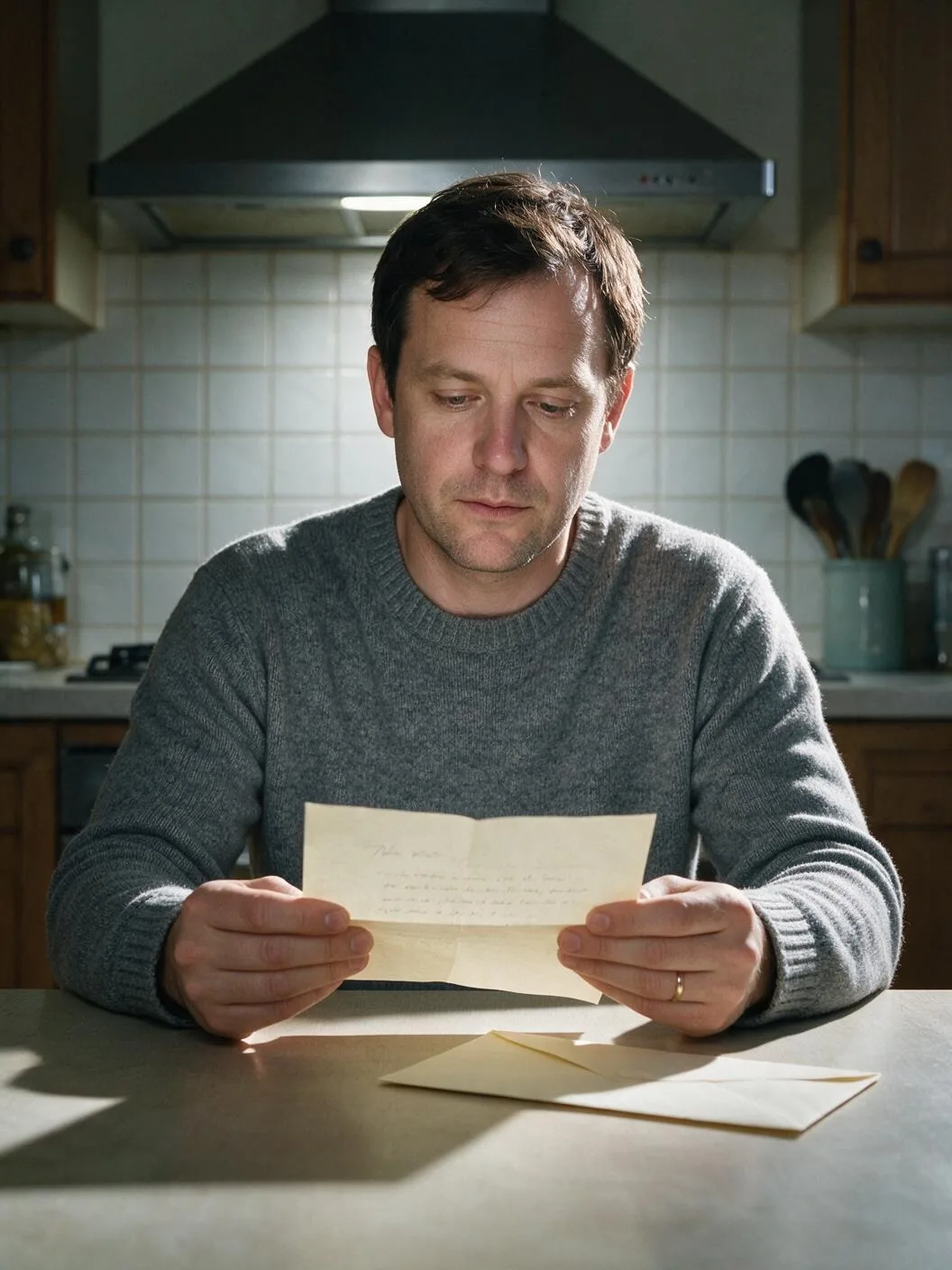
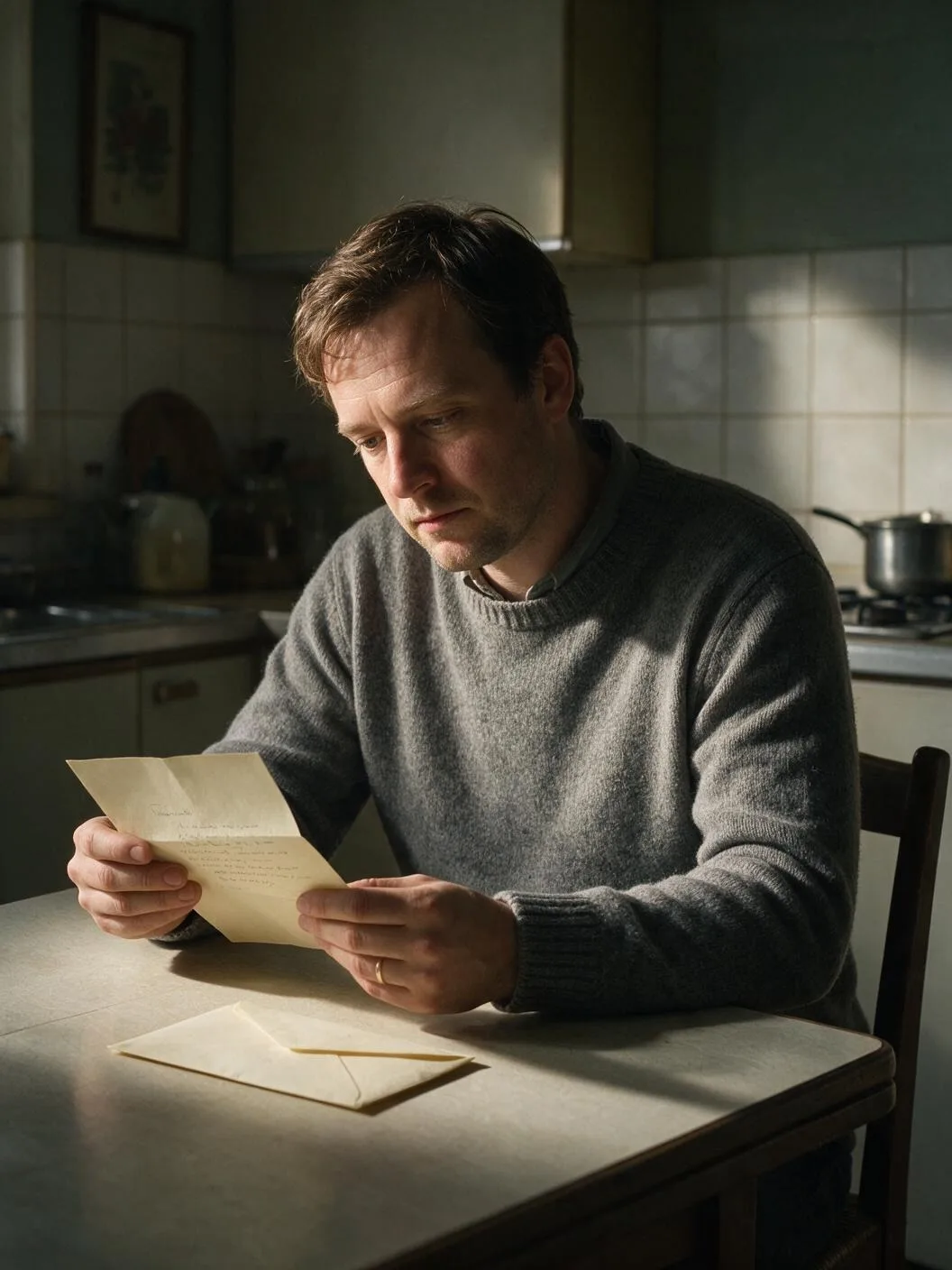
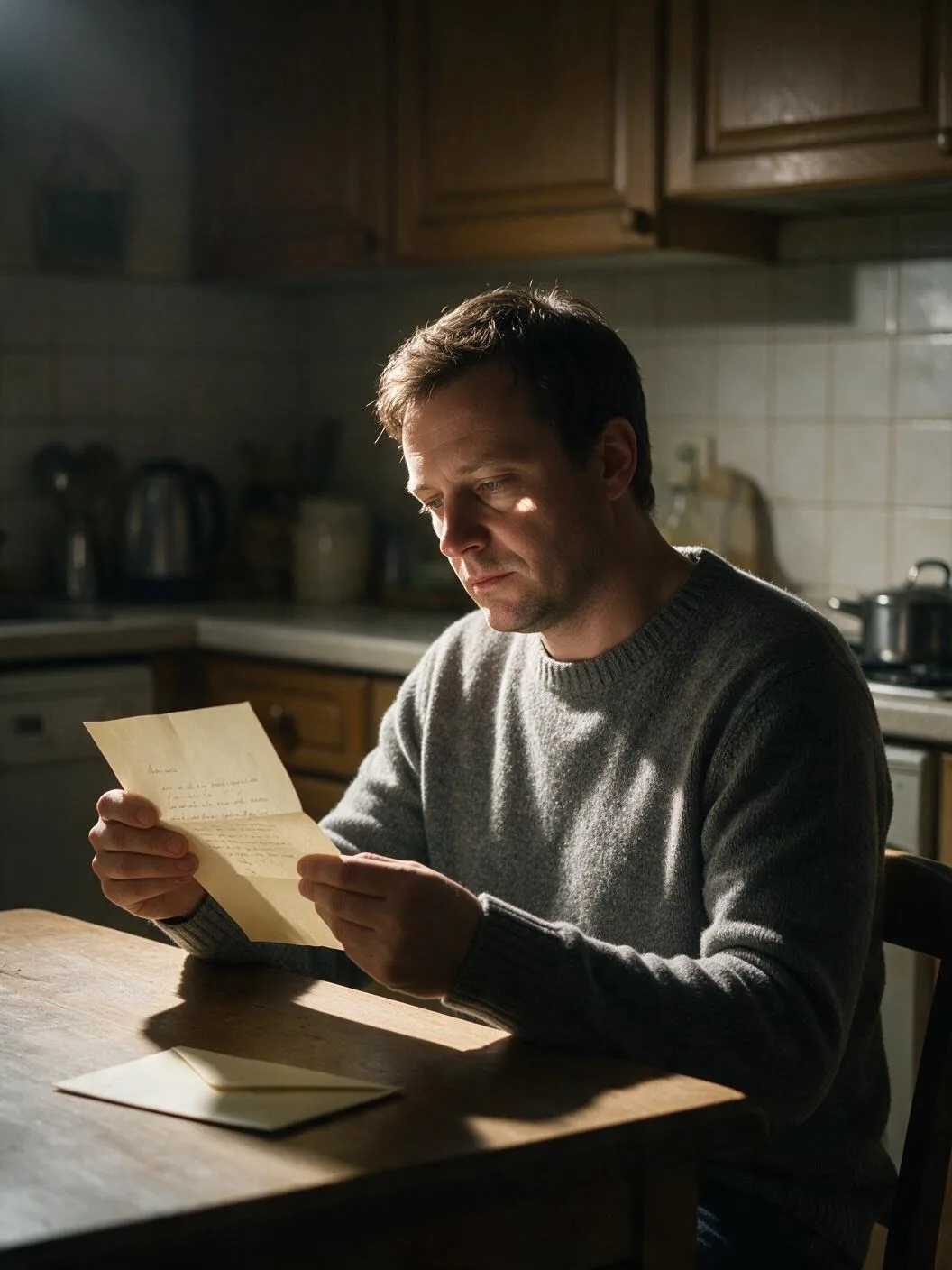
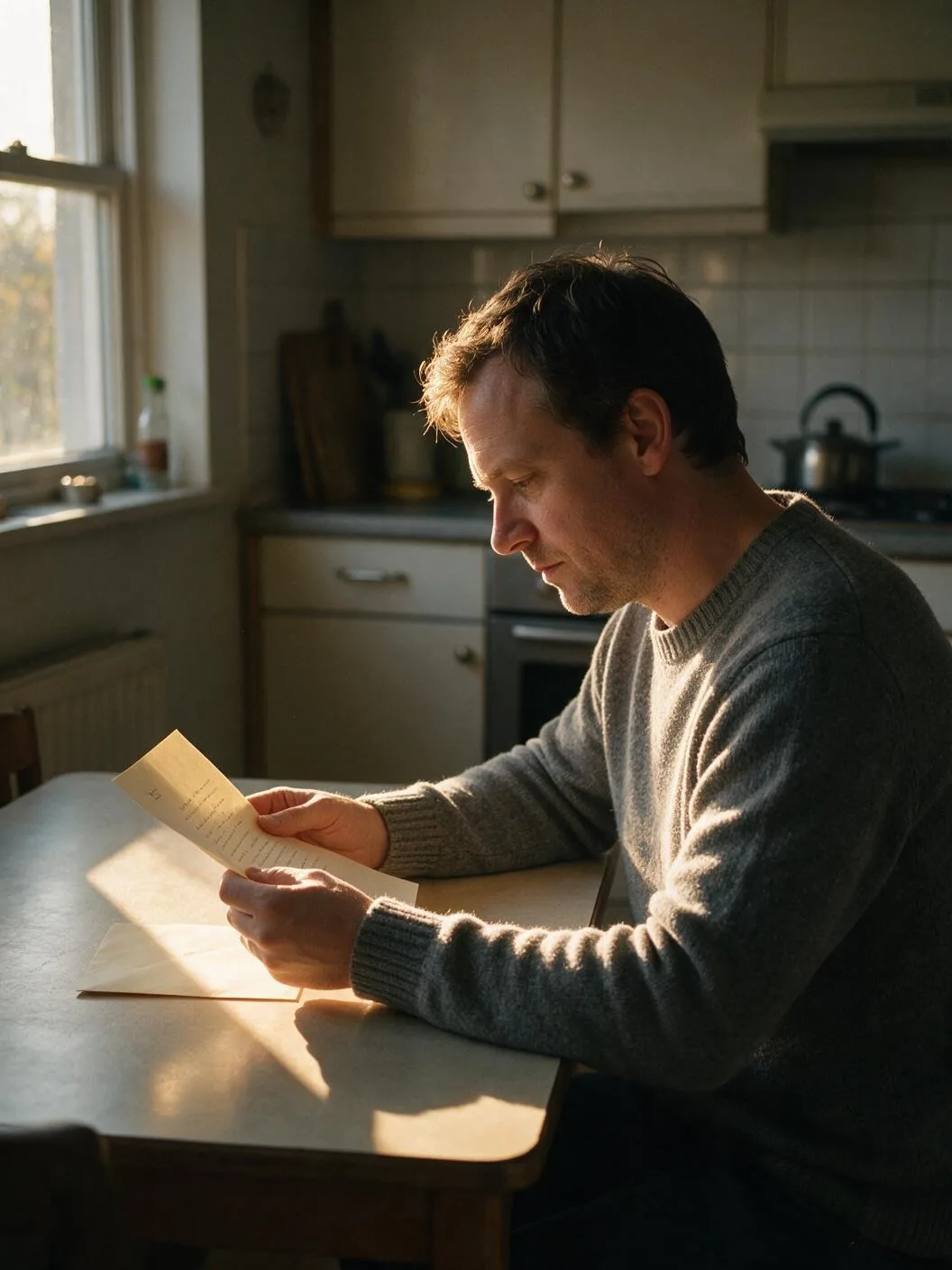
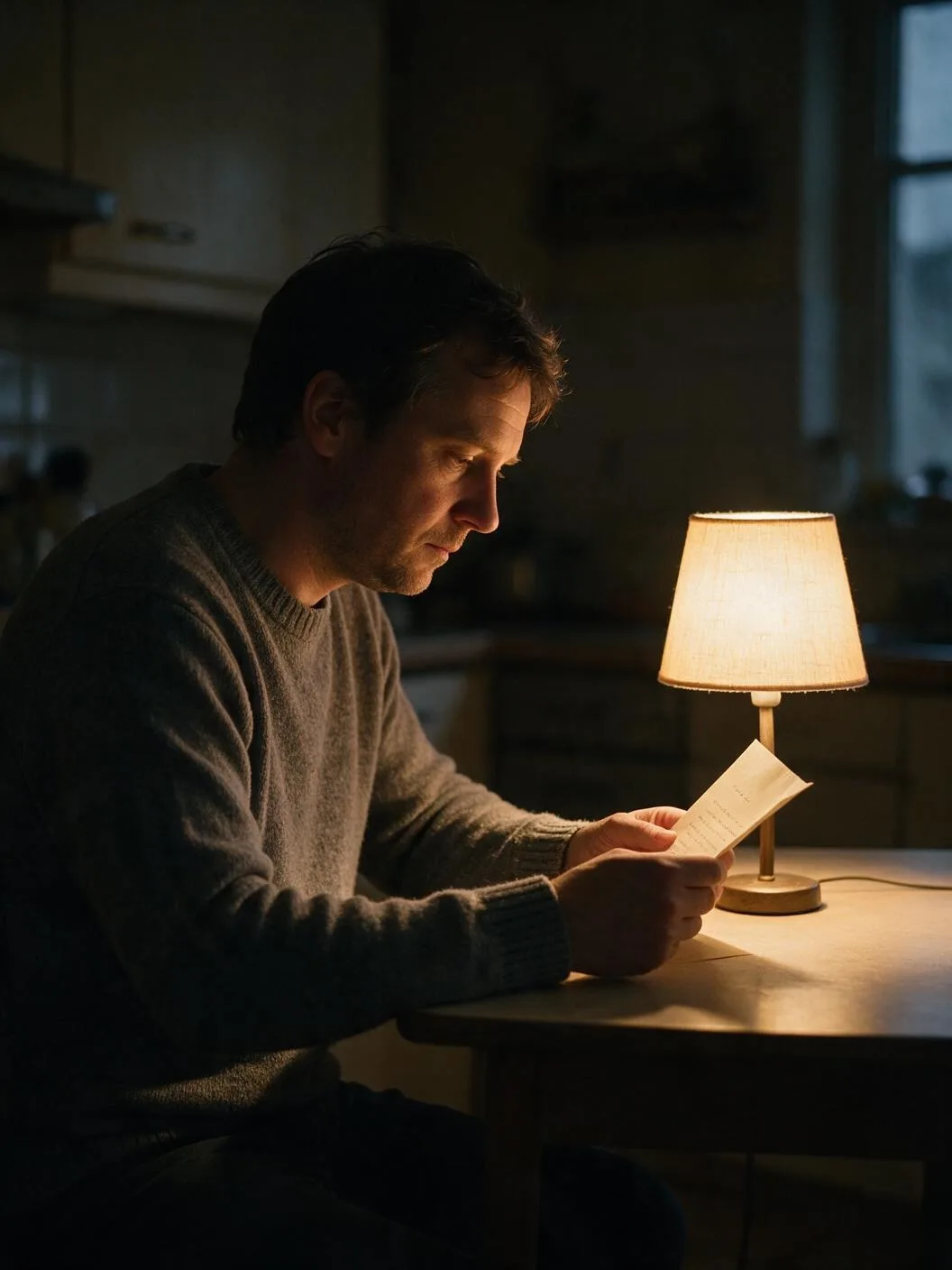
Tip:Write the name and what it does. A setup name draws nothing you don't want, and it works better with its effect written next to it, as the two Rembrandt pictures show.
The light line, as a template
[Where the light comes from: camera left, camera right, behind, or above the camera], [how big and soft it is: a large soft light, a small hard light], at about [color temperature: 2700 K for a warm household bulb, 5600 K for daylight] or [a time of day]. It [falls on what] and leaves [where the shadow goes]. The source is out of frame.
- A lamp you want to see: write it as part of the scene. "A small table lamp with a fabric shade on the table beside him, switched on."
- A lamp you don't want: add one line at the end. "No lamps or bulbs anywhere in the picture."
- A setup name: write the name, then what it does. "Rembrandt lighting: the light comes from high on camera left, out of frame, and leaves a small triangle of light on the cheek away from the light, under the eye."
What it costs
Every picture here is one run at the default size. A light line costs nothing extra: it's part of the prompt. The Generate button shows the price before you spend anything.
Seedream 5.0 ProEvery plan
Per image
1K 5 credits · 2K 9 credits
Nano Banana ProEvery plan
Per image
Native 8 credits · 2K 8 credits · 4K 14 credits
Read live from the catalog when this page loads. Every price is shown before you generate. See every rate.
Checklist before you press Generate
- No lighting or camera equipment named in the prompt: no book light, China ball, softbox, octabox, flag, egg crate or apple box.
- One light: its side, how big and soft, its color or time of day, what it falls on.
- The source is out of frame, in words.
- Lamps you want to see are written as part of the scene.
- If a lamp still appears: one line, no lamps or bulbs anywhere in the picture.
- Setup names are fine. Write what they do next to them.
Questions and answers
- Can I ever name lighting equipment?
- Yes, when you want it in the picture: a behind-the-scenes shot, a photo studio, a creator's ring light. Write it as part of the scene, like any other object.
- Why doesn't "out of frame" fix it?
- The model still reads the equipment's name as something to draw. In our runs a named black panel stayed in the picture in 2 of 2 runs with a line saying every light is off frame. Take the name out and write what the light does.
- Do the safe names work on every model?
- Butterfly, Rembrandt and direct on-camera flash drew nothing unwanted on Seedream 5.0 Pro, and direct flash also worked on Nano Banana Pro in our earlier tests. Check the first picture on your model before you make the rest.
- Does this work for video?
- We tested these words on pictures. For video, the habit is the same: say where the light comes from and what it does. Our guide Make AI video look real shows a light written by its source and direction on two video models.
- What about Aura?
- Aura is on by default when your prompt describes a person, and adds real skin texture and natural light from the scene. Every picture here was made with Aura off, so you see what the light line alone does. If you write the light yourself, you can turn Aura off.
Write the light in your next prompt
Open Create imagesRelated guides
Prompting
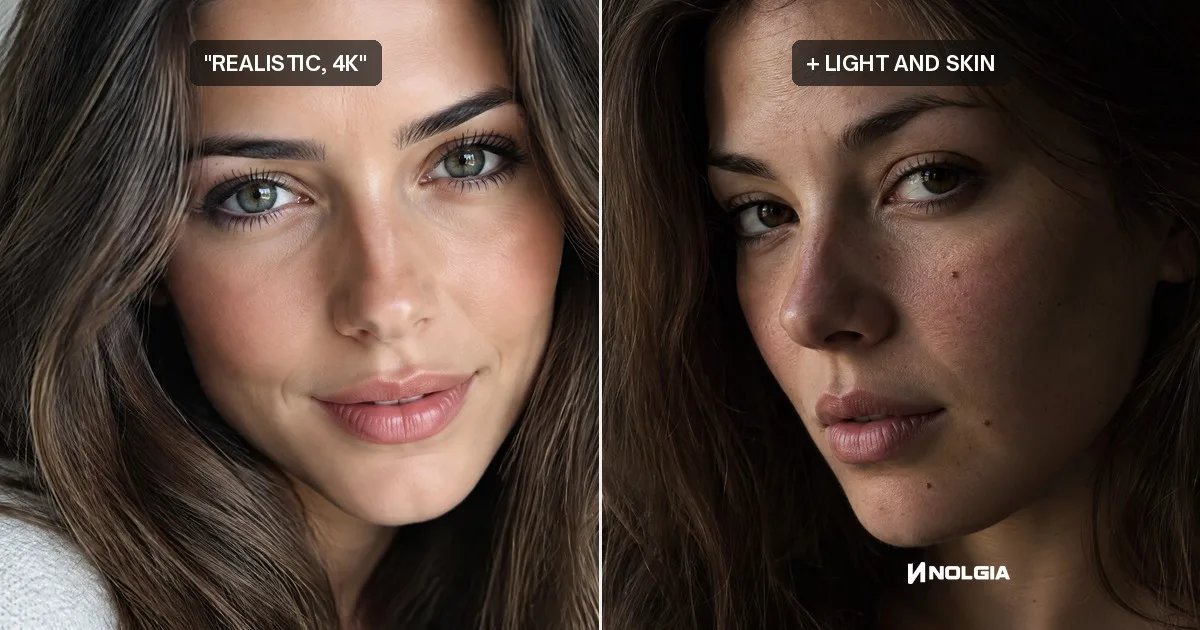
Why typing 4k doesn't make an AI image sharper, and what does
Typing 4k, 8k or hyperrealistic adds no pixels and no detail. We ran the same portrait with and without them, and show what does make it sharper.
· 10 min read
Prompting
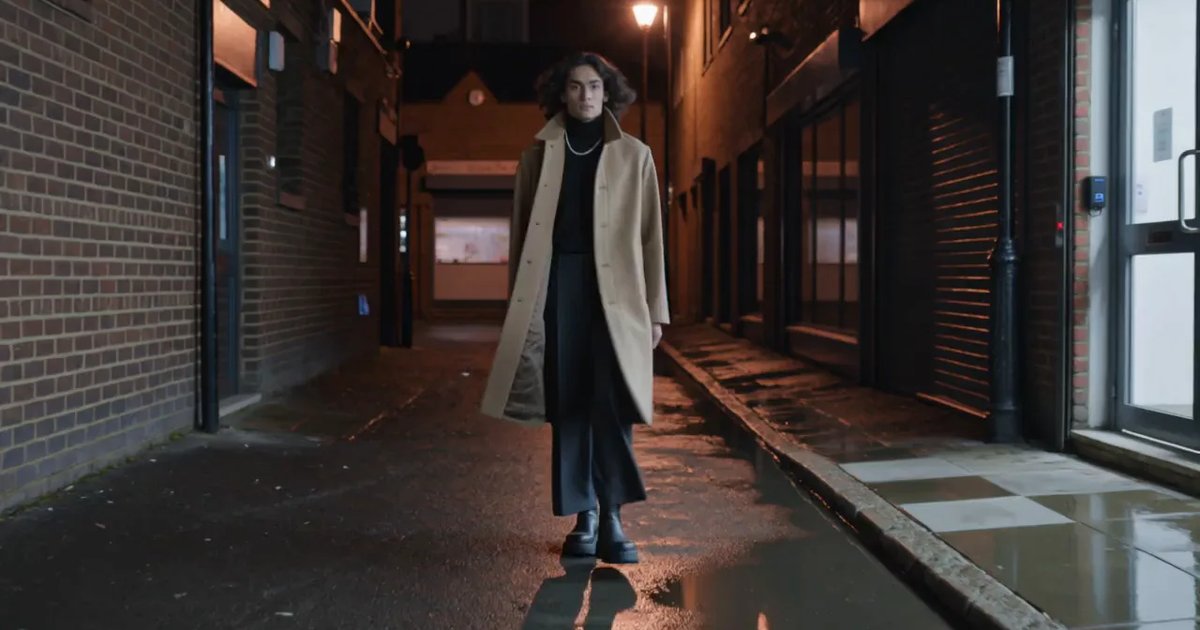
Make AI video look real: light, motion and camera
Three sentences make a clip read as filmed: a named light source, a walk with weight, a camera someone is holding. Each tested before and after on Kling v3.
· 9 min read
Prompting
Seven video prompt mistakes, and the fix for each
The seven ways a video prompt goes wrong, each rendered twice on Kling v3: the vague prompt, then the same prompt with one fix. Copy the fixes, and read what a seed does not do.
· 12 min read