
Distancia focal para video con IA: 24mm, 70mm, 135mm y 200mm
¿Por qué la IA muestra todo tu cuerpo cuando pides un primer plano? Porque un número de lente no define la toma. Aquí te explicamos qué cambia la distancia focal, cómo escribirla para que un modelo de video la siga y cómo se creó el reel de NOLGIA sobre el tema, toma por toma.
- 16 min de lectura
Traducido automáticamente del inglés. Leer el original
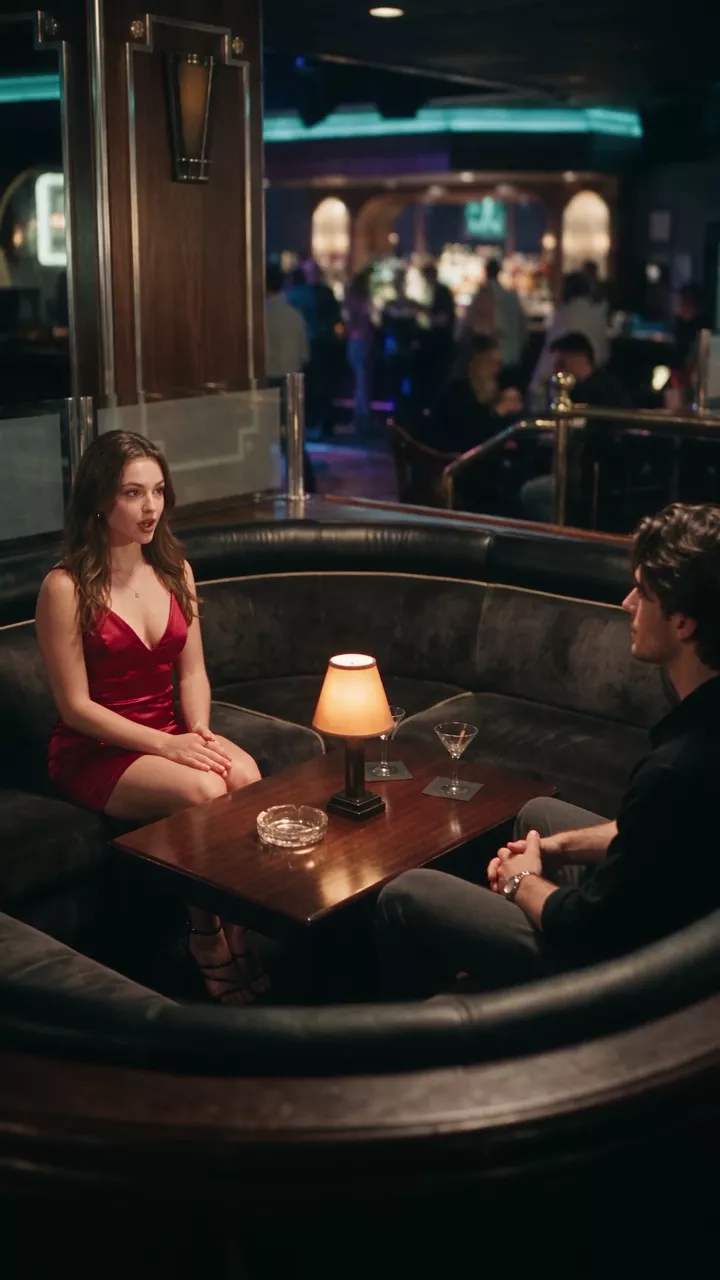
Esta guía sigue el proyecto de NOLGIA detrás de un reel corto sobre la distancia focal. Dos personas en un reservado de un club nocturno de finales de los 90 se preguntan por qué la IA ignora los primeros planos; el reel responde con el mismo hombre fuera del club a 24 mm, 70 mm y 135 mm, y una toma de 200 mm desde la puerta del club hasta la barra. Son seis clips de Seedance 2.5 a 1080p, dos hojas de personaje y una imagen del club. Cada prompt se cita tal como se envió; el único cambio es que los guiones largos se escriben como guiones. Todos los personajes de los clips se generaron con NOLGIA.
Son dos lecciones en una: qué significan los milímetros, según la propia guía de distancia focal del creador de videos, y cómo se construyó cada toma del reel, para que puedas crearlo con tus propios personajes.
El reel, toma por toma
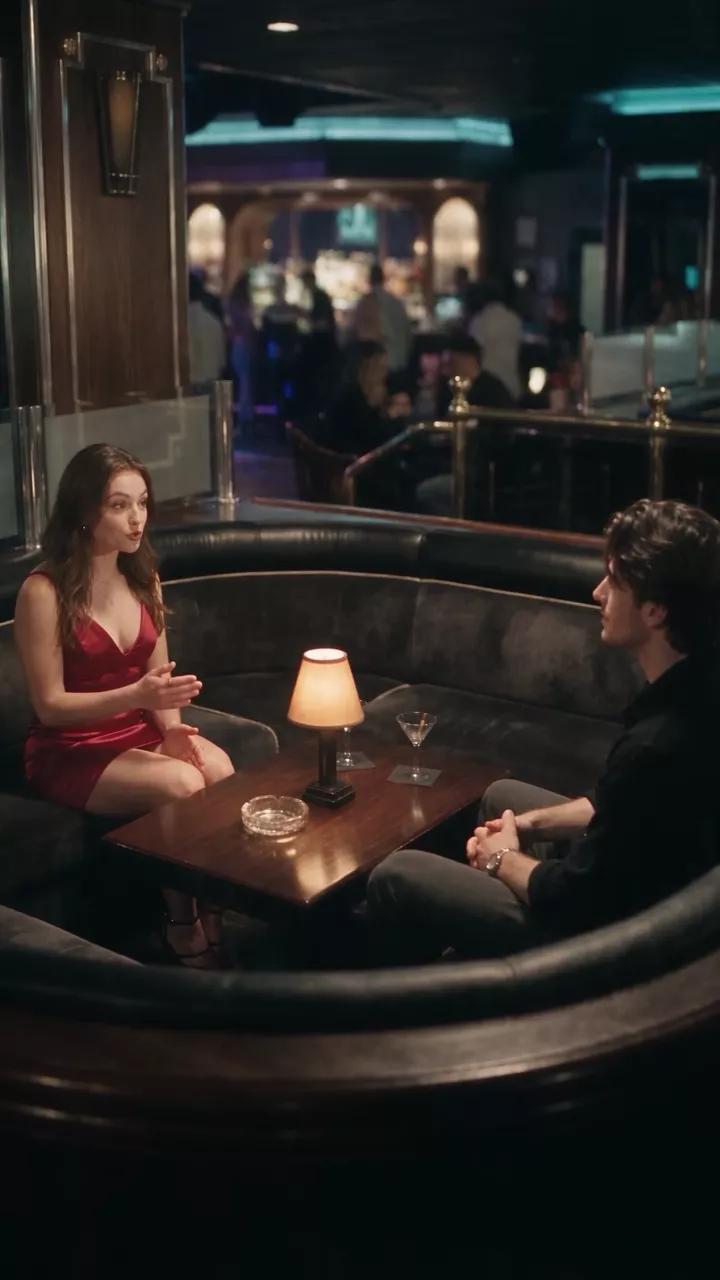
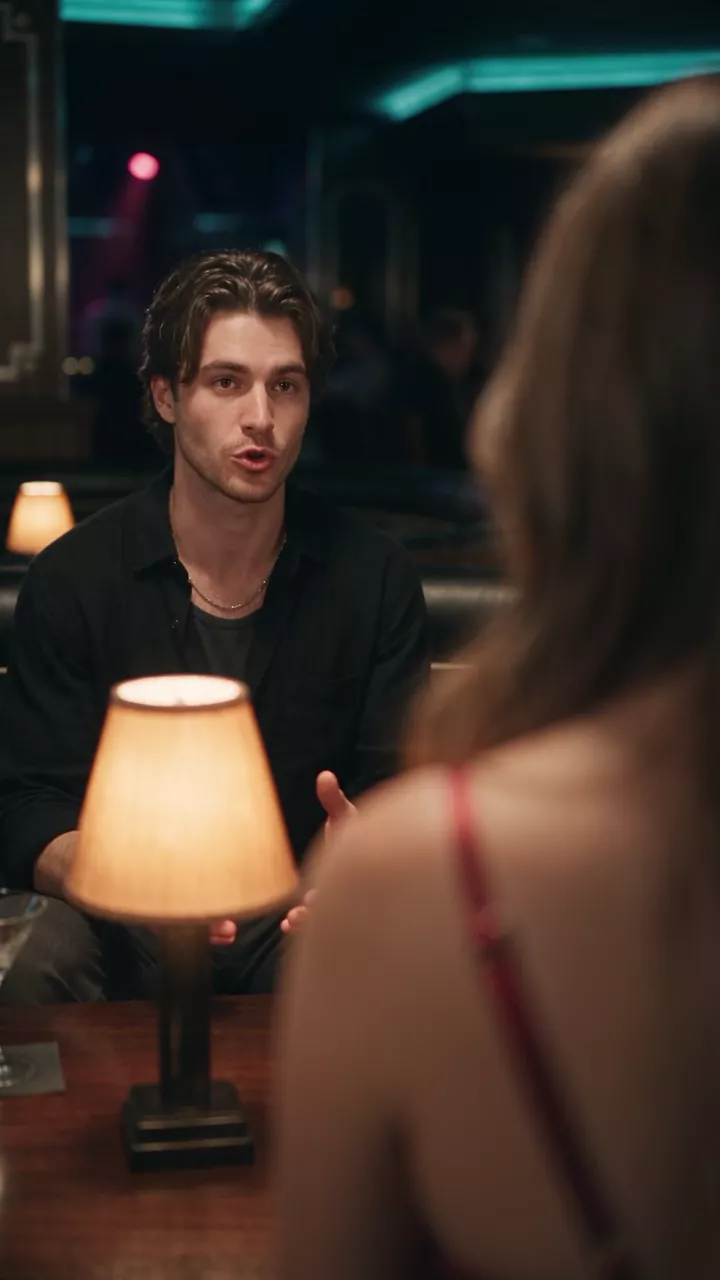
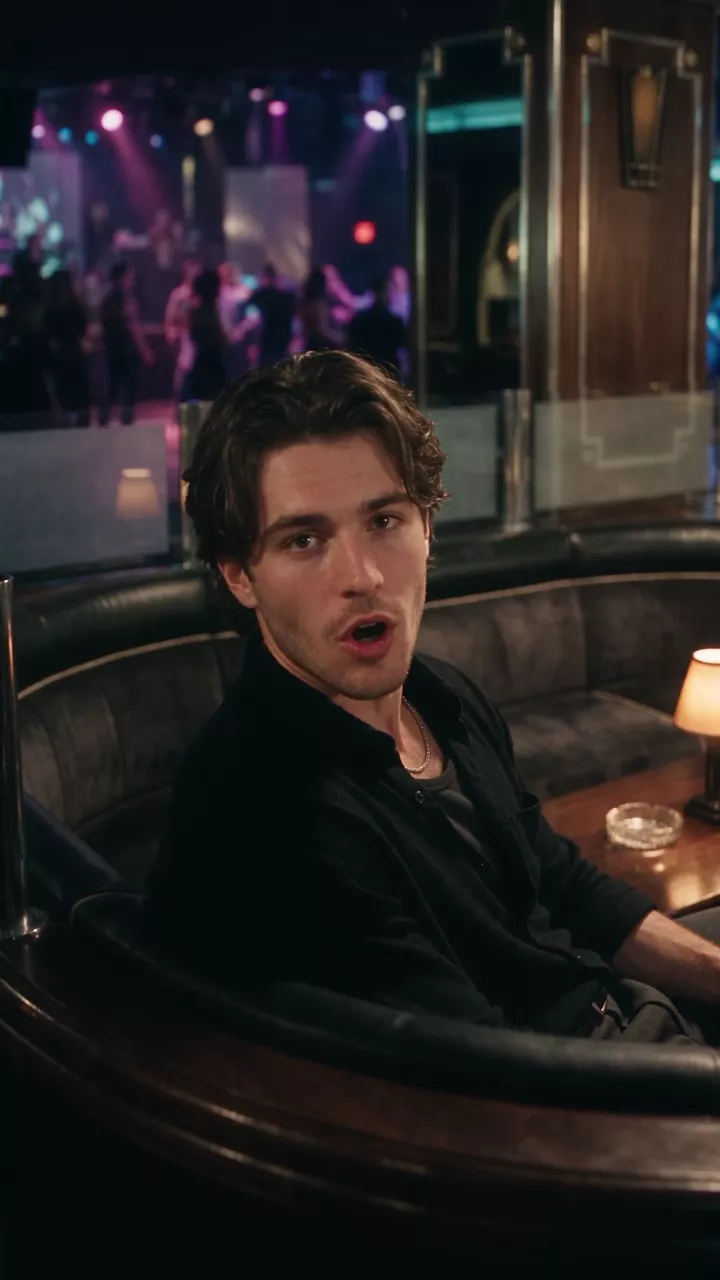
| Plano | Qué se dice o se muestra | Lente y cámara |
|---|---|---|
| 1. La cabina | Ella pregunta por qué la IA muestra su cuerpo completo para un primer plano; él responde: "Vamos a los detalles. Analizaremos la distancia focal." | Un plano general de dos personas, un acercamiento lento hacia ella y luego un barrido rápido hacia él |
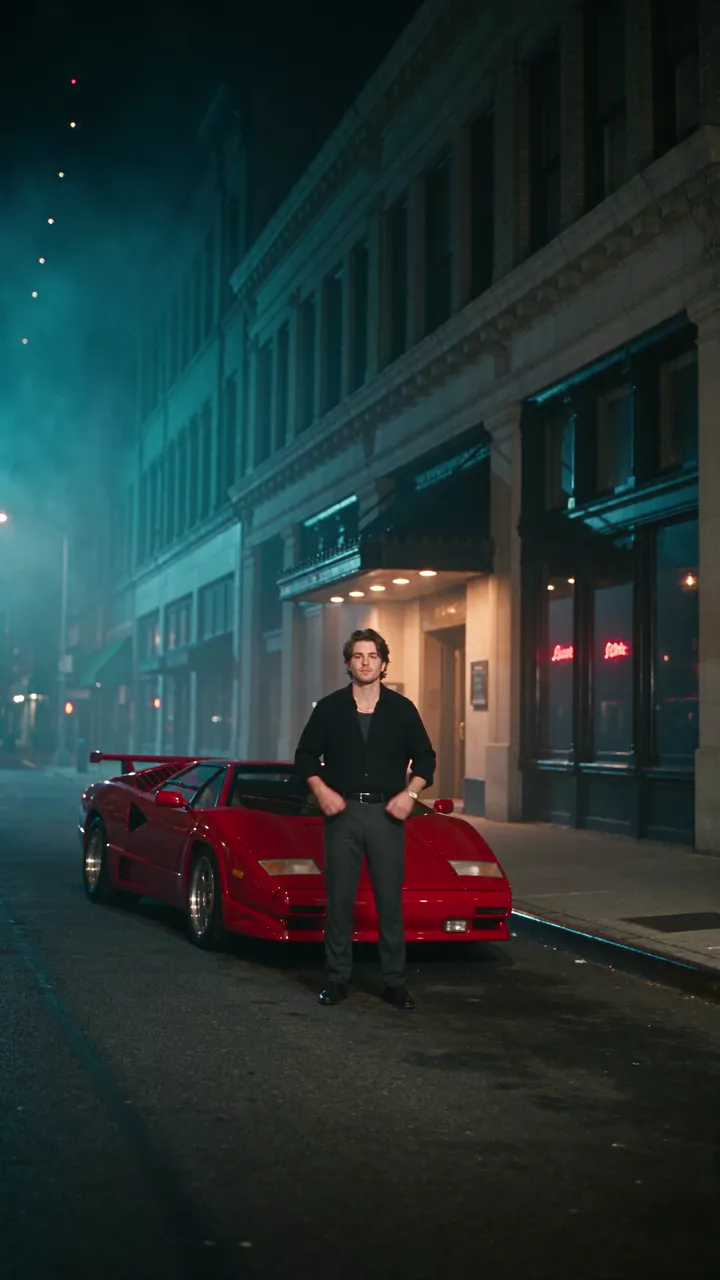
| 2. Afuera del club | El mismo hombre a 24mm, 70mm y 135mm | Un clip, tres etapas cronometradas, sin movimiento de cámara |
| 3. La barra | Desde la puerta hasta un primer plano del hombre en la barra | Un zoom brusco: se alcanza 200mm durante la toma |
| 4. La cabina | "¡Oh! Entiendo, menos milímetros, más en cuadro." | Una órbita lenta de un cuarto |
| 5. Sobre su hombro | "Sí, más milímetros, encuadre más cerrado. Acercarse o alejarse también lo cambia." | Una toma fija sobre el hombro |
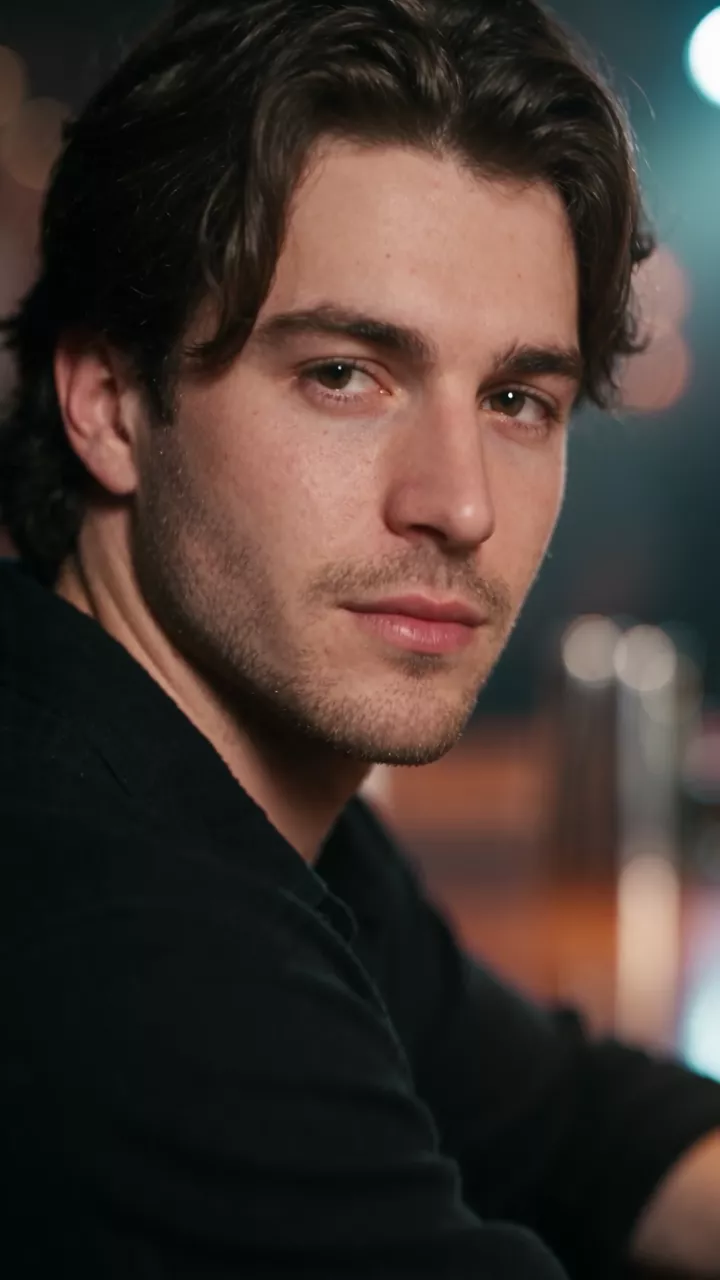
| 6. Cerca | Él mira a la lente: "Responde 'knoll' para la guía gratis." | Cámara fija |
Qué significan los milímetros
24mm, 70mm, 135mm y 200mm son distancias focales: números que describen el campo de visión de un lente. Si la cámara y el sujeto permanecen en su lugar y la relación de aspecto no cambia, una distancia focal más corta muestra más del entorno, y una más larga ofrece un encuadre más cerrado y hace que el sujeto se vea más grande.
La distancia focal por sí sola no define el tamaño del plano. Puedes filmar un rostro o un cuerpo entero con 135 mm; el resultado también depende de la distancia entre la cámara y el sujeto. Esta tabla muestra qué parte de la escena llena un encuadre vertical 9:16 a tres distancias:
| Lente | A 3 m | A 10 m | A 30 m |
|---|---|---|---|
| 24mm | 4.5 m | 15 m | 45 m |
| 70mm | 1.5 m | 5 m | 15 m |
| 135mm | 0.8 m | 2.7 m | 8 m |
| 200mm | 0.54 m | 1.8 m | 5.4 m |
Léelo considerando una persona de aproximadamente 1.8 m de altura. A 3 m de distancia, un lente de 135 mm la encuadra del pecho hacia arriba, mientras que uno de 24 mm la muestra de la cabeza a los pies con mucho espacio alrededor. A 30 m de distancia, el mismo lente de 135 mm aún la muestra de la cabeza a los pies, ocupando aproximadamente una quinta parte de la altura del encuadre. Esta es la respuesta a la pregunta inicial del reel: indica cuánto de la persona quieres mostrar, no solo el lente.
Combina el lente con el plano
Usa la distancia focal como una pista visual y luego describe el encuadre con palabras claras. Estos son puntos de partida, no reglas estrictas:
| Distancia focal | Mejor uso | Describe el encuadre como |
|---|---|---|
| 24mm | Quieres mostrar al sujeto dentro de la locación | Un plano general de cuerpo entero con un entorno legible alrededor del sujeto |
| 70mm | El sujeto, la ropa y los gestos de las manos son importantes | Un plano medio de la cintura hacia arriba, con toda la cabeza y ambas manos visibles |
| 135mm | La cara y la reacción marcan el momento | Un primer plano de los hombros hacia arriba, con los ojos y la expresión claramente legibles |
| 200mm | Necesitas un retrato cerrado desde lejos | Una posición de cámara lejana, con la cabeza y los hombros llenando la mayor parte del encuadre |
Todas las distancias focales de esta guía son equivalentes a formato completo: el número que tendría un lente en una cámara de formato completo de 35 mm. Ofrece una referencia común para comparar los campos de visión.
Describe el encuadre, no solo el lente
Escribir lente de 135 mm no es suficiente. Un prompt útil sigue este orden:
- El encuadre: general, medio, primer plano.
- La distancia focal, como apariencia: una apariencia de lente de 135 mm equivalente a formato completo.
- Lo que debe permanecer visible: de los hombros hacia arriba, manteniendo toda la cabeza visible.
- La acción: una cosa simple, como una mirada hacia la cámara y una pequeña sonrisa.
- El movimiento de cámara: handheld contenido, sin zoom.
Close-up with a 135mm full-frame-equivalent lens look.
Frame the subject from the shoulders up, keeping the entire head visible. The subject looks toward the camera with a subtle smile. Restrained handheld movement. No zoom.Atención:Una pista visual, no una garantía. En los videos con IA, la distancia focal es una pista, no una promesa de que el modelo reproduzca la óptica de un lente real. Juzga el resultado por la imagen: qué tan grande es el sujeto, cuánto del lugar permanece visible y si la reacción se entiende.
Cuatro bloques para pegar
Elige un bloque y agrégalo a tu escena. Describe al personaje, el lugar, la luz, la relación de aspecto y la duración por separado.
Wide shot with a 24mm full-frame-equivalent lens look.
Show the subject from head to toe, with generous space around them and a clearly readable environment. Keep the subject away from the extreme frame edges.
The subject takes one relaxed step and looks across the location. Restrained handheld movement from a fixed camera position. No zoom or camera travel.Medium shot with a 70mm full-frame-equivalent lens look.
Frame the subject from the waist up, keeping the entire head and both hands visible. Show a limited portion of the environment.
The subject briefly adjusts their sleeve, then looks toward the camera. Restrained handheld movement from a fixed camera position. No zoom or camera travel.Close-up with a 135mm full-frame-equivalent lens look.
Frame the subject from the shoulders up, keeping the entire head visible. Make the eyes and facial expression clearly readable.
The subject turns slightly toward the camera and gives a restrained, knowing smile. Subtle breathing and natural blinking. Restrained handheld movement from a fixed camera position. No zoom or camera travel.Close-up from a distant camera position, with a 200mm full-frame-equivalent telephoto lens look. The subject's head and shoulders fill most of the frame.
The subject pauses their work and looks toward the camera. Keep the eyes sharp and the expression natural. Restrained handheld movement from the same distant position.
No zoom or forward camera travel.Usa 24mm cuando el lugar es parte de la historia, 70mm cuando el espectador necesita ver tanto la expresión como las manos, 135mm cuando una mirada o una pequeña sonrisa transmiten el significado, y 200mm cuando la cámara observa desde el otro lado de un patio, una calle o una habitación grande.
Haz la comparación de 24, 70 y 135
El corazón del reel es un clip de 18 segundos de Seedance 2.5 con tres etapas cronometradas: 24mm de 0 a 6 segundos, 70mm de 6 a 12, 135mm de 12 a 18. El hombre permanece en el mismo lugar junto al Lamborghini rojo, y el prompt pide que cada cambio "se sienta como cambios reales de cámara/lente" sin zoom digital.
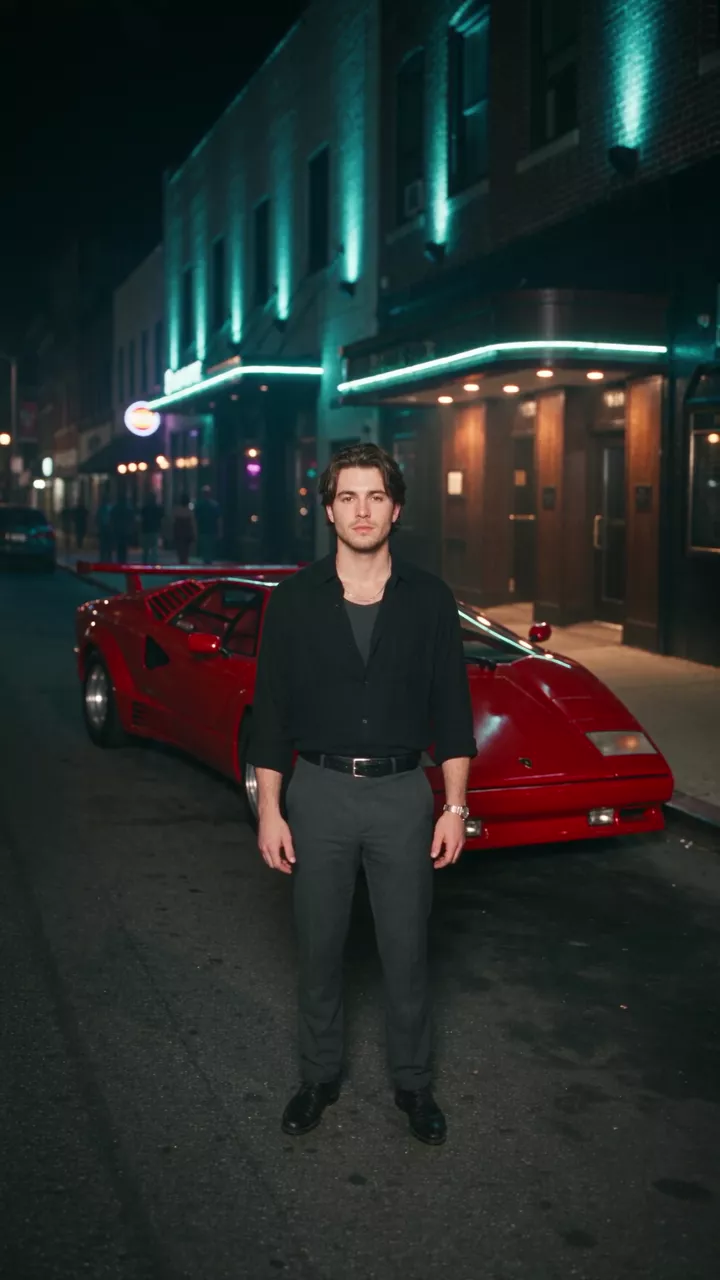
La solución fue dar a la toma amplia una distancia y un tamaño, no solo un lente: "Coloca la cámara MUY LEJOS del hombre, aproximadamente a 25-35 metros de distancia", y "Él debe ocupar aproximadamente el 8-12% de la altura total del encuadre". Dos pruebas de 5 segundos de la toma amplia de la calle se hicieron antes de la primera ejecución de 18 segundos.
SEEDANCE 2.5 - 18 SECOND VIDEO - 9:16 VERTICAL

Use the uploaded male character reference as the STRICT identity reference.

Preserve his exact face, hairstyle, facial structure, body proportions, clothing, accessories and overall appearance throughout the entire video.

The character remains in the SAME physical location throughout all three focal-length stages.

CONCEPT:

A stylish late-1990s American nightclub exterior at night.

The man stands outside the nightclub, confidently facing the camera while naturally posing.

He does NOT speak.

He maintains a generally straight, front-facing body orientation toward the camera, but behaves like a real person casually posing: subtle posture changes, natural hand movements, fixing his collar, briefly putting a hand into his pocket, shifting his weight, glancing to the side and naturally returning his eyes to camera.

These movements must remain subtle, relaxed and masculine.

He should NEVER look frozen or mannequin-like.

Behind him is an authentic late-1990s nightclub exterior with a period-correct RED LAMBORGHINI parked behind him.

The Lamborghini has authentic late-1990s styling, glossy red paint and realistic period-correct details.

--------------------------------------------------
0-6 SECONDS - 24MM EXTREME WIDE
--------------------------------------------------

IMPORTANT: THIS SHOT MUST BE MUCH FARTHER AWAY THAN THE PREVIOUS VERSION.

Use a TRUE 24MM ENVIRONMENTAL WIDE SHOT.

Place the camera VERY FAR from the man, approximately 25-35 meters away.

The man should appear SMALL within the 9:16 vertical frame.

He should occupy approximately 8-12% of the total frame height.

The environment must dominate the composition.

Show a LARGE amount of:

nightclub facade,
street,
sidewalk,
nightclub entrance,
parked Lamborghini,
surrounding architecture,
streetlights,
distant background,
nighttime atmosphere.

The man should feel like a person standing within a large environment, NOT like a portrait subject.

He remains approximately centered but has substantial negative space around him.

The camera remains stationary or has only extremely subtle natural operator movement.

DO NOT push toward him.

DO NOT zoom.

DO NOT crop in.

DO NOT track tightly.

This should feel like the same distant environmental scale as the 24MM reference, but pushed even farther.

During these six seconds, the man naturally poses while remaining small in the frame.

For example:

He begins with both hands relaxed.

He subtly shifts his weight.

He casually places one hand into his trouser pocket.

He briefly adjusts his jacket/collar with the other hand.

He returns to a relaxed stance.

He looks directly at the camera, briefly glances toward the side, then naturally returns his gaze to the camera.

All movements are slow, subtle and believable.

His body remains generally facing the camera.

He does NOT walk.

He does NOT turn his body away.

--------------------------------------------------
6-12 SECONDS - 70MM MEDIUM
--------------------------------------------------

At exactly 6 seconds, transition to the 70MM MEDIUM SHOT.

Keep the character in EXACTLY the same physical location.

Match the 70MM reference framing from the previous version.

Frame approximately from the waist/chest upward.

The man is now substantially larger in frame.

The nightclub remains visible behind him but is more compressed.

The red Lamborghini remains recognizable in the background.

The man continues naturally posing.

He may:

casually put one hand in his pocket,
adjust his collar,
briefly straighten his shirt,
shift his shoulders slightly,
look briefly toward one side,
then return his eyes directly to camera.

Keep the body generally facing straight toward camera.

These actions should flow naturally into each other rather than feeling like separate poses.

His facial expression gradually becomes more confident and relaxed.

A very subtle smile begins to develop.

Natural blinking.
Natural breathing.
Natural eye movement.
Subtle facial muscle movement.

No dialogue.

Do NOT make him perform exaggerated fashion-model poses.

--------------------------------------------------
12-18 SECONDS - 135MM CLOSE-UP
--------------------------------------------------

At exactly 12 seconds, transition to the 135MM CLOSE-UP.

Match the 135MM reference framing from the previous version.

The man's face becomes the dominant element of the vertical frame.

Frame approximately from the upper chest/shoulders upward.

The nightclub becomes heavily compressed and softly blurred.

The red Lamborghini becomes a soft red shape in the background.

Club lights become beautiful soft bokeh.

The man maintains direct eye contact most of the time.

He develops a natural, subtle confident smile.

He can briefly glance slightly to the side, then return his eyes to the camera.

He may make one tiny collar adjustment or subtle shoulder movement if naturally motivated, but keep the close-up primarily focused on his face.

The final expression should feel charismatic, relaxed and confident.

NOT a huge smile.
NOT a laugh.
NOT exaggerated.

Focus intensely on realistic facial performance:

subtle eye movement,
natural blinking,
tiny eyebrow movement,
natural cheek movement,
subtle lip movement,
realistic facial muscle movement,
natural skin deformation while smiling.

--------------------------------------------------
REALISTIC SKIN - CRITICAL
--------------------------------------------------

The 135MM close-up must reveal REALISTIC HUMAN SKIN.

Visible natural pores.
Fine facial hairs.
Peach fuzz.
Subtle blemishes.
Natural under-eye texture.
Realistic lips.
Individual eyelashes.
Tiny variations in skin tone.
Natural skin translucency.
Realistic texture around the nose, cheeks and forehead.

Do NOT smooth or beautify the skin.

Do NOT use plastic AI skin.

Do NOT airbrush.

Do NOT sharpen the pores artificially.

The skin should look like an extremely high-quality real 35mm photographic close-up of an actual human being.

When the man smiles, the skin around his eyes, cheeks and mouth should move naturally.

--------------------------------------------------
LENS / FRAMING ACCURACY
--------------------------------------------------

24MM:
EXTREMELY FAR.
True environmental wide shot.
Man very small.
Approximately 8-12% of frame height.
Large amount of environment.
Lamborghini clearly visible.
Minimal compression.

70MM:
MEDIUM SHOT.
Man significantly larger.
Waist/chest-up framing.
Less environment.
More background compression.
Lamborghini still recognizable.

135MM:
CLOSE-UP.
Face dominates frame.
Upper chest/shoulders visible.
Very little environment.
Strong background compression.
Nightclub lights become soft bokeh.
Lamborghini becomes a soft red background element.

The three stages must feel like genuinely different focal lengths.

Do NOT simulate them with simple digital cropping.

--------------------------------------------------
CAMERA TRANSITIONS
--------------------------------------------------

24MM → 70MM at exactly 6 seconds.

70MM → 135MM at exactly 12 seconds.

The transitions should feel like real camera/lens changes while preserving the man's physical position.

Do NOT digitally zoom.

Do NOT change the location.

Do NOT move the character forward.

Do NOT change his wardrobe.

--------------------------------------------------
VISUAL AESTHETIC
--------------------------------------------------

Authentic late-1990s American nightlife.

Premium realistic commercial photography.

Cool cyan-blue and blue-green environmental lighting.
Warm amber nightclub entrance lighting.
Deep charcoal blacks.
Subtle red and magenta nightlife accents.
Warm natural skin.
Glossy red Lamborghini.
Slightly desaturated color palette.
Soft highlights.
Gentle contrast.
Subtle nighttime atmospheric haze.

Authentic 35mm photographic rendering.
Fine organic film grain.
Gentle analog softness.
Subtle highlight halation.
Realistic optical depth of field.
Physically believable nighttime lighting.

The overall image should feel like a premium late-1990s nightlife editorial brought to life.

NO dialogue.
NO subtitles.
NO captions.
NO text.
NO logos.
NO watermarks.
NO modern cars.
NO modern nightclub design.
NO smartphones.
NO LED screens.
NO exaggerated posing.
NO mannequin-like stillness.

FINAL STRUCTURE:

0-6 sec:
24MM - EXTREMELY FAR environmental wide - man very small in frame - subtle confident posing.

6-12 sec:
70MM - MEDIUM - natural body movement - subtle confident smile.

12-18 sec:
135MM - CLOSE-UP - realistic skin texture - natural facial expressions - confident subtle smile - direct eye contact.

The character remains confident, relaxed and naturally alive throughout all three focal lengths.Consejo:Temporiza las tomas, no las cortes. Un solo clip con "A los exactamente 6 segundos, transición al PLANO MEDIO DE 70MM" mantiene la luz, el hombre y la calle idénticos en los tres lentes, algo por lo que tres clips separados tendrían que luchar.
Este prompt crea un reel, no una prueba de laboratorio. Mueve la cámara muy atrás para 24 mm y luego pide un plano de cintura para arriba con 70 mm y un plano de hombros para arriba con 135 mm, algo que ningún lente real daría desde 30 m (ver la tabla de arriba). Para una comparación estricta, mantén todo fijo excepto el lente:
| Mantén igual | Por qué |
|---|---|
| El sujeto y el lugar | Para que los cambios de contenido no afecten la comparación |
| Las posiciones de la cámara y del sujeto | Para que el punto de vista permanezca igual |
| La altura de la cámara y la dirección de visión | Para que un cambio de ángulo no se confunda con un cambio de distancia focal |
| La luz y la relación de aspecto | Para que la exposición, la composición y las proporciones permanezcan iguales |
Keep the camera position, camera height, viewing direction and subject position identical across all three shots.
Use the same sensor format and aspect ratio.
Change only the focal length: 24mm, 70mm, then 135mm.
Allow the framing to become progressively tighter.
Do not move the camera or subject to compensate.Atención:No pidas el mismo tamaño. En una comparación real, el sujeto se hace más grande en cada paso, así que nunca le pidas al modelo que mantenga el sujeto del mismo tamaño. Para tener más control, crea primero tres imágenes de referencia coincidentes, revisa las composiciones y luego anima cada una, con solo movimientos pequeños para que no distraigan del lente.
La toma de 200 mm: de la puerta a la barra
La toma de 200mm se construye sobre la distancia. Una mano abre la puerta del club; muy adentro, un bartender sirve una bebida al hombre en la barra, y él es "MINÚSCULO en el encuadre", aproximadamente el 2 al 4% de su altura. Luego, la vista se acerca rápidamente a un primer plano de 200mm, y solo entonces él nota la cámara, se gira y asiente. El prompt marca el tiempo de cada momento:
- 0 a 1 segundo: la mano agarra la manija y la puerta se abre.
- 1 a 2.2 segundos: el bartender sirve; el hombre es minúsculo y no se da cuenta.
- 2.2 a 2.8 segundos: él toma la bebida.
- 2.8 a 4.8 segundos: la aproximación rápida de teleobjetivo de 200mm, de una figura minúscula a un primer plano.
- Luego: él nota la cámara, se gira y hace un pequeño asentimiento.
SEEDANCE 2.5 - 6 SECOND VIDEO - 9:16 VERTICAL

Use the uploaded male character reference as the STRICT identity reference.
Preserve his exact face, hairstyle, facial structure, body proportions, wardrobe and appearance.

CORE CONCEPT:

A 200MM CLOSE-UP FROM AN EXTREME DISTANCE.

The camera begins OUTSIDE a late-1990s nightclub.

A person's hand opens the nightclub door.

The door reveals an extremely deep nightclub interior.

At the VERY FAR END of the club, the male character is sitting at the drink counter.

He is extremely small in the opening frame.

A BARTENDER IS ALREADY POURING HIS DRINK as soon as the door opens.

The man is naturally focused on the bartender and his drink, completely unaware of the camera.

The camera then rapidly telephoto-zooms from this enormous distance toward him.

As the camera approaches, he naturally notices the camera, turns his head toward it, makes eye contact and gives one subtle confident nod.

ONE CONTINUOUS SHOT.
NO CUT.

--------------------------------------------------
0.0-1.0 SEC - HAND OPENS THE DOOR
--------------------------------------------------

Start OUTSIDE the nightclub entrance.

The nightclub door is in the foreground.

A person's hand reaches into frame and naturally grabs the door handle.

The hand opens the door.

The door swings open naturally.

IMPORTANT:

The nightclub interior must NOT already be fully visible.

The first visual action is:

HAND GRABS DOOR
→ DOOR OPENS
→ CLUB INTERIOR REVEALED.

As the door opens, the camera looks DEEP into the nightclub.

--------------------------------------------------
1.0-2.2 SEC - BARTENDER POURS HIS DRINK
--------------------------------------------------

The opening door reveals a VERY LARGE, DEEP nightclub interior.

The camera is still outside.

The male character is sitting AT THE VERY FAR END of the nightclub at the drink counter.

He is TINY in the frame.

He should occupy only approximately 2-4% of the total vertical frame height.

There must be a HUGE amount of physical space between camera and character.

Show multiple layers of depth:

foreground doorway,
door frame,
nearby patrons,
tables,
chairs,
club architecture,
midground crowd,
bar patrons,
waitstaff,
more nightclub space,
FAR BACK DRINK COUNTER,
male character.

The club must feel long and deep.

At the far drink counter:

THE BARTENDER IS ACTIVELY POURING WHISKEY INTO THE MAN'S GLASS.

This action must be clearly visible even though they are very far away.

The bartender stands directly in front of him behind the counter.

The whiskey is visibly being poured from a bottle into a short whiskey glass.

The man is sitting naturally and watching the bartender pour.

He is NOT looking toward the camera.

He is NOT posing.

He is NOT aware of the camera.

The surrounding crowd continues behaving naturally.

People are talking, drinking and moving around the bar.

--------------------------------------------------
2.2-2.8 SEC - HE PICKS UP THE DRINK
--------------------------------------------------

The bartender finishes pouring.

The man naturally reaches forward and picks up the freshly poured whiskey glass.

He looks at the drink or briefly toward the bartender.

He remains relaxed.

He still has NO awareness of the camera.

His body remains oriented toward the bar.

--------------------------------------------------
2.8-4.8 SEC - MASSIVE 200MM TELEPHOTO WHOOSH
--------------------------------------------------

NOW begin the dramatic telephoto movement.

The camera rapidly moves/zooms from the EXTREME DISTANCE toward the man.

The character goes from:

TINY FIGURE AT THE FAR END OF THE CLUB

to:

LARGE 200MM TELEPHOTO CLOSE-UP.

The enormous physical distance must be visually obvious.

As the camera rapidly approaches:

foreground doorway elements,
people,
tables,
bar patrons,
lights
and nightclub architecture

create layered natural motion blur and compression.

The crowd becomes increasingly compressed.

The nightclub background progressively collapses into shallow depth of field.

This should feel like an extremely powerful long-lens 200MM camera bringing a distant subject into close view.

NOT a digital crop.

NOT a simple image enlargement.

NOT a CGI tunnel.

NOT teleportation.

Do not distort or morph the character's face.

--------------------------------------------------
CHARACTER REACTION DURING THE ZOOM
--------------------------------------------------

The man does NOT look toward the camera at the beginning.

Only when the camera gets close enough does he notice it.

While still holding the whiskey glass:

he naturally turns his HEAD toward camera.

His BODY remains mostly oriented toward the bar.

His head turns gradually and naturally.

His eyes find the camera.

The reaction should happen organically:

drinking
→ notices something
→ turns head
→ sees camera
→ makes eye contact.

No sudden snap.

No exaggerated acting.

--------------------------------------------------
4.8-6.0 SEC - 200MM CLOSE-UP
--------------------------------------------------

Land on a TRUE 200MM TELEPHOTO CLOSE-UP.

Frame approximately upper chest/shoulders to top of head.

The man's face dominates the 9:16 frame.

He is still holding the whiskey glass naturally.

His body remains slightly turned toward the bar.

His head is turned toward camera.

He looks directly into the lens.

He gives ONE subtle, confident nod.

Then holds a calm, confident expression.

The nod should communicate quiet acknowledgment.

No exaggerated smile.

No speaking.

No dramatic head movement.

--------------------------------------------------
FINAL 200MM LOOK
--------------------------------------------------

The final shot must genuinely look like a 200MM telephoto lens.

Strong background compression.
Extremely shallow depth of field.
Minimal perspective distortion.
Natural facial proportions.
Compressed nightclub crowd.
Soft amber and cyan nightclub bokeh.

The character should look like he has been photographed from a very large distance using a powerful telephoto lens.

--------------------------------------------------
SKIN REALISM - CRITICAL
--------------------------------------------------

The final close-up must reveal extremely realistic human skin:

visible pores,
fine peach fuzz,
individual facial hairs,
subtle blemishes,
natural under-eye texture,
realistic lips,
individual eyelashes,
natural skin-tone variation,
realistic facial movement.

No plastic AI skin.
No beauty filter.
No airbrushing.
No excessive smoothing.

--------------------------------------------------
NIGHTCLUB ENVIRONMENT
--------------------------------------------------

Authentic late-1990s upscale American nightclub.

Very deep interior.

Busy crowd.

Male character seated at the FAR BACK drink counter.

Dark wood.
Black leather.
Chrome.
Smoked glass.
Warm amber bar lights.
Cool cyan-blue ambient lighting.
Subtle blue-green shadows.
Muted red/magenta accents.
Atmospheric haze.

All people, clothing and styling should feel authentically late-1990s.

--------------------------------------------------
EXACT ACTION ORDER - DO NOT CHANGE
--------------------------------------------------

1. CAMERA OUTSIDE NIGHTCLUB.
2. HAND GRABS CLUB DOOR.
3. HAND OPENS DOOR.
4. DEEP CLUB INTERIOR IS REVEALED.
5. MALE CHARACTER IS TINY AT THE VERY FAR END OF THE CLUB.
6. BARTENDER IS ACTIVELY POURING WHISKEY FOR HIM.
7. MAN WATCHES BARTENDER POUR.
8. BARTENDER FINISHES.
9. MAN PICKS UP HIS WHISKEY GLASS.
10. CAMERA RAPIDLY TELEPHOTO-ZOOMS FROM EXTREME DISTANCE.
11. MAN NATURALLY NOTICES CAMERA.
12. MAN TURNS HIS HEAD TOWARD CAMERA.
13. EYES MEET CAMERA.
14. CAMERA LANDS ON 200MM CLOSE-UP.
15. MAN GIVES ONE SUBTLE CONFIDENT NOD.

ONE CONTINUOUS SHOT.

NO CUTS.
NO DIALOGUE.
NO SUBTITLES.
NO TEXT.
NO LOGOS.
NO WATERMARKS.

The opening must make the viewer feel that they are standing OUTSIDE the club and looking an enormous distance through the entire nightclub to discover the man sitting at the bar, while the bartender is visibly pouring his drink. Camera: a fast crash zoom in on the subject from a fixed position, the lens snapping from wide to a tight close-up.Atención:Esto es un zoom, no una toma de 200mm. El clip termina con una apariencia de 200mm, pero llega ahí cambiando la distancia focal durante la toma: su última frase es la selección de Movimiento de cámara Zoom in en Strong, "un crash zoom rápido hacia el sujeto desde una posición fija". Una toma de 200mm propiamente dicha comienza y permanece ajustada desde lejos; usa el bloque de 200mm anterior para eso.
Crea primero a los dos personajes y al club
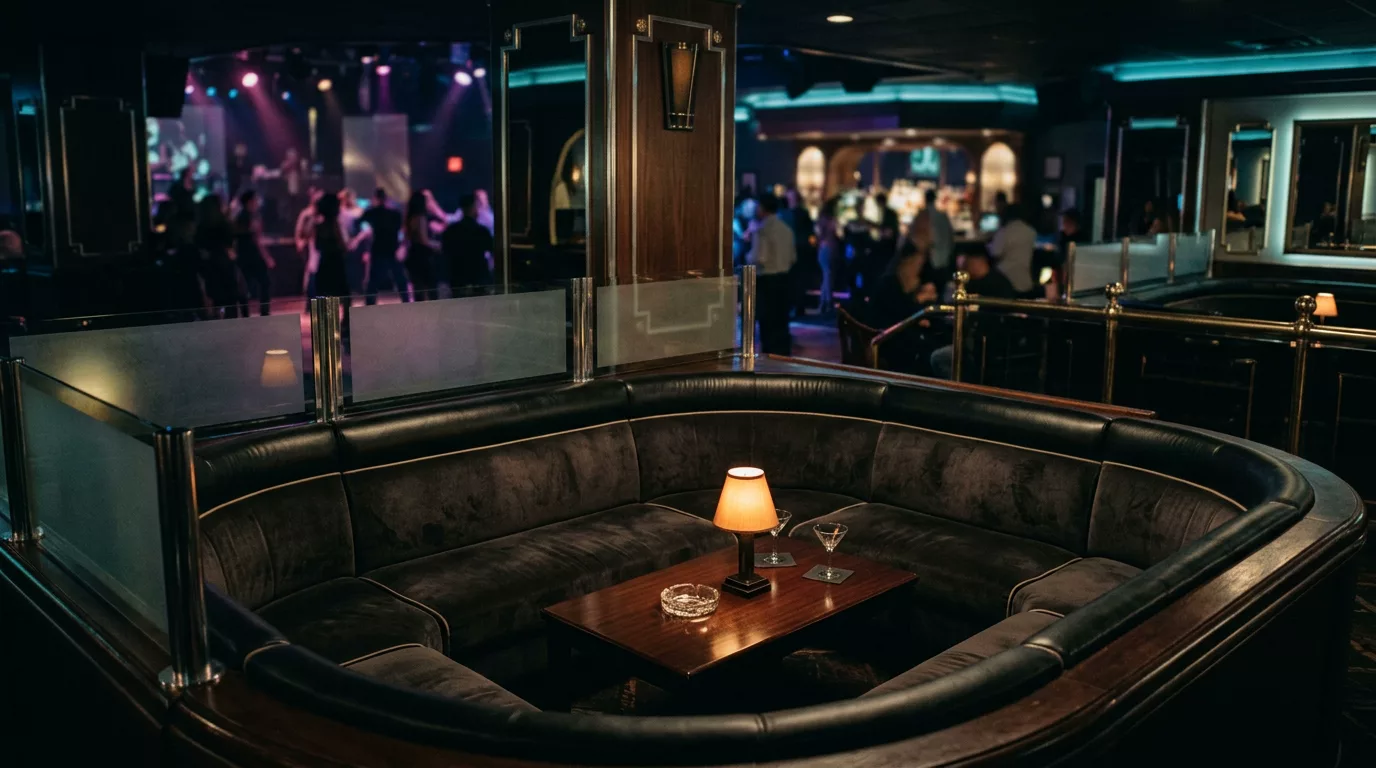
Los clips se basan en tres imágenes: una hoja de personaje para cada una de las dos personas y una imagen fija del club, todas creadas con Nano Banana 2. Se colocan en el compositor de video bajo Imágenes de referencia, y los prompts las nombran: "@Image 1 = referencia exacta del personaje masculino. @Image 2 = referencia exacta del personaje femenino. @Image 3 = referencia exacta de la locación del club nocturno."
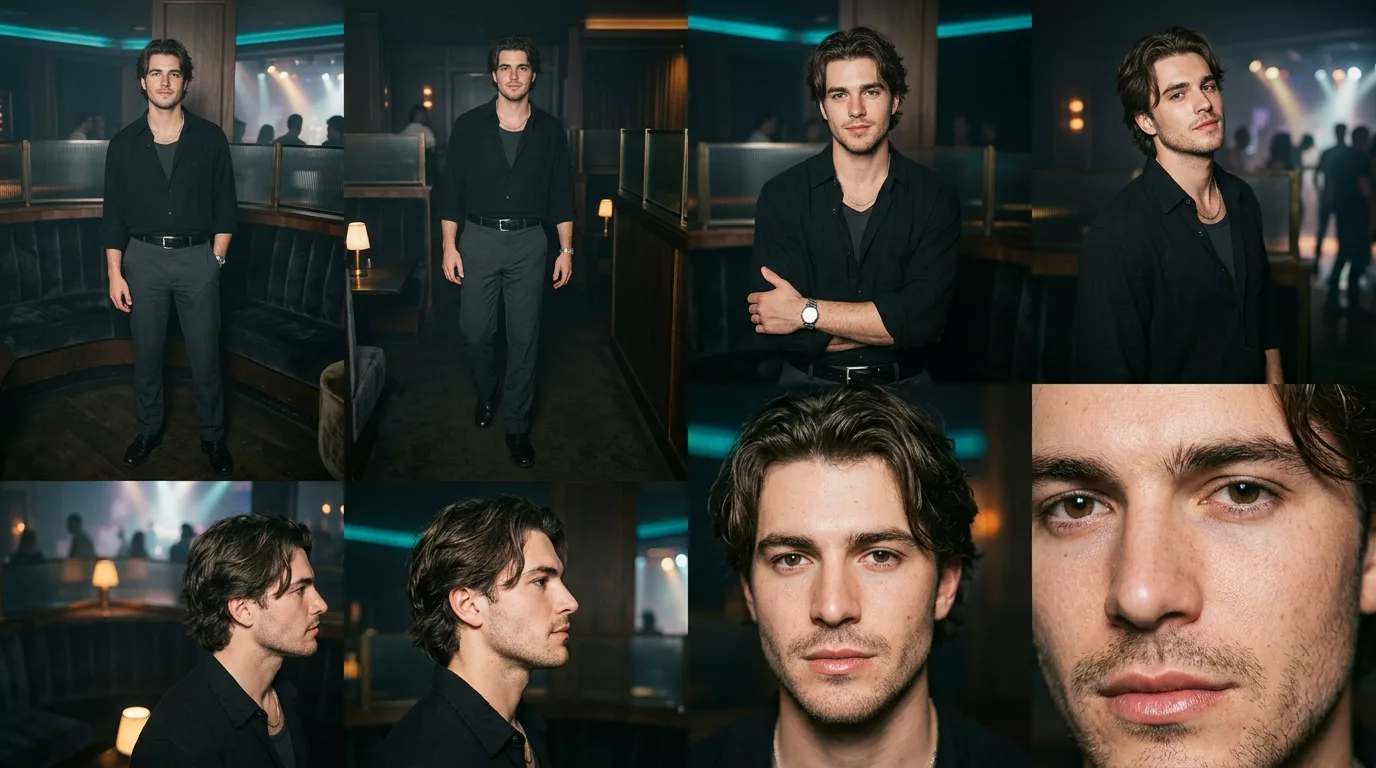
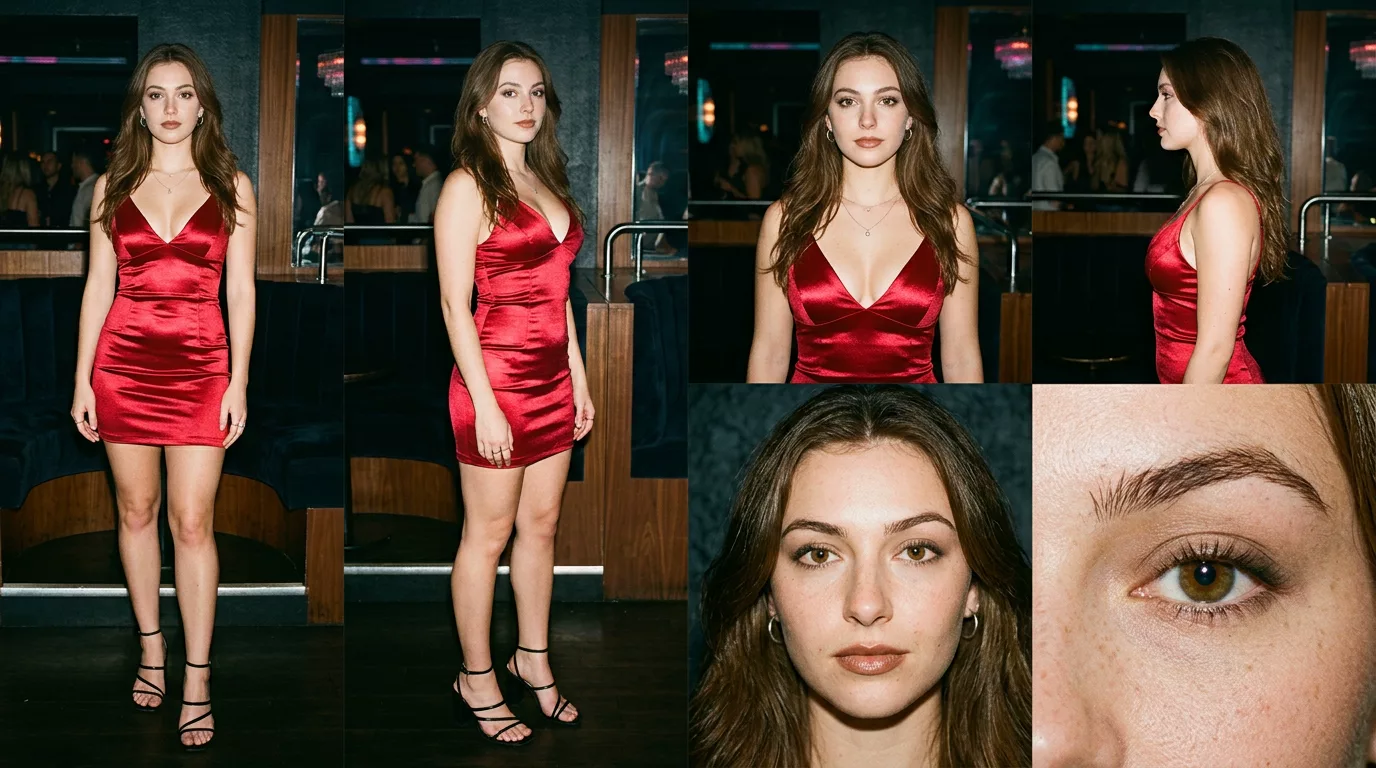
Create a highly realistic photographic character sheet of a handsome white American man, approximately 21-23 years old, designed as a recurring main character for a late-1990s nightclub film.

He should look like a real young American man from approximately 1998-1999 - naturally handsome, stylish and confident, but not like a modern model dressed in vintage clothing.

FACE:
Strong but realistic facial structure, expressive brown eyes, natural eyebrows, defined cheekbones, realistic nose and lips, subtle facial asymmetry and a relaxed confident expression. Slight natural facial imperfections.

SKIN:
Extremely realistic human skin texture: visible pores, fine peach fuzz, subtle blemishes, natural under-eye texture, realistic lips, individual facial hairs and believable skin translucency. No plastic AI skin, no beauty filter, no airbrushed appearance.

HAIR:
Medium-length dark brown hair with an authentic late-1990s hairstyle: naturally thick, slightly layered, softly tousled with subtle volume and imperfect individual strands. Period-correct without becoming exaggerated.

FACIAL HAIR:
Very subtle late-90s stubble along the jaw and upper lip, naturally uneven and realistic.

WARDROBE:
Authentic late-1990s upscale club fashion: relaxed black button-up shirt worn slightly open at the collar, fitted but not skinny dark charcoal trousers, black leather belt and polished black leather shoes.

Add a simple silver chain necklace and understated silver watch.

The clothing should feel expensive and fashionable for 1998-1999 without looking like modern streetwear.

BODY:
Natural lean athletic build with realistic proportions, broad but believable shoulders and relaxed posture. No exaggerated muscularity.

CHARACTER PRESENCE:
Calm, confident, slightly mysterious and effortlessly cool. He should feel like someone who naturally belongs in an upscale late-90s nightclub.

ENVIRONMENT:
Place him in a private seating area inside an authentic late-1990s American nightclub: dark velvet booth seating, small low table, dark wood, smoked glass, chrome details, dim club lighting, subtle cyan/blue practical lights and warm amber highlights, with an indistinct dance floor and blurred clubgoers far behind him.

The space must feel PRIVATE while clearly being part of a real nightclub.

PHOTOGRAPHIC STYLE:
Premium realistic photographic aesthetic with cool cyan-blue and muted green environmental tones contrasted against warm natural skin and subtle amber practical lighting.

Slightly desaturated colors, soft highlights, gentle contrast, atmospheric haze and realistic depth of field.

Authentic late-1990s nightlife photography shot on 35mm film. Fine organic film grain, subtle analog softness, realistic halation around lights and natural photographic imperfections.

CHARACTER SHEET:
Show the EXACT SAME MAN in:

1. Full-body front view
2. Full-body 3/4 view
3. Waist-up front portrait
4. Waist-up 3/4 portrait
5. Side profile
6. Tight facial close-up
7. Extreme facial close-up showing realistic pores, peach fuzz, facial hair, eyelashes and natural skin texture

Maintain EXACT facial identity, hairstyle, age, body proportions, wardrobe, accessories and skin tone across every view.

No modern clothing, modern hairstyle, modern grooming, influencer aesthetic, plastic skin, CGI appearance, excessive retouching, logos, text or watermarks.Create a highly realistic photographic establishing image of an upscale late-1990s American nightclub, specifically a private VIP seating area inside the club.
The location should feel like an authentic 1998-1999 nightclub - sophisticated, slightly dark, intimate and expensive, NOT a modern nightclub designed to look retro.
COMPOSITION:
A spacious private booth area occupies the foreground and middle ground. Large curved dark charcoal/black velvet banquettes wrap around a low dark wooden table. Several empty booth sections extend naturally through the space.
The camera is positioned at approximately seated eye level, looking diagonally across the private seating area. Leave enough open space in the main booth for two people to sit naturally later.
The VIP area should feel secluded but still visually connected to the nightclub behind it.
BACKGROUND:
Behind the private booths, show a larger nightclub environment with a distant dance floor and bar area. Only a few indistinct clubgoers are visible in the background, heavily blurred by shallow depth of field.
Include subtle late-1990s nightclub details:
dark wood paneling,
smoked glass,
brushed chrome,
black leather and velvet,
small table lamps,
frosted glass partitions,
mirrored surfaces,
period-correct bar furniture,
subtle decorative wall panels,
dim practical lighting.
No modern LED screens, no contemporary furniture, no modern architectural details.
LIGHTING:
The nightclub is primarily illuminated by practical light sources.
Cool cyan-blue ambient lighting runs subtly along architectural edges and ceiling details.
Warm amber table lamps and small tungsten practicals illuminate the booths.
Very subtle magenta/purple nightclub light can appear deep in the background around the dance floor.
The lighting must feel sophisticated and atmospheric rather than colorful or neon-heavy.
Create beautiful pools of warm light on the seating while the surrounding environment falls into cool cyan-green shadows.
COLOR PALETTE - CRITICAL:
Premium cinematic photographic color treatment:
deep charcoal black,
dark espresso brown,
muted cyan,
cool blue-green,
soft teal,
warm amber,
subtle muted magenta in the distant background.
The environment should be slightly desaturated overall.
Keep the blacks rich but retain visible detail.
Keep cyan lighting subtle and sophisticated.
Warm amber practical lights should create contrast against the cool environment.
Do NOT use exaggerated neon colors.
Do NOT make everything blue.
Do NOT use modern teal-and-orange Hollywood grading.
The result should have the same refined cool-environment / warm-subject relationship as a high-end commercial photograph.
CAMERA / LENS:
Photographed on a professional 35mm film camera with a natural 40-50mm perspective.
Moderately shallow depth of field.
Foreground booth texture remains detailed.
Background gradually falls into soft optical blur.
Natural lens rendering, subtle halation around practical lights, gentle highlight rolloff, organic film grain and very slight analog softness.
The image should feel photographed rather than digitally rendered.
ERA AUTHENTICITY:
Every visible object must feel appropriate to approximately 1998-1999.
Late-90s nightclub furniture.
Late-90s lighting fixtures.
Late-90s bar design.
Late-90s interior materials.
Late-90s glassware and tables.
Late-90s atmosphere.
Avoid obvious 1970s, 1980s or modern nightclub design.
ATMOSPHERE:
Sophisticated late-night energy without looking chaotic.
There is a sense that a busy party is happening beyond the private booth, but this particular seating area is quiet enough for two people to have a conversation.
Subtle atmospheric haze catches the distant club lighting.
The club feels exclusive, intimate, slightly mysterious and luxurious.
IMPORTANT:
No main characters.
No recognizable people in the foreground.
Only indistinct blurred silhouettes far in the background.
No text.
No logos.
No signage.
No DJ visible.
No screens.
No modernPara crearlos, abre Imagen desde el menú Crear y elige el modelo, o pídele al NOLGIA Agent y él elegirá el modelo adecuado para el trabajo. Para elegir manualmente: para imágenes con texto, como un póster, un anuncio o el título de una miniatura, elige GPT Image 2.6 Flare; para personas y personajes recurrentes, Seedream 5.5; para una imagen en 4K real, Nano Banana 2.1 a 4K. Google ha descontinuado Nano Banana 2, que generaba estas tres; Nano Banana 2.1 lo reemplaza al mismo precio. Para usarlas, pulsa Imágenes de referencia en el compositor de video y agrégales con Subir o Biblioteca. La comparación y la toma de 200mm solo adjuntan su hoja, porque solo él aparece en ellas.
Las escenas en la cabina: diálogo y cámara
Los cuatro clips de la cabina llevan el guion. Cada prompt da las palabras exactas entre comillas, quién las dice y cuándo, y cómo se comportan los dos: "TWO CONFIDENT PEOPLE CASUALLY TALKING IN A NIGHTCLUB WHILE A CAMERA HAPPENS TO BE FILMING THEM." Cada uno tiene una idea clara de cámara:
- La pregunta: un plano general de dos, un movimiento lento hacia adelante sobre ella mientras habla, luego un barrido rápido y con desenfoque de movimiento hacia él. Recrea el movimiento de cámara de un video de referencia que adjuntó el creador de videos.
- La revelación: una órbita lenta de un cuarto alrededor de la cabina, con la opción Movimiento de cámara Orbit left.
- La explicación: una toma fija sobre su hombro, encuadrada desde una imagen de referencia subida.
- La frase final: cámara fija, sus ojos en el lente para la frase, luego se vuelve hacia la conversación.
SEEDANCE 2.5 - 7.5 SECOND VIDEO - 9:16 VERTICAL

REFERENCE IMAGES:
@Image 1 = exact male character reference.
@Image 2 = exact female character reference.
@Image 3 = exact nightclub location reference.

Preserve the exact facial identity, hairstyle, body proportions, wardrobe, accessories and skin texture of both characters.

Preserve the exact nightclub booth, curved seating, low table, lamp, wood paneling, glass partitions, background club and lighting from the location image.

IMPORTANT COMPOSITION:
The man and woman are sitting OPPOSITE EACH OTHER across the curved VIP booth, with the low table between them.

They are NOT sitting beside each other.

Both characters sit in a relaxed, confident, natural manner. They look completely comfortable in the environment, as if they regularly spend time in this nightclub.

They are stylish, self-assured and charismatic, but NOT overly posed.

ONE CONTINUOUS CONVERSATIONAL SCENE.

DIALOGUE - EXACT WORDING:

WOMAN:
“Why does AI show my whole body when I ask for a close up?”

MAN:
“Let’s get to specifics. We are gonna break down focal length.”

Do not change, shorten, paraphrase or add dialogue.

--------------------------------------------------
PERFORMANCE
--------------------------------------------------

The couple must speak naturally, like two confident young adults having a casual conversation.

The dialogue must NOT feel like an advertisement being recited.

The woman speaks naturally to the man while remaining relaxed in her seat.

She uses subtle, believable conversational hand gestures while talking - a small movement of one hand, a slight open-palm gesture or a small gesture toward herself when saying “my whole body.”

Her gestures should happen naturally at appropriate moments, NOT on every word.

Her facial expression changes naturally throughout the sentence: confident, mildly amused, slightly questioning and curious.

She occasionally shifts her eyes toward the man, briefly glances away naturally, then returns her attention to him.

She does NOT stare directly into the camera while delivering the entire sentence.

The man listens confidently and comfortably.

While the woman speaks, he naturally reacts with small facial expressions, subtle eye movement, a slight nod or tiny amused reaction.

He does NOT sit completely frozen.

When the camera transitions to him, he naturally takes over the conversation.

The man delivers:

“Let’s get to specifics. We are gonna break down focal length.”

His tone is calm, confident and conversational.

He makes one or two subtle natural hand gestures while speaking, emphasizing the idea of “specifics” and “focal length.”

He may briefly shift his posture or lean slightly forward as he begins speaking.

Both characters have:
natural blinking,
natural breathing,
subtle facial reactions,
small head movements,
natural eye movement,
realistic mouth movement,
small posture adjustments,
natural hand gestures.

Do NOT exaggerate their expressions.

Do NOT make them constantly smile.

Do NOT make them constantly gesture.

Do NOT make them look like actors performing for a commercial.

The feeling should be:
TWO CONFIDENT PEOPLE CASUALLY TALKING IN A NIGHTCLUB WHILE A CAMERA HAPPENS TO BE FILMING THEM.

--------------------------------------------------
CAMERA MOVEMENT - MATCH THE ORIGINAL REFERENCE
--------------------------------------------------

THIS IS THE MOST IMPORTANT PART OF THE PROMPT.

Recreate the camera movement of the uploaded reference video as closely as possible.

The reference camera movement is NOT a dramatic cinematic dolly, orbit or handheld sequence.

It is a very controlled, gradual move from a wide two-shot into a close-up of the woman, followed by a fast motion-blurred transition to the man.

0.0-0.7 SECONDS:

Start with a WIDE TWO-SHOT.

Both characters are visible sitting opposite each other across the booth.

The entire seating area and some of the nightclub environment are visible.

The camera is stable and positioned at approximately eye level.

The couple is already sitting naturally when the video begins.

0.7-3.3 SECONDS:

Begin a SLOW, CONTINUOUS FORWARD CAMERA MOVE toward the WOMAN.

The camera gradually gets closer and closer to her.

This should feel like the camera is physically moving toward her while maintaining the same general viewing direction.

The composition progressively changes:

WIDE TWO-SHOT
→ MEDIUM TWO-SHOT
→ MEDIUM CLOSE-UP OF WOMAN
→ CLOSE-UP OF WOMAN.

The man gradually leaves the frame as the woman becomes dominant.

The movement is smooth, controlled and deliberate.

It is NOT a dramatic dolly.

It is NOT a digital zoom.

It is NOT random handheld movement.

The camera should reproduce the restrained forward movement visible in the reference.

The woman delivers her complete line during this movement:

“Why does AI show my whole body when I ask for a close up?”

By the end of her sentence, the camera is close to her face and upper torso.

Her natural facial expressions and hand movements remain visible during the move.

3.3-3.8 SECONDS:

FAST CAMERA TRANSITION.

Immediately after the woman finishes speaking, rapidly swing the camera from the woman toward the man.

Create the SAME strong motion-blurred camera transition visible in the original reference.

The entire frame briefly becomes naturally motion-blurred as the camera rapidly changes direction.

This must look like REAL CAMERA MOTION.

Not a digital transition.
Not a crossfade.
Not a whip-pan graphic.
Not an editing effect.

The motion blur should naturally smear the nightclub and the woman's figure during the rapid camera movement.

3.8-7.5 SECONDS:

The camera lands on the MAN in a close-up.

The man is still seated opposite the woman in the same booth.

His position, wardrobe, face and environment remain completely consistent.

He begins speaking naturally:

“Let’s get to specifics. We are gonna break down focal length.”

He initially looks naturally toward the woman, then shifts his gaze toward the camera as he begins explaining.

While speaking, the camera makes a VERY SUBTLE continued forward movement toward him, similar to the gentle push-in visible in the original reference.

Do not make this movement dramatic.

The man remains relaxed and confident.

Finish with him in a tight conversational close-up.

--------------------------------------------------
CAMERA RULES
--------------------------------------------------

The camera sequence MUST be:

WIDE TWO-SHOT
→ SLOW FORWARD MOVE TOWARD WOMAN
→ PROGRESSIVELY TIGHTER WOMAN FRAMING
→ WOMAN CLOSE-UP
→ FAST MOTION-BLURRED CAMERA TRANSITION
→ MAN CLOSE-UP
→ SUBTLE FORWARD PUSH-IN.

NO camera cuts.

NO orbit.

NO crane.

NO drone.

NO gimbal look.

NO dramatic dolly.

NO digital zoom.

NO random handheld shake.

NO exaggerated camera movement.

NO slow motion.

The camera should feel like a real operator deliberately moving closer to whoever is speaking.

--------------------------------------------------
VISUAL AESTHETIC
--------------------------------------------------

Match the uploaded nightclub location and the premium color aesthetic of the original reference.

Late-1990s upscale nightclub.

Cool cyan-blue and blue-green ambient lighting.
Warm amber practical table lamp.
Warm natural skin tones.
Deep charcoal blacks.
Dark brown wood.
Glossy red dress catching subtle cyan and amber reflections.
Slightly desaturated environment.
Soft highlights.
Gentle contrast.
Subtle atmospheric haze.

Keep the nightclub environment cool while maintaining naturally warm skin.

Background clubgoers remain distant, indistinct and heavily out of focus.

Use realistic optical depth of field.

Premium 35mm photographic rendering.
Fine organic film grain.
Subtle analog softness.
Gentle highlight halation.
Realistic skin pores.
Natural hair texture.
Realistic satin reflections.

The result should feel like a premium contemporary commercial photographed with a real camera, while retaining authentic late-1990s nightclub styling.

--------------------------------------------------
CONTINUITY
--------------------------------------------------

The couple remains seated opposite each other throughout the entire sequence.

They never switch seats.

They never stand up.

They never sit beside each other.

The booth remains identical.

The nightclub remains identical.

Their faces, hairstyles, clothing and accessories remain identical.

No new foreground characters.

No text.
No subtitles.
No captions.
No logos.
No watermarks.
No UI.

FINAL FEEL:

A confident, stylish young couple casually talking in a private VIP booth inside a late-1990s nightclub.

Natural facial expressions.
Natural hand gestures.
Relaxed confident body language.

The camera behaves exactly like the reference:
it starts wide, gradually moves toward the woman as she speaks, gets progressively tighter until her close-up, rapidly motion-blurs across to the man, then settles into his close-up with a subtle forward push. Camera: aggressive handheld, the frame shaking and lurching with the action, quick reframes and an urgent run-and-gun feel.SEEDANCE 2.5 - 5 SECOND VIDEO - 9:16 VERTICAL
Use the uploaded male and female character references as STRICT identity references.
Use the uploaded reference image as the framing and visual composition reference.
SCENE:
Continue inside the same late-1990s nightclub booth.
The woman and man remain seated opposite each other across the table.
This shot is filmed OVER THE WOMAN'S SHOULDER, with the woman in the immediate foreground and the man as the primary subject.
The woman should be partially visible from behind in the foreground/right side of frame.
Her shoulder, upper back, and a small portion of her hair create natural foreground depth.
The man's face and upper torso are clearly visible beyond her.
The composition should closely resemble the uploaded reference:
woman's shoulder/hair softly out of focus in foreground,
man centered / slightly off-center in the background,
man looking toward the woman,
shallow depth of field,
natural nightclub environment behind him.
--------------------------------------------------
DIALOGUE - EXACT
--------------------------------------------------
MAN:
“Yes, more millimetres, tighter framing. Moving closer or farther changes it too.”
He delivers the ENTIRE sentence naturally and continuously.
No unnecessary pauses.
No extra words.
No rushing.
The delivery should sound like a confident person casually explaining something to someone sitting across from him.
--------------------------------------------------
PERFORMANCE
--------------------------------------------------
The man speaks directly to the woman.
He does NOT look into the camera.
He maintains natural eye contact with the woman positioned in the foreground.
His expression is relaxed, confident and slightly instructional.
As he says:
“Yes, more millimetres, tighter framing.”
he can make a small natural hand gesture toward the space between them, subtly emphasizing the idea of tighter framing.
As he says:
“Moving closer or farther changes it too.”
he makes a restrained conversational gesture, perhaps a small movement of his hand forward and backward to naturally illustrate moving closer/farther.
Keep the gestures subtle.
Do NOT choreograph every word.
The woman remains mostly still in the foreground, listening naturally.
She can make a tiny head movement or nod while listening.
Natural blinking.
Natural breathing.
Natural facial expressions.
Natural eye movement.
Subtle posture shifts.
--------------------------------------------------
CAMERA
--------------------------------------------------
STATIC OVER-THE-SHOULDER COMPOSITION.
Do NOT orbit in this shot.
Do NOT zoom.
Do NOT push in.
Do NOT pull out.
The camera should remain positioned behind and slightly to the side of the woman.
The woman's shoulder and hair should remain softly out of focus in the foreground.
The man remains the sharp focal point.
Use realistic shallow depth of field to separate him from the woman and nightclub background.
Very subtle organic handheld micro-movement is acceptable, but the framing itself remains stable.
--------------------------------------------------
TIMING
--------------------------------------------------
0.0-0.4 SEC:
Establish the over-the-shoulder composition.
Woman's shoulder/hair in foreground.
Man looking naturally toward her.
0.4-4.5 SEC:
Man continuously delivers:
“Yes, more millimetres, tighter framing. Moving closer or farther changes it too.”
Natural facial expressions and subtle hand gestures throughout.
4.5-5.0 SEC:
He finishes the sentence and holds a subtle confident expression while maintaining eye contact with the woman.
No additional dialogue.
--------------------------------------------------
VISUAL STYLE
--------------------------------------------------
Match the established nightclub aesthetic.
Authentic late-1990s upscale American nightclub.
Dark wood.
Black leather booth.
Warm amber table lamp.
Cool cyan-blue ambient lighting.
Deep shadows.
Subtle red/magenta nightclub accents.
Soft atmospheric haze.
Distant nightclub crowd.
Late-1990s clothing and styling.
Natural realistic skin texture.
Visible pores and subtle facial imperfections.
Realistic eyes, lips, hair and facial movement.
Organic 35mm film grain.
Gentle analog softness.
Natural optical depth of field.
Subtle highlight halation.
The woman's foreground should have realistic optical blur rather than artificial Gaussian blur.
The man should have crisp, photorealistic facial detail.
No beauty filter.
No plastic skin.
No artificial sharpening.
No modern nightclub elements.
No smartphones.
No text.
No subtitles.
No logos.
No watermarks.
FINAL FEEL:
A natural cinematic conversation.
The camera observes the man from over the woman's shoulder while he casually explains:
“Yes, more millimetres, tighter framing. Moving closer or farther changes it too.”
He feels relaxed and confident, not like he is presenting to an audience.
The woman feels like a real conversational partner rather than a foreground prop.Atención:Una opción que contradice el prompt. El prompt de la pregunta pide "un movimiento muy controlado y gradual" y descarta una secuencia con cámara en mano, pero su última oración es la selección de Movimiento de cámara en Handheld con intensidad Strong: "cámara en mano agresiva, con el cuadro temblando y sacudiéndose". La selección se aplica después de tu prompt y nada verifica que coincidan, así que elige el movimiento que corresponda, o ninguno.
La pregunta tomó cinco ejecuciones: la cuarta fue una ejecución de 720p del prompt final, y la quinta, a 1080p, es la que se conservó. La materialización tomó tres, la explicación una y la línea de cierre tres.
Tres confusiones
- Longitud focal o distancia. Ambas cambian el tamaño aparente del sujeto. Mover la cámara también cambia la perspectiva, es decir, cómo se relacionan los objetos cercanos y lejanos entre sí; cambiar la longitud focal desde un mismo punto no lo hace. En el reel, la frase del hombre lo dice: "Acercarse o alejarse también lo cambia".
- Un primer plano o un fondo desenfocado. Son decisiones separadas. Si quieres un fondo suave, pídelo: "Fondo suavemente desenfocado, ojos en enfoque nítido".
- Una distancia focal o un movimiento de cámara. 200mm es una distancia focal. Un crash zoom es un cambio rápido de la distancia focal durante la toma, como la toma de la barra en el reel. Un dolly in es la cámara moviéndose físicamente hacia el sujeto, como el acercamiento lento a ella en la cabina. Si quieres que la toma comience cerrada, escribe "Start on a close-up", y agrega un movimiento solo cuando quieras que la audiencia vea el acercamiento.
Generarlo en NOLGIA
Abre Video desde el menú Crear y quédate en Texto a video. Presiona Cambiar en la tarjeta del modelo y elige Seedance 2.5. Presiona Imágenes de referencia y agrega las hojas y el club. Configura el chip de relación de aspecto en 9:16, el chip de duración en la longitud que quieras (18s para la comparación), la calidad en 1080p como aquí o 720p para probar, y deja Audio On para el diálogo. En la fila de Movimiento de cámara, elige el movimiento que describe el prompt, o ninguno. Elige tu proyecto en el menú desplegable Proyecto, pega el prompt y presiona Generar video. El precio aparece en el botón antes de que se ejecute nada.
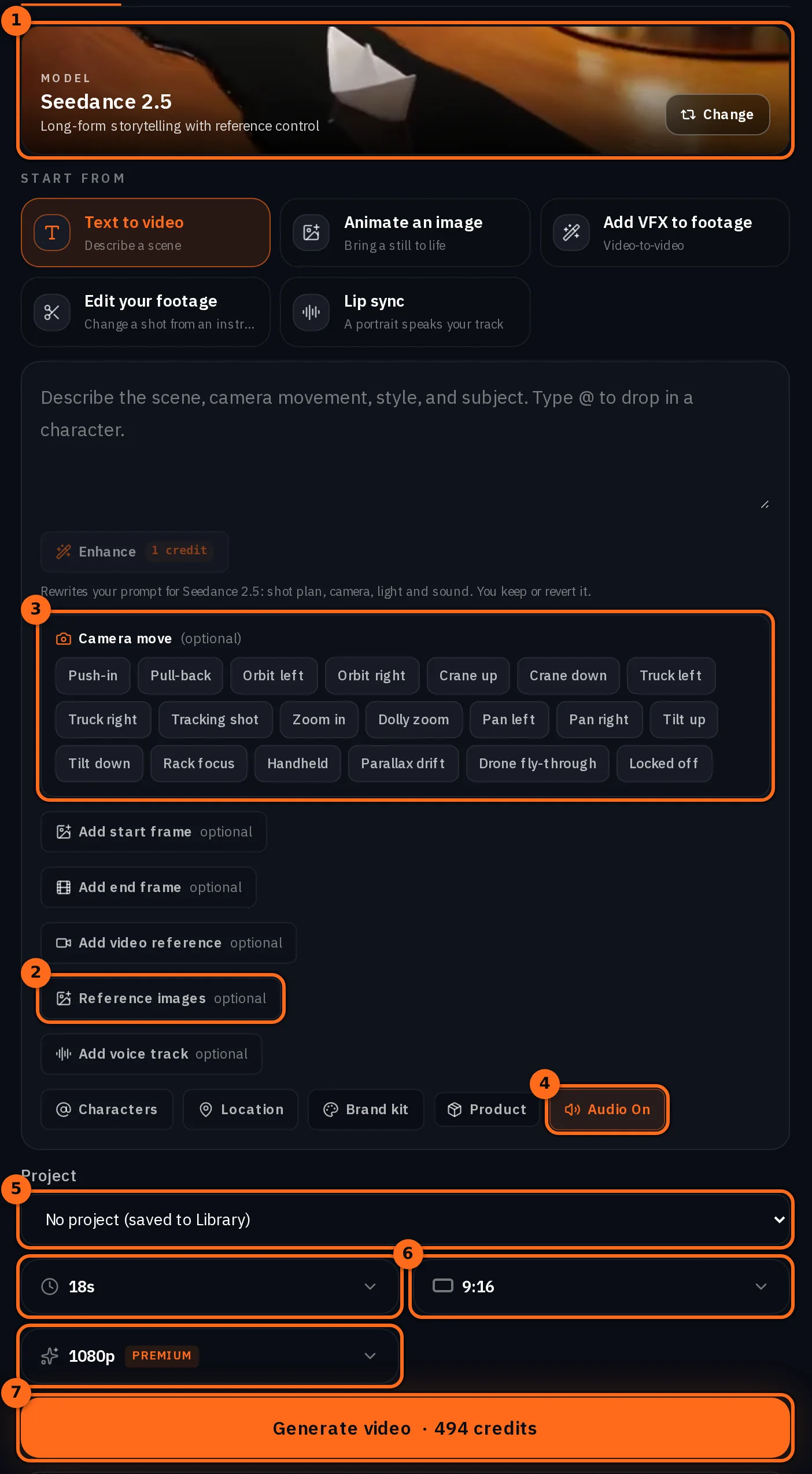
Atención:El chip de duración establece la longitud. Dos prompts aquí dicen VIDEO DE 6 SEGUNDOS y regresaron con 5 segundos; la pregunta dice 7.5 y regresó con 8. El clip es tan largo como el chip de duración, independientemente de lo que diga el prompt, así que ajusta tus tiempos al chip.
Los seis clips tomaron 22 ejecuciones de Seedance 2.5 en aproximadamente cuatro horas: cinco para la pregunta, cuatro para la comparación incluyendo las dos pruebas cortas, seis para la toma de 200mm, tres para la realización, una para la explicación y tres para la línea de cierre.
Pruébalo con tu propio personaje
Crea dos tomas: 24mm para establecer el lugar, luego 135mm para mostrar la reacción. En cada prompt, indica exactamente qué debe permanecer visible. Así es como guías la atención del espectador: primero el lugar, luego lo que importa.
- El encuadre en palabras: plano general, medio o cerrado, y desde dónde hasta dónde.
- La distancia focal como estilo visual, escrita como equivalente a formato completo.
- Lo que debe permanecer visible: toda la cabeza, ambas manos, el auto detrás de él.
- Una acción simple.
- El movimiento de cámara, o sin zoom y sin desplazamiento de cámara.
- Para una comparación, todo fijo excepto el lente.
Cuánto cuesta
Los clips se cobran según el modelo, la duración y la calidad, y 1080p cuesta más que 720p, así que prueba en 720p. El precio aparece en el botón Generar video antes de que se ejecute. Las tarifas vigentes para los modelos en este reel:
Seedance 2.5Pro y superiores
Per 5s clip
480p 31 créditos · 720p 66 créditos · 1080p 160 créditos · 4K 202 créditos
1080p renders at 16:9 and 9:16
4K renders at 16:9 and 9:16
Nano Banana 2Todos los planes
Per image
Native 4 créditos · 2K 6 créditos · 4K 9 créditos
Se lee en vivo del catálogo al cargar esta página. Cada precio se muestra antes de generar. Ver todas las tarifas.
Preguntas y respuestas
- ¿Por qué la IA muestra todo el cuerpo cuando pido un primer plano?
- Porque el tamaño del plano depende tanto de la distancia de la cámara como del lente, y un modelo completa lo que omites. Describe el encuadre: un primer plano desde los hombros hacia arriba, manteniendo toda la cabeza visible, con el estilo visual de un lente de 135mm equivalente a formato completo.
- ¿Escribir 135mm me da un lente real de 135mm?
- No. En el video con IA, la distancia focal es una pista visual, no una promesa de óptica real. Juzga el resultado por la imagen: qué tan grande es el sujeto, cuánto del lugar se ve y si la reacción se entiende.
- ¿Qué significa equivalente a formato completo?
- Es la distancia focal que tendría un lente en una cámara de formato completo de 35 mm. Usar esto para cada número da una referencia común para comparar los campos de visión.
- ¿200 mm es lo mismo que hacer zoom?
- No. 200 mm es una distancia focal. Un crash zoom cambia la distancia focal durante la toma, y un dolly in mueve la cámara hacia el sujeto. Si quieres un plano cerrado desde el principio, escribe Start on a close-up.
- ¿Puedo mostrar los tres lentes en un solo clip?
- Sí. El reel lo hace en un clip de Seedance 2.5 de 18 segundos con tres etapas cronometradas. Para un control más preciso, crea tres imágenes de referencia coincidentes y anima cada una por separado.
- ¿Las personas son reales?
- No. Tanto las personas como el club fueron generados con NOLGIA a partir de los prompts de esta guía.
Prueba el par de 24 mm y 135 mm
Abrir el compositor de videoGuías relacionadas
Prompts
Movimientos de cámara: qué hace cada uno y las palabras que lo logran
Doce movimientos de cámara en palabras sencillas: qué hace la cámara, qué hace sentir, las palabras para escribir en tu prompt, y el movimiento con el que se confunde cada uno. Cada uno con un clip hecho en NOLGIA.
· 26 min de lectura
Cine
Cómo crear videos realistas con IA
El flujo de trabajo paso a paso para videos realistas con IA: planifica con NOLGIA Agent, fija los personajes y el lugar, escribe cada toma beat por beat para Seedance 2.5, luego añade música y edita.
· 22 min de lectura
Prompts
Seedance 2.5: cómo crear prompts, con una biblioteca que ya se ejecutó
Cómo escribir para Seedance 2.5 en NOLGIA: texto a video, una imagen fija como fotograma inicial, una toma como @Video1 con su sonido, las seis relaciones de aspecto, de 4 a 30 segundos, y lo que rechaza.
· 10 min de lectura